

space, building envelope efficiency and large
switching costs (Fig. 58).
Industry
Electrification options exist for many mediumand high-grade industrial heat processes, though
relative costs remain high.
Iron and steel: Electric arc furnaces hold
significant potential for scrap-based crude steel
production. In iron production, electrowinning
(extracting iron from the ore through electrolysis), is still in its early stages of development.
Chemicals and petrochemicals: Electrothermal furnaces could potentially be used for a
variety of petrochemical cracking processes,
though it remains a marginal technology.
Ammonia production through grid electrolysis is
technically feasible.
Cement: Electrothermal dryers can be used for
clinker calcination. While technically feasible,
the extremely high heat requirements of clinker
production make electrification of the process
prohibitively high cost.
Pulp and paper: Electrothermal technologies,
such as induction or electric arc furnaces, can be
used in medium-heat pulp and paper drying
processes. These technologies are increasingly
cost-competitive.
Aluminium: Electrothermal dryers can be used
for the bauxite reduction process, though technical availability is low. Production of fused
aluminium oxides in electric arc furnaces by
electrothermal fusion is commercially feasible,
though it remains a marginal process.
Decarbonisation will raise electrification of
transport and buildings due to electric vehicle and
heat pump uptake, but industry options are limited.
In summary:
Transport
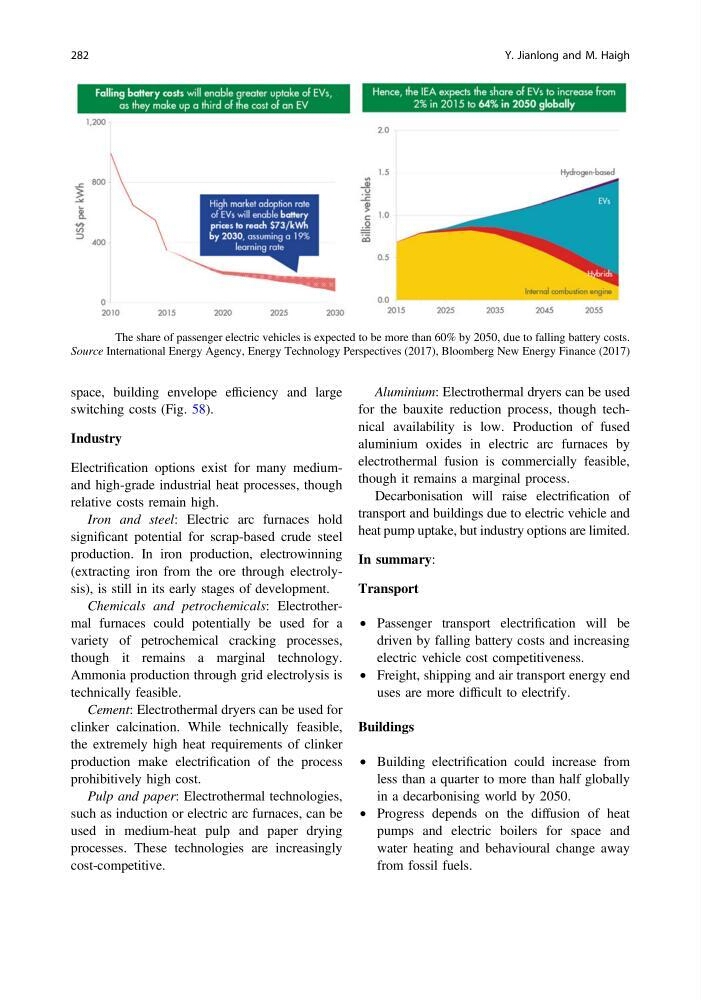
• Passenger transport electrification will be
driven by falling battery costs and increasing
electric vehicle cost competitiveness.
• Freight, shipping and air transport energy end
uses are more difficult to electrify.
Buildings
• Building electrification could increase from
less than a quarter to more than half globally
in a decarbonising world by 2050.
• Progress depends on the diffusion of heat
pumps and electric boilers for space and
water heating and behavioural change away
from fossil fuels.
Fig. 57 The share of passenger electric vehicles is expected to be more than 60% by 2050, due to falling battery costs.
Source International Energy Agency, Energy Technology Perspectives (2017), Bloomberg New Energy Finance (2017)
282
Y. Jianlong and M. Haigh
switching costs (Fig. 58).
Industry
Electrification options exist for many mediumand high-grade industrial heat processes, though
relative costs remain high.
Iron and steel: Electric arc furnaces hold
significant potential for scrap-based crude steel
production. In iron production, electrowinning
(extracting iron from the ore through electrolysis), is still in its early stages of development.
Chemicals and petrochemicals: Electrothermal furnaces could potentially be used for a
variety of petrochemical cracking processes,
though it remains a marginal technology.
Ammonia production through grid electrolysis is
technically feasible.
Cement: Electrothermal dryers can be used for
clinker calcination. While technically feasible,
the extremely high heat requirements of clinker
production make electrification of the process
prohibitively high cost.
Pulp and paper: Electrothermal technologies,
such as induction or electric arc furnaces, can be
used in medium-heat pulp and paper drying
processes. These technologies are increasingly
cost-competitive.
Aluminium: Electrothermal dryers can be used
for the bauxite reduction process, though technical availability is low. Production of fused
aluminium oxides in electric arc furnaces by
electrothermal fusion is commercially feasible,
though it remains a marginal process.
Decarbonisation will raise electrification of
transport and buildings due to electric vehicle and
heat pump uptake, but industry options are limited.
In summary:
Transport
• Passenger transport electrification will be
driven by falling battery costs and increasing
electric vehicle cost competitiveness.
• Freight, shipping and air transport energy end
uses are more difficult to electrify.
Buildings
• Building electrification could increase from
less than a quarter to more than half globally
in a decarbonising world by 2050.
• Progress depends on the diffusion of heat
pumps and electric boilers for space and
water heating and behavioural change away
from fossil fuels.
Fig. 57 The share of passenger electric vehicles is expected to be more than 60% by 2050, due to falling battery costs.
Source International Energy Agency, Energy Technology Perspectives (2017), Bloomberg New Energy Finance (2017)
282
Y. Jianlong and M. Haigh