

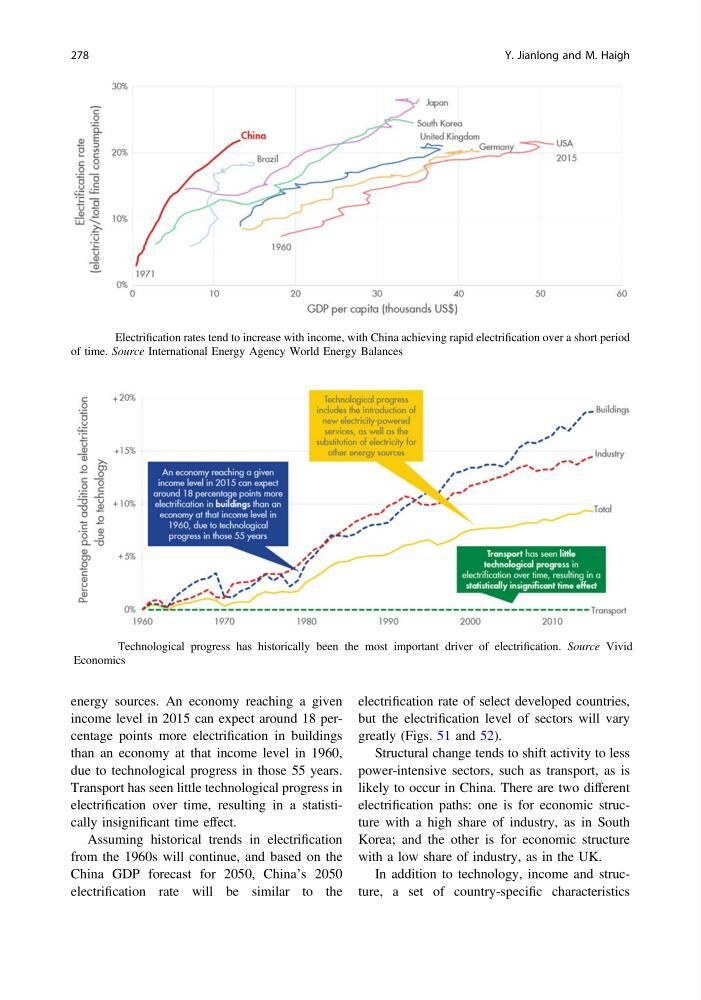
energy sources. An economy reaching a given
income level in 2015 can expect around 18 percentage points more electrification in buildings
than an economy at that income level in 1960,
due to technological progress in those 55 years.
Transport has seen little technological progress in
electrification over time, resulting in a statistically insignificant time effect.
Assuming historical trends in electrification
from the 1960s will continue, and based on the
China GDP forecast for 2050, China’s 2050
electrification rate will be similar to the
electrification rate of select developed countries,
but the electrification level of sectors will vary
greatly (Figs. 51 and 52).
Structural change tends to shift activity to less
power-intensive sectors, such as transport, as is
likely to occur in China. There are two different
electrification paths: one is for economic structure with a high share of industry, as in South
Korea; and the other is for economic structure
with a low share of industry, as in the UK.
In addition to technology, income and structure, a set of country-specific characteristics
Fig. 50 Electrification rates tend to increase with income, with China achieving rapid electrification over a short period
of time. Source International Energy Agency World Energy Balances
Fig. 51 Technological progress has historically been the most important driver of electrification. Source Vivid
Economics
278
Y. Jianlong and M. Haigh
income level in 2015 can expect around 18 percentage points more electrification in buildings
than an economy at that income level in 1960,
due to technological progress in those 55 years.
Transport has seen little technological progress in
electrification over time, resulting in a statistically insignificant time effect.
Assuming historical trends in electrification
from the 1960s will continue, and based on the
China GDP forecast for 2050, China’s 2050
electrification rate will be similar to the
electrification rate of select developed countries,
but the electrification level of sectors will vary
greatly (Figs. 51 and 52).
Structural change tends to shift activity to less
power-intensive sectors, such as transport, as is
likely to occur in China. There are two different
electrification paths: one is for economic structure with a high share of industry, as in South
Korea; and the other is for economic structure
with a low share of industry, as in the UK.
In addition to technology, income and structure, a set of country-specific characteristics
Fig. 50 Electrification rates tend to increase with income, with China achieving rapid electrification over a short period
of time. Source International Energy Agency World Energy Balances
Fig. 51 Technological progress has historically been the most important driver of electrification. Source Vivid
Economics
278
Y. Jianlong and M. Haigh