

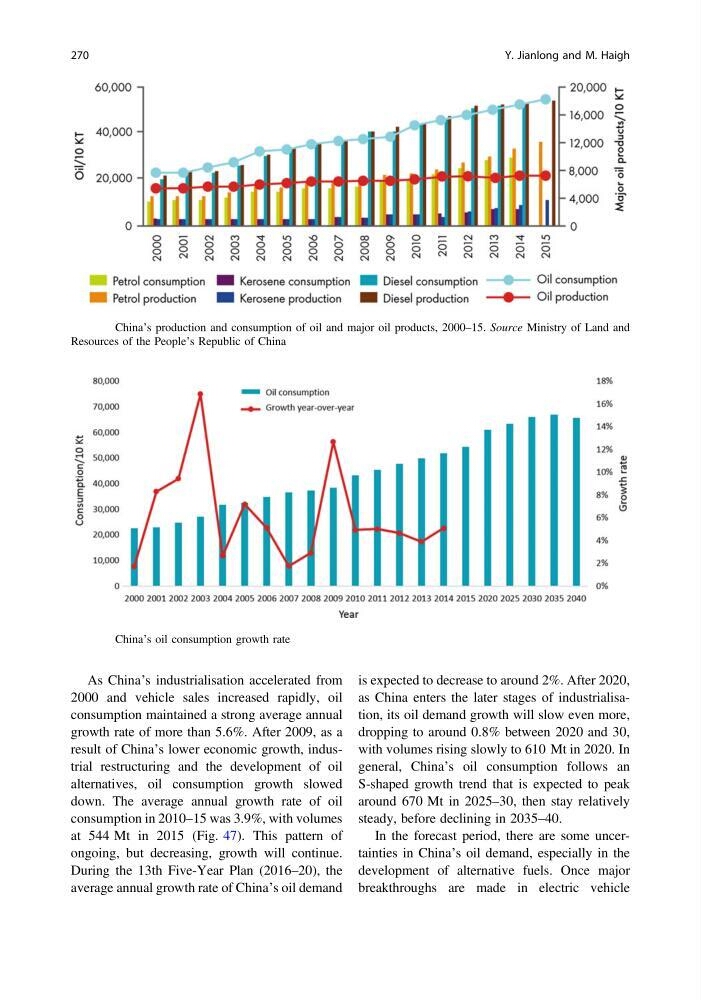
As China’s industrialisation accelerated from
2000 and vehicle sales increased rapidly, oil
consumption maintained a strong average annual
growth rate of more than 5.6%. After 2009, as a
result of China’s lower economic growth, industrial restructuring and the development of oil
alternatives, oil consumption growth slowed
down. The average annual growth rate of oil
consumption in 2010–15 was 3.9%, with volumes
at 544 Mt in 2015 (Fig. 47). This pattern of
ongoing, but decreasing, growth will continue.
During the 13th Five-Year Plan (2016–20), the
average annual growth rate of China’s oil demand
is expected to decrease to around 2%. After 2020,
as China enters the later stages of industrialisation, its oil demand growth will slow even more,
dropping to around 0.8% between 2020 and 30,
with volumes rising slowly to 610 Mt in 2020. In
general, China’s oil consumption follows an
S-shaped growth trend that is expected to peak
around 670 Mt in 2025–30, then stay relatively
steady, before declining in 2035–40.
In the forecast period, there are some uncertainties in China’s oil demand, especially in the
development of alternative fuels. Once major
breakthroughs are made in electric vehicle
Fig. 46 China’s production and consumption of oil and major oil products, 2000–15. Source Ministry of Land and
Resources of the People’s Republic of China
Fig. 47 China’s oil consumption growth rate
270
Y. Jianlong and M. Haigh
2000 and vehicle sales increased rapidly, oil
consumption maintained a strong average annual
growth rate of more than 5.6%. After 2009, as a
result of China’s lower economic growth, industrial restructuring and the development of oil
alternatives, oil consumption growth slowed
down. The average annual growth rate of oil
consumption in 2010–15 was 3.9%, with volumes
at 544 Mt in 2015 (Fig. 47). This pattern of
ongoing, but decreasing, growth will continue.
During the 13th Five-Year Plan (2016–20), the
average annual growth rate of China’s oil demand
is expected to decrease to around 2%. After 2020,
as China enters the later stages of industrialisation, its oil demand growth will slow even more,
dropping to around 0.8% between 2020 and 30,
with volumes rising slowly to 610 Mt in 2020. In
general, China’s oil consumption follows an
S-shaped growth trend that is expected to peak
around 670 Mt in 2025–30, then stay relatively
steady, before declining in 2035–40.
In the forecast period, there are some uncertainties in China’s oil demand, especially in the
development of alternative fuels. Once major
breakthroughs are made in electric vehicle
Fig. 46 China’s production and consumption of oil and major oil products, 2000–15. Source Ministry of Land and
Resources of the People’s Republic of China
Fig. 47 China’s oil consumption growth rate
270
Y. Jianlong and M. Haigh