

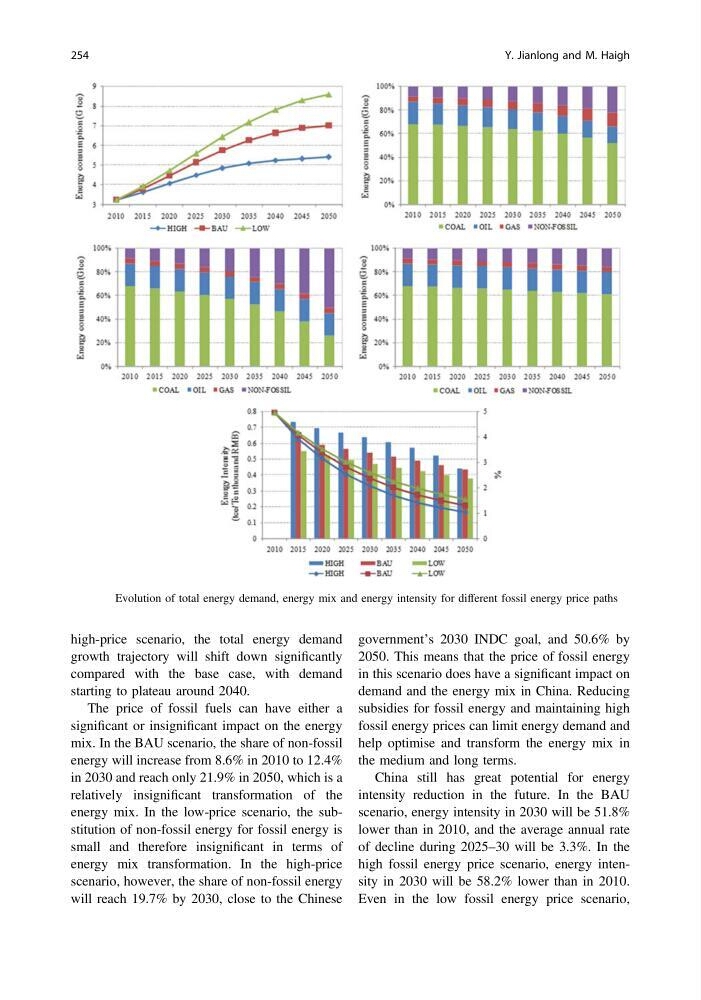
high-price scenario, the total energy demand
growth trajectory will shift down significantly
compared with the base case, with demand
starting to plateau around 2040.
The price of fossil fuels can have either a
significant or insignificant impact on the energy
mix. In the BAU scenario, the share of non-fossil
energy will increase from 8.6% in 2010 to 12.4%
in 2030 and reach only 21.9% in 2050, which is a
relatively insignificant transformation of the
energy mix. In the low-price scenario, the substitution of non-fossil energy for fossil energy is
small and therefore insignificant in terms of
energy mix transformation. In the high-price
scenario, however, the share of non-fossil energy
will reach 19.7% by 2030, close to the Chinese
government’s 2030 INDC goal, and 50.6% by
2050. This means that the price of fossil energy
in this scenario does have a significant impact on
demand and the energy mix in China. Reducing
subsidies for fossil energy and maintaining high
fossil energy prices can limit energy demand and
help optimise and transform the energy mix in
the medium and long terms.
China still has great potential for energy
intensity reduction in the future. In the BAU
scenario, energy intensity in 2030 will be 51.8%
lower than in 2010, and the average annual rate
of decline during 2025–30 will be 3.3%. In the
high fossil energy price scenario, energy intensity in 2030 will be 58.2% lower than in 2010.
Even in the low fossil energy price scenario,
Fig. 38 Evolution of total energy demand, energy mix and energy intensity for different fossil energy price paths
254
Y. Jianlong and M. Haigh
growth trajectory will shift down significantly
compared with the base case, with demand
starting to plateau around 2040.
The price of fossil fuels can have either a
significant or insignificant impact on the energy
mix. In the BAU scenario, the share of non-fossil
energy will increase from 8.6% in 2010 to 12.4%
in 2030 and reach only 21.9% in 2050, which is a
relatively insignificant transformation of the
energy mix. In the low-price scenario, the substitution of non-fossil energy for fossil energy is
small and therefore insignificant in terms of
energy mix transformation. In the high-price
scenario, however, the share of non-fossil energy
will reach 19.7% by 2030, close to the Chinese
government’s 2030 INDC goal, and 50.6% by
2050. This means that the price of fossil energy
in this scenario does have a significant impact on
demand and the energy mix in China. Reducing
subsidies for fossil energy and maintaining high
fossil energy prices can limit energy demand and
help optimise and transform the energy mix in
the medium and long terms.
China still has great potential for energy
intensity reduction in the future. In the BAU
scenario, energy intensity in 2030 will be 51.8%
lower than in 2010, and the average annual rate
of decline during 2025–30 will be 3.3%. In the
high fossil energy price scenario, energy intensity in 2030 will be 58.2% lower than in 2010.
Even in the low fossil energy price scenario,
Fig. 38 Evolution of total energy demand, energy mix and energy intensity for different fossil energy price paths
254
Y. Jianlong and M. Haigh