

consistent with the predictions of He Jiankun.
6
Due to rising demand for non-fossil energy
technologies, coal’s share of TPED will be continuously squeezed. Even so, coal will still make
up more than 50% of demand in 2030 in the
Conservative and Moderate scenarios. In the
Optimistic scenario, coal’s share of demand will
decrease to 49% in 2030 and 37.1% in 2050,
which echoes mainstream opinion about the
long-term decline in coal demand.
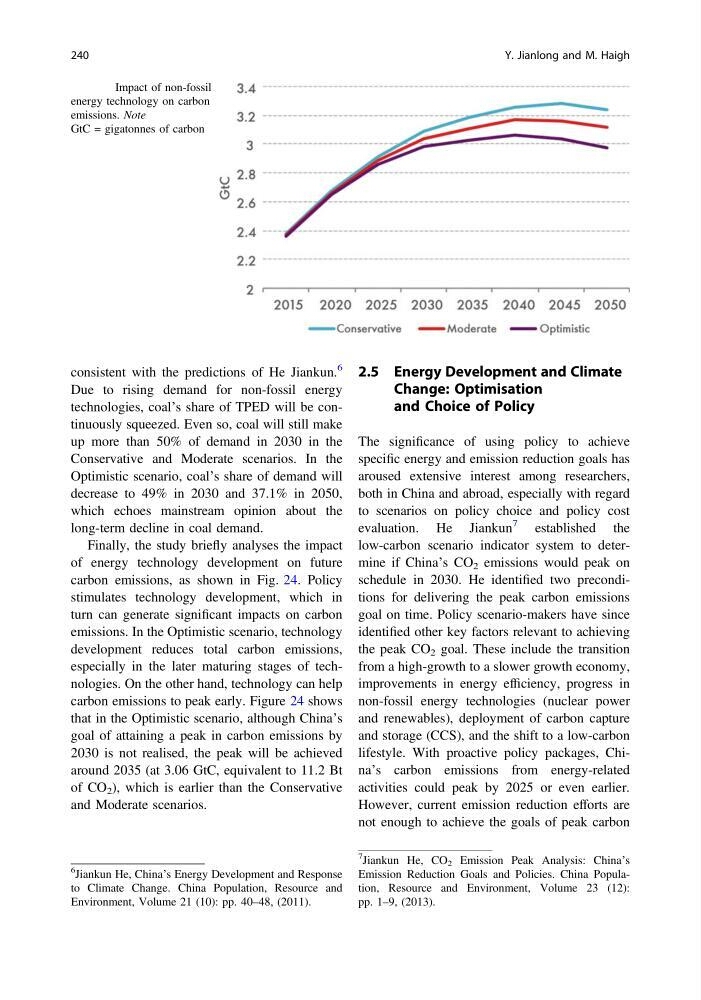
Finally, the study briefly analyses the impact
of energy technology development on future
carbon emissions, as shown in Fig. 24. Policy
stimulates technology development, which in
turn can generate significant impacts on carbon
emissions. In the Optimistic scenario, technology
development reduces total carbon emissions,
especially in the later maturing stages of technologies. On the other hand, technology can help
carbon emissions to peak early. Figure 24 shows
that in the Optimistic scenario, although China’s
goal of attaining a peak in carbon emissions by
2030 is not realised, the peak will be achieved
around 2035 (at 3.06 GtC, equivalent to 11.2 Bt
of CO 2 ), which is earlier than the Conservative
and Moderate scenarios.
2.5 Energy Development and Climate
Change: Optimisation
and Choice of Policy
The significance of using policy to achieve
specific energy and emission reduction goals has
aroused extensive interest among researchers,
both in China and abroad, especially with regard
to scenarios on policy choice and policy cost
evaluation. He Jiankun
7
established the
low-carbon scenario indicator system to determine if China’s CO 2 emissions would peak on
schedule in 2030. He identified two preconditions for delivering the peak carbon emissions
goal on time. Policy scenario-makers have since
identified other key factors relevant to achieving
the peak CO 2 goal. These include the transition
from a high-growth to a slower growth economy,
improvements in energy efficiency, progress in
non-fossil energy technologies (nuclear power
and renewables), deployment of carbon capture
and storage (CCS), and the shift to a low-carbon
lifestyle. With proactive policy packages, China’s carbon emissions from energy-related
activities could peak by 2025 or even earlier.
However, current emission reduction efforts are
not enough to achieve the goals of peak carbon
Fig. 24 Impact of non-fossil
energy technology on carbon
emissions. Note
GtC = gigatonnes of carbon
6
Jiankun He, China’s Energy Development and Response
to Climate Change. China Population, Resource and
Environment, Volume 21 (10): pp. 40–48, (2011).
7
Jiankun He, CO 2 Emission Peak Analysis: China’s
Emission Reduction Goals and Policies. China Population, Resource and Environment, Volume 23 (12):
pp. 1–9, (2013).
240
Y. Jianlong and M. Haigh
6
Due to rising demand for non-fossil energy
technologies, coal’s share of TPED will be continuously squeezed. Even so, coal will still make
up more than 50% of demand in 2030 in the
Conservative and Moderate scenarios. In the
Optimistic scenario, coal’s share of demand will
decrease to 49% in 2030 and 37.1% in 2050,
which echoes mainstream opinion about the
long-term decline in coal demand.
Finally, the study briefly analyses the impact
of energy technology development on future
carbon emissions, as shown in Fig. 24. Policy
stimulates technology development, which in
turn can generate significant impacts on carbon
emissions. In the Optimistic scenario, technology
development reduces total carbon emissions,
especially in the later maturing stages of technologies. On the other hand, technology can help
carbon emissions to peak early. Figure 24 shows
that in the Optimistic scenario, although China’s
goal of attaining a peak in carbon emissions by
2030 is not realised, the peak will be achieved
around 2035 (at 3.06 GtC, equivalent to 11.2 Bt
of CO 2 ), which is earlier than the Conservative
and Moderate scenarios.
2.5 Energy Development and Climate
Change: Optimisation
and Choice of Policy
The significance of using policy to achieve
specific energy and emission reduction goals has
aroused extensive interest among researchers,
both in China and abroad, especially with regard
to scenarios on policy choice and policy cost
evaluation. He Jiankun
7
established the
low-carbon scenario indicator system to determine if China’s CO 2 emissions would peak on
schedule in 2030. He identified two preconditions for delivering the peak carbon emissions
goal on time. Policy scenario-makers have since
identified other key factors relevant to achieving
the peak CO 2 goal. These include the transition
from a high-growth to a slower growth economy,
improvements in energy efficiency, progress in
non-fossil energy technologies (nuclear power
and renewables), deployment of carbon capture
and storage (CCS), and the shift to a low-carbon
lifestyle. With proactive policy packages, China’s carbon emissions from energy-related
activities could peak by 2025 or even earlier.
However, current emission reduction efforts are
not enough to achieve the goals of peak carbon
Fig. 24 Impact of non-fossil
energy technology on carbon
emissions. Note
GtC = gigatonnes of carbon
6
Jiankun He, China’s Energy Development and Response
to Climate Change. China Population, Resource and
Environment, Volume 21 (10): pp. 40–48, (2011).
7
Jiankun He, CO 2 Emission Peak Analysis: China’s
Emission Reduction Goals and Policies. China Population, Resource and Environment, Volume 23 (12):
pp. 1–9, (2013).
240
Y. Jianlong and M. Haigh