

(3) calculate the values of cleanliness and flexibility for each sector, country and observation in time, and normalise them to the
sample average value;
(4) plot, as a third-degree line of best fit through
all data points (across all countries and all
time periods), the average line in a sector for
each dimension of quality;
(5) divide the data into $5,000 tranches and
identify the top and bottom quartile data
points for each dimension of quality;
(6) plot the high and low path lines of best fit
through the top and bottom quartile data
points of energy carrier quality across each
$5,000 income tranche; and
(7) highlight China’s current values and
third-party forecasts of China’s energy
demand in 2030.
1.2.1 Buildings
In the buildings sector, excess air ratio is a proxy
for the flexibility of an energy carrier. Excess air
ratio is the amount of air above the stoichiometric
air quantity ratio (the absolute minimum amount
of oxygen required for complete combustion of
the fuel) that is required for a fuel to burn
effectively. It is used as a proxy indicator for the
size of equipment needed to convert the carrier
fuel into a useful energy service, such as heat.
The most flexible energy carrier is the one that
can be used without large equipment, as space is
limited in buildings. According to this definition,
electricity is flexible, while coal generally needs
a large amount of excess air to combust to avoid
emitting harmful carbon monoxide, making it
difficult to use in buildings.
Because it is possible to improve both cleanliness and flexibility simultaneously in buildings,
changes in the carrier mix have occurred rapidly.
International experience shows that buildings
have shifted quickly towards electricity and gas
as incomes have risen. This is because electricity
and gas are cleaner and more flexible than the
other
available
energy
carriers.
The
income-driven improvements in both aspects of
carrier quality are clearly evident in Fig. 15.
Belgium and the UK are examples of countries
that have made rapid transitions to higher-quality
fuels in this sector.
1.2.2 Power
Flexibility in the power sector is dependent on
the capacity factor and the cost of transmission
infrastructure for different methods of generation.
A composite factor accounting for both the
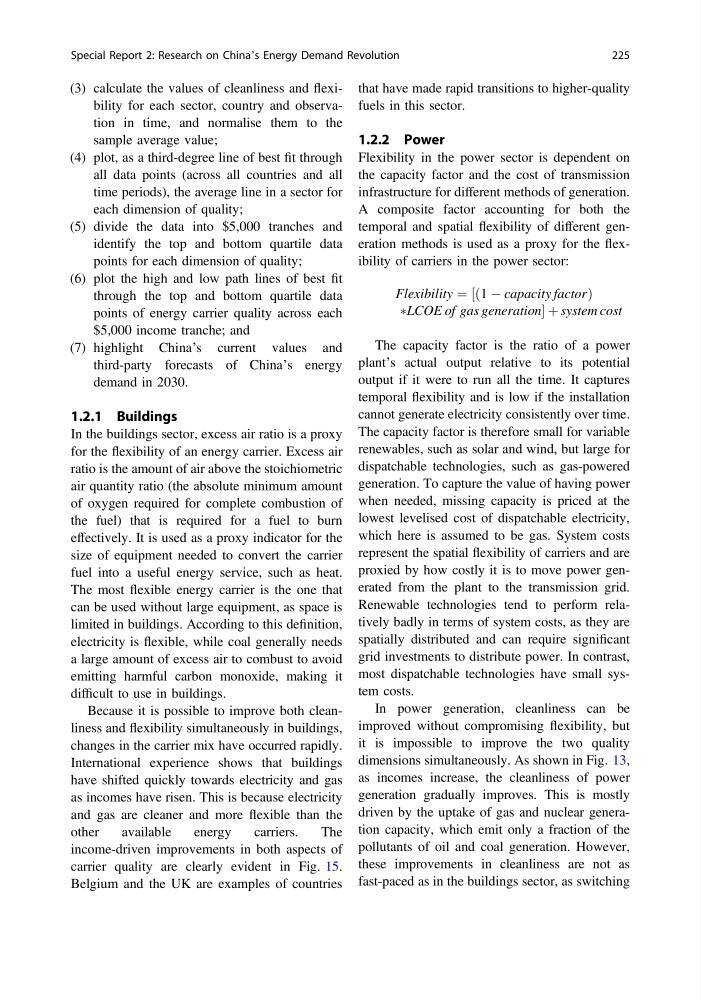
temporal and spatial flexibility of different generation methods is used as a proxy for the flexibility of carriers in the power sector:
Flexibility ¼ 1 À capacity factor
ð
Þ
½
ÃLCOE of gas generation þ system cost
The capacity factor is the ratio of a power
plant’s actual output relative to its potential
output if it were to run all the time. It captures
temporal flexibility and is low if the installation
cannot generate electricity consistently over time.
The capacity factor is therefore small for variable
renewables, such as solar and wind, but large for
dispatchable technologies, such as gas-powered
generation. To capture the value of having power
when needed, missing capacity is priced at the
lowest levelised cost of dispatchable electricity,
which here is assumed to be gas. System costs
represent the spatial flexibility of carriers and are
proxied by how costly it is to move power generated from the plant to the transmission grid.
Renewable technologies tend to perform relatively badly in terms of system costs, as they are
spatially distributed and can require significant
grid investments to distribute power. In contrast,
most dispatchable technologies have small system costs.
In power generation, cleanliness can be
improved without compromising flexibility, but
it is impossible to improve the two quality
dimensions simultaneously. As shown in Fig. 13,
as incomes increase, the cleanliness of power
generation gradually improves. This is mostly
driven by the uptake of gas and nuclear generation capacity, which emit only a fraction of the
pollutants of oil and coal generation. However,
these improvements in cleanliness are not as
fast-paced as in the buildings sector, as switching
Special Report 2: Research on China’s Energy Demand Revolution
225
sample average value;
(4) plot, as a third-degree line of best fit through
all data points (across all countries and all
time periods), the average line in a sector for
each dimension of quality;
(5) divide the data into $5,000 tranches and
identify the top and bottom quartile data
points for each dimension of quality;
(6) plot the high and low path lines of best fit
through the top and bottom quartile data
points of energy carrier quality across each
$5,000 income tranche; and
(7) highlight China’s current values and
third-party forecasts of China’s energy
demand in 2030.
1.2.1 Buildings
In the buildings sector, excess air ratio is a proxy
for the flexibility of an energy carrier. Excess air
ratio is the amount of air above the stoichiometric
air quantity ratio (the absolute minimum amount
of oxygen required for complete combustion of
the fuel) that is required for a fuel to burn
effectively. It is used as a proxy indicator for the
size of equipment needed to convert the carrier
fuel into a useful energy service, such as heat.
The most flexible energy carrier is the one that
can be used without large equipment, as space is
limited in buildings. According to this definition,
electricity is flexible, while coal generally needs
a large amount of excess air to combust to avoid
emitting harmful carbon monoxide, making it
difficult to use in buildings.
Because it is possible to improve both cleanliness and flexibility simultaneously in buildings,
changes in the carrier mix have occurred rapidly.
International experience shows that buildings
have shifted quickly towards electricity and gas
as incomes have risen. This is because electricity
and gas are cleaner and more flexible than the
other
available
energy
carriers.
The
income-driven improvements in both aspects of
carrier quality are clearly evident in Fig. 15.
Belgium and the UK are examples of countries
that have made rapid transitions to higher-quality
fuels in this sector.
1.2.2 Power
Flexibility in the power sector is dependent on
the capacity factor and the cost of transmission
infrastructure for different methods of generation.
A composite factor accounting for both the
temporal and spatial flexibility of different generation methods is used as a proxy for the flexibility of carriers in the power sector:
Flexibility ¼ 1 À capacity factor
ð
Þ
½
ÃLCOE of gas generation þ system cost
The capacity factor is the ratio of a power
plant’s actual output relative to its potential
output if it were to run all the time. It captures
temporal flexibility and is low if the installation
cannot generate electricity consistently over time.
The capacity factor is therefore small for variable
renewables, such as solar and wind, but large for
dispatchable technologies, such as gas-powered
generation. To capture the value of having power
when needed, missing capacity is priced at the
lowest levelised cost of dispatchable electricity,
which here is assumed to be gas. System costs
represent the spatial flexibility of carriers and are
proxied by how costly it is to move power generated from the plant to the transmission grid.
Renewable technologies tend to perform relatively badly in terms of system costs, as they are
spatially distributed and can require significant
grid investments to distribute power. In contrast,
most dispatchable technologies have small system costs.
In power generation, cleanliness can be
improved without compromising flexibility, but
it is impossible to improve the two quality
dimensions simultaneously. As shown in Fig. 13,
as incomes increase, the cleanliness of power
generation gradually improves. This is mostly
driven by the uptake of gas and nuclear generation capacity, which emit only a fraction of the
pollutants of oil and coal generation. However,
these improvements in cleanliness are not as
fast-paced as in the buildings sector, as switching
Special Report 2: Research on China’s Energy Demand Revolution
225