

high-speed rail line than the rest of the world
combined. Such a high level of infrastructure
development may increase transport service
demand but may also decrease road transport
demand and improve energy efficiency in the
sector. It is therefore important to take China’s
infrastructure into account when considering
which service demand path to follow in the 2°C
scenario. In addition, China’s historical experience suggests that large-scale deployment of
infrastructure investment within a short time can
gradually change service demand. For example,
China has built many airports, creating a market
for energy-intensive air travel. International
experience might therefore not be a good predictor for future Chinese transport pathways, and
policymakers should continually update their
expectations as the infrastructure landscape
changes.
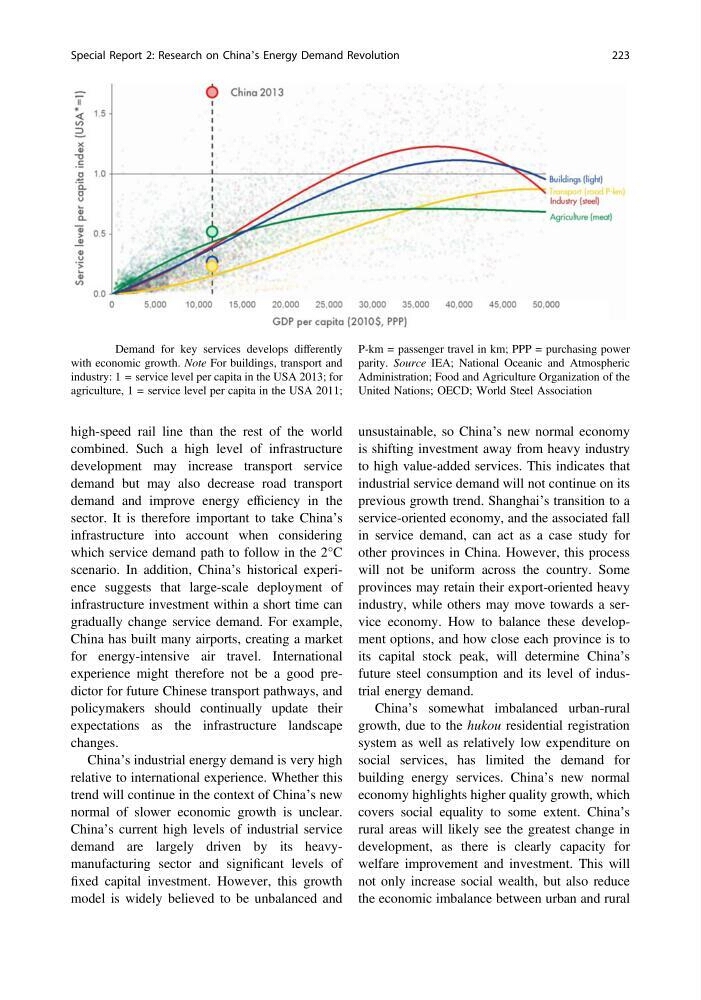
China’s industrial energy demand is very high
relative to international experience. Whether this
trend will continue in the context of China’s new
normal of slower economic growth is unclear.
China’s current high levels of industrial service
demand are largely driven by its heavymanufacturing sector and significant levels of
fixed capital investment. However, this growth
model is widely believed to be unbalanced and
unsustainable, so China’s new normal economy
is shifting investment away from heavy industry
to high value-added services. This indicates that
industrial service demand will not continue on its
previous growth trend. Shanghai’s transition to a
service-oriented economy, and the associated fall
in service demand, can act as a case study for
other provinces in China. However, this process
will not be uniform across the country. Some
provinces may retain their export-oriented heavy
industry, while others may move towards a service economy. How to balance these development options, and how close each province is to
its capital stock peak, will determine China’s
future steel consumption and its level of industrial energy demand.
China’s somewhat imbalanced urban-rural
growth, due to the hukou residential registration
system as well as relatively low expenditure on
social services, has limited the demand for
building energy services. China’s new normal
economy highlights higher quality growth, which
covers social equality to some extent. China’s
rural areas will likely see the greatest change in
development, as there is clearly capacity for
welfare improvement and investment. This will
not only increase social wealth, but also reduce
the economic imbalance between urban and rural
Fig. 12 Demand for key services develops differently
with economic growth. Note For buildings, transport and
industry: 1 = service level per capita in the USA 2013; for
agriculture, 1 = service level per capita in the USA 2011;
P-km = passenger travel in km; PPP = purchasing power
parity. Source IEA; National Oceanic and Atmospheric
Administration; Food and Agriculture Organization of the
United Nations; OECD; World Steel Association
Special Report 2: Research on China’s Energy Demand Revolution
223
combined. Such a high level of infrastructure
development may increase transport service
demand but may also decrease road transport
demand and improve energy efficiency in the
sector. It is therefore important to take China’s
infrastructure into account when considering
which service demand path to follow in the 2°C
scenario. In addition, China’s historical experience suggests that large-scale deployment of
infrastructure investment within a short time can
gradually change service demand. For example,
China has built many airports, creating a market
for energy-intensive air travel. International
experience might therefore not be a good predictor for future Chinese transport pathways, and
policymakers should continually update their
expectations as the infrastructure landscape
changes.
China’s industrial energy demand is very high
relative to international experience. Whether this
trend will continue in the context of China’s new
normal of slower economic growth is unclear.
China’s current high levels of industrial service
demand are largely driven by its heavymanufacturing sector and significant levels of
fixed capital investment. However, this growth
model is widely believed to be unbalanced and
unsustainable, so China’s new normal economy
is shifting investment away from heavy industry
to high value-added services. This indicates that
industrial service demand will not continue on its
previous growth trend. Shanghai’s transition to a
service-oriented economy, and the associated fall
in service demand, can act as a case study for
other provinces in China. However, this process
will not be uniform across the country. Some
provinces may retain their export-oriented heavy
industry, while others may move towards a service economy. How to balance these development options, and how close each province is to
its capital stock peak, will determine China’s
future steel consumption and its level of industrial energy demand.
China’s somewhat imbalanced urban-rural
growth, due to the hukou residential registration
system as well as relatively low expenditure on
social services, has limited the demand for
building energy services. China’s new normal
economy highlights higher quality growth, which
covers social equality to some extent. China’s
rural areas will likely see the greatest change in
development, as there is clearly capacity for
welfare improvement and investment. This will
not only increase social wealth, but also reduce
the economic imbalance between urban and rural
Fig. 12 Demand for key services develops differently
with economic growth. Note For buildings, transport and
industry: 1 = service level per capita in the USA 2013; for
agriculture, 1 = service level per capita in the USA 2011;
P-km = passenger travel in km; PPP = purchasing power
parity. Source IEA; National Oceanic and Atmospheric
Administration; Food and Agriculture Organization of the
United Nations; OECD; World Steel Association
Special Report 2: Research on China’s Energy Demand Revolution
223