

• in industry, the merit order of carriers varies
by subsector—a single, representative line
cannot be plotted.
Policymakers should understand these pattern
changes and guide the formation of an energy
system that accurately meets consumer demand,
enables the efficient use of resources and restricts
externalities like local air pollution or national
energy security concerns. Lack of understanding
of how energy demand will change and the factors causing these changes may result in an
inefficient energy system that features oversupply, poor-quality fuels and an inability to achieve
climate goals.
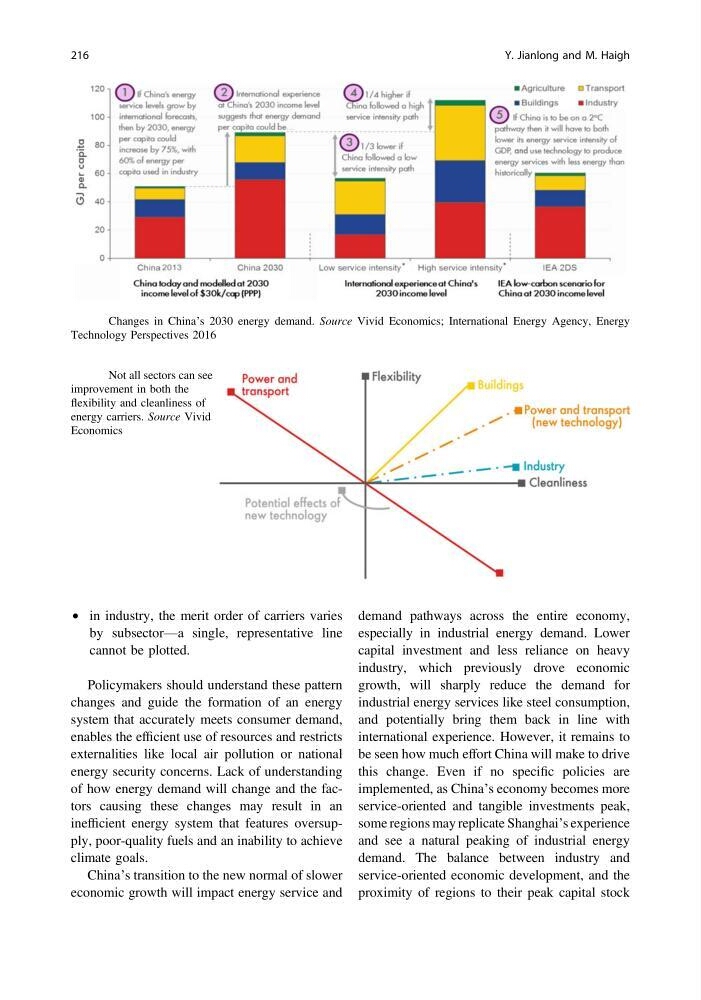
China’s transition to the new normal of slower
economic growth will impact energy service and
demand pathways across the entire economy,
especially in industrial energy demand. Lower
capital investment and less reliance on heavy
industry, which previously drove economic
growth, will sharply reduce the demand for
industrial energy services like steel consumption,
and potentially bring them back in line with
international experience. However, it remains to
be seen how much effort China will make to drive
this change. Even if no specific policies are
implemented, as China’s economy becomes more
service-oriented and tangible investments peak,
some regions may replicate Shanghai’s experience
and see a natural peaking of industrial energy
demand. The balance between industry and
service-oriented economic development, and the
proximity of regions to their peak capital stock
Fig. 3 Changes in China’s 2030 energy demand. Source Vivid Economics; International Energy Agency, Energy
Technology Perspectives 2016
Fig. 4 Not all sectors can see
improvement in both the
flexibility and cleanliness of
energy carriers. Source Vivid
Economics
216
Y. Jianlong and M. Haigh
by subsector—a single, representative line
cannot be plotted.
Policymakers should understand these pattern
changes and guide the formation of an energy
system that accurately meets consumer demand,
enables the efficient use of resources and restricts
externalities like local air pollution or national
energy security concerns. Lack of understanding
of how energy demand will change and the factors causing these changes may result in an
inefficient energy system that features oversupply, poor-quality fuels and an inability to achieve
climate goals.
China’s transition to the new normal of slower
economic growth will impact energy service and
demand pathways across the entire economy,
especially in industrial energy demand. Lower
capital investment and less reliance on heavy
industry, which previously drove economic
growth, will sharply reduce the demand for
industrial energy services like steel consumption,
and potentially bring them back in line with
international experience. However, it remains to
be seen how much effort China will make to drive
this change. Even if no specific policies are
implemented, as China’s economy becomes more
service-oriented and tangible investments peak,
some regions may replicate Shanghai’s experience
and see a natural peaking of industrial energy
demand. The balance between industry and
service-oriented economic development, and the
proximity of regions to their peak capital stock
Fig. 3 Changes in China’s 2030 energy demand. Source Vivid Economics; International Energy Agency, Energy
Technology Perspectives 2016
Fig. 4 Not all sectors can see
improvement in both the
flexibility and cleanliness of
energy carriers. Source Vivid
Economics
216
Y. Jianlong and M. Haigh