

• fracking has led to both an increase in oil
supply (and projected future supply) and
low-cost natural gas; this is expected to continue for at least the next decade;
• tight/shale oil production rises marginally
from 2020–25, then flattens to 2040—but
there is no significant decline;
• electric
vehicle
growth
is
largely
technology-driven; future projections to as
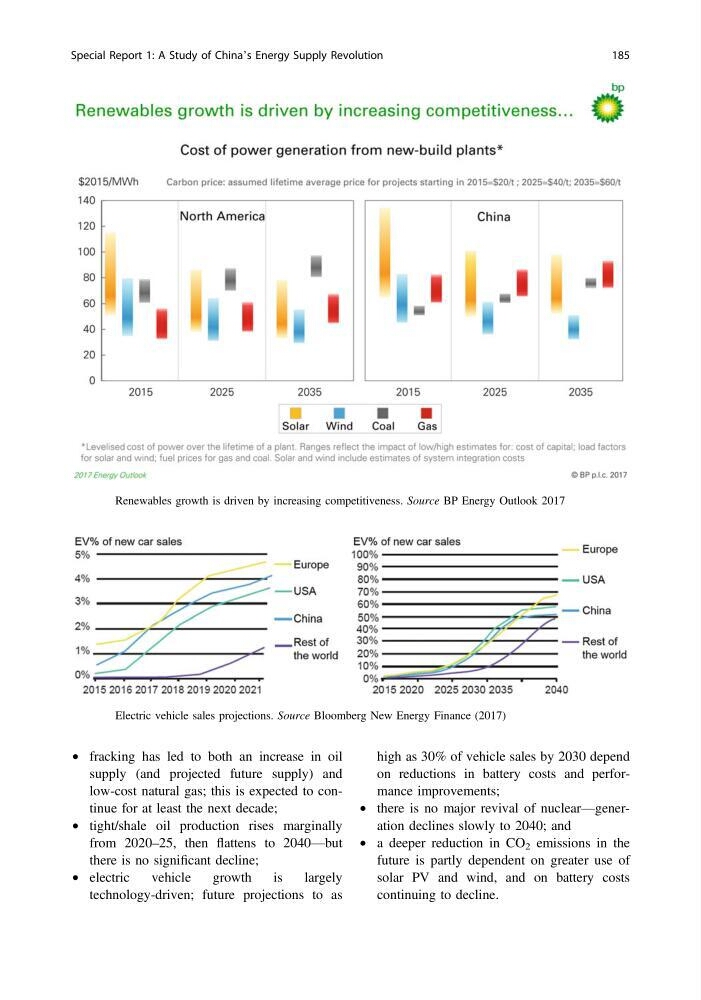
high as 30% of vehicle sales by 2030 depend
on reductions in battery costs and performance improvements;
• there is no major revival of nuclear—generation declines slowly to 2040; and
• a deeper reduction in CO 2 emissions in the
future is partly dependent on greater use of
solar PV and wind, and on battery costs
continuing to decline.
Fig. 70 Renewables growth is driven by increasing competitiveness. Source BP Energy Outlook 2017
Fig. 71 Electric vehicle sales projections. Source Bloomberg New Energy Finance (2017)
Special Report 1: A Study of China’s Energy Supply Revolution
185
supply (and projected future supply) and
low-cost natural gas; this is expected to continue for at least the next decade;
• tight/shale oil production rises marginally
from 2020–25, then flattens to 2040—but
there is no significant decline;
• electric
vehicle
growth
is
largely
technology-driven; future projections to as
high as 30% of vehicle sales by 2030 depend
on reductions in battery costs and performance improvements;
• there is no major revival of nuclear—generation declines slowly to 2040; and
• a deeper reduction in CO 2 emissions in the
future is partly dependent on greater use of
solar PV and wind, and on battery costs
continuing to decline.
Fig. 70 Renewables growth is driven by increasing competitiveness. Source BP Energy Outlook 2017
Fig. 71 Electric vehicle sales projections. Source Bloomberg New Energy Finance (2017)
Special Report 1: A Study of China’s Energy Supply Revolution
185