

6.3.2 Diversified Investment Sources
In accordance with China’s Strategy of Energy
Production and Consumption Revolution (2016–
30) issued by the State Council, China will
reform the administrative approval system for the
energy industry. It will also revise the negative
list restricting foreign investment and market
access and encourage and guide market participants to legally and equally invest and operate in
those energy fields not on the negative list.
Currently, state-owned capital dominates
investment in China’s energy industry, although
there is some private capital invested in renewable
energy like wind and solar. However, most
investment in distributed energy resources is by
users. As development of renewable energy, distributed energy-based microgrids and the Energy
Internet gathers pace, the amount of private capital
invested in these areas will increase.
Marketisation of the energy industry will also
diversify investment sources. Currently, the new
round of power market reforms has deregulated
the additional power distribution and sales businesses, allowing private capital to take part. Oil
and gas market reforms have deregulated
unconventional oil and gas exploitation, oil and
gas pipelines and crude oil reserve storage. As
energy sectors are further deregulated, investors
in energy production, transmission system construction and equipment manufacturing will also
diversify.
6.4 Employment
Currently, China’s energy supply-side reform
focuses on five issues: cutting overcapacity,
reducing excess inventory, deleveraging,
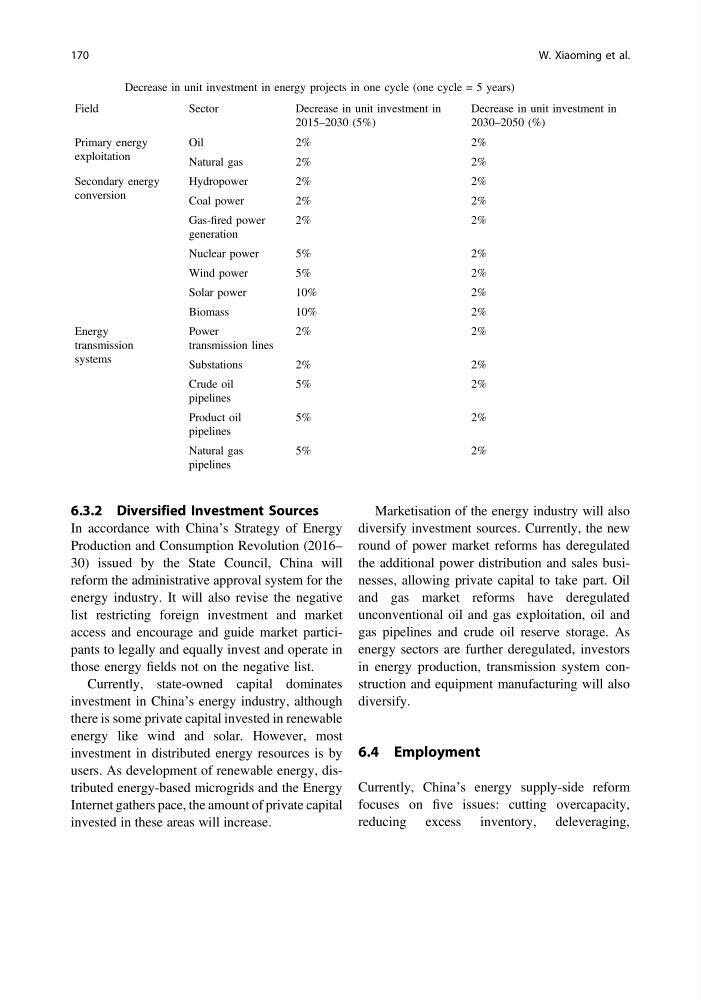
Table 20 Decrease in unit investment in energy projects in one cycle (one cycle = 5 years)
Field
Sector
Decrease in unit investment in
2015–2030 (5%)
Decrease in unit investment in
2030–2050 (%)
Primary energy
exploitation
Oil
2%
2%
Natural gas
2%
2%
Secondary energy
conversion
Hydropower
2%
2%
Coal power
2%
2%
Gas-fired power
generation
2%
2%
Nuclear power
5%
2%
Wind power
5%
2%
Solar power
10%
2%
Biomass
10%
2%
Energy
transmission
systems
Power
transmission lines
2%
2%
Substations
2%
2%
Crude oil
pipelines
5%
2%
Product oil
pipelines
5%
2%
Natural gas
pipelines
5%
2%
170
W. Xiaoming et al.
In accordance with China’s Strategy of Energy
Production and Consumption Revolution (2016–
30) issued by the State Council, China will
reform the administrative approval system for the
energy industry. It will also revise the negative
list restricting foreign investment and market
access and encourage and guide market participants to legally and equally invest and operate in
those energy fields not on the negative list.
Currently, state-owned capital dominates
investment in China’s energy industry, although
there is some private capital invested in renewable
energy like wind and solar. However, most
investment in distributed energy resources is by
users. As development of renewable energy, distributed energy-based microgrids and the Energy
Internet gathers pace, the amount of private capital
invested in these areas will increase.
Marketisation of the energy industry will also
diversify investment sources. Currently, the new
round of power market reforms has deregulated
the additional power distribution and sales businesses, allowing private capital to take part. Oil
and gas market reforms have deregulated
unconventional oil and gas exploitation, oil and
gas pipelines and crude oil reserve storage. As
energy sectors are further deregulated, investors
in energy production, transmission system construction and equipment manufacturing will also
diversify.
6.4 Employment
Currently, China’s energy supply-side reform
focuses on five issues: cutting overcapacity,
reducing excess inventory, deleveraging,
Table 20 Decrease in unit investment in energy projects in one cycle (one cycle = 5 years)
Field
Sector
Decrease in unit investment in
2015–2030 (5%)
Decrease in unit investment in
2030–2050 (%)
Primary energy
exploitation
Oil
2%
2%
Natural gas
2%
2%
Secondary energy
conversion
Hydropower
2%
2%
Coal power
2%
2%
Gas-fired power
generation
2%
2%
Nuclear power
5%
2%
Wind power
5%
2%
Solar power
10%
2%
Biomass
10%
2%
Energy
transmission
systems
Power
transmission lines
2%
2%
Substations
2%
2%
Crude oil
pipelines
5%
2%
Product oil
pipelines
5%
2%
Natural gas
pipelines
5%
2%
170
W. Xiaoming et al.