

territories. In the mid-2000s, following the EU’s
Electricity Market Directive, Germany unbundled generation, transmission, distribution and
retail in its electricity sector, but allowed different degrees of unbundling. The levels of the
supply chain could be separated completely,
legally or functionally, resulting in a complex
and heterogenous structure. Unbundling of
transmission and generation took place in 2005,
while unbundling of distribution and retail was
completed in 2007.
Germany’s transmission network now consists of four different transmission systems, with
different institutional models. Two of these are
based on the TSO model, with TenneT and
50 Hz owning and operating their networks.
A further two retain a degree of vertical integration, with the generation companies RWE and
EnBW continuing to own transmission assets,
though these are regulated to mitigate conflicts of
interest.
There are around 900 distribution operators
serving 20,000 municipalities in Germany. The
900 distribution operators include four of the formerly vertically integrated supra-regional network
energy supply companies, a number of regional
companies and around 700 municipality-owned
utilities. Often municipality-owned utilities are
vertically integrated from generation to retail.
At the national level, the federal network
agency (Bundesnetzagentur) regulates the German electricity sector and has various responsibilities. It oversees competition in the electricity
sector and unbundling of vertically integrated
companies and ensures non-discriminatory
access to the transmission and distribution networks. Bundesnetzagentur also regulates charges
levied by transmission and distribution system
operators. Since 2009, the TSOs are subject to
regulation that caps grid tariffs, but which also
provides incentives to increase efficiency and
reduce costs. At the state level, 11 state regulatory authorities enforce regulations, while the
other five states have delegated all their regulatory responsibility to the Bundesnetzagentur.
Grids with more than 100,000 customers, or
covering more than one state, are also overseen
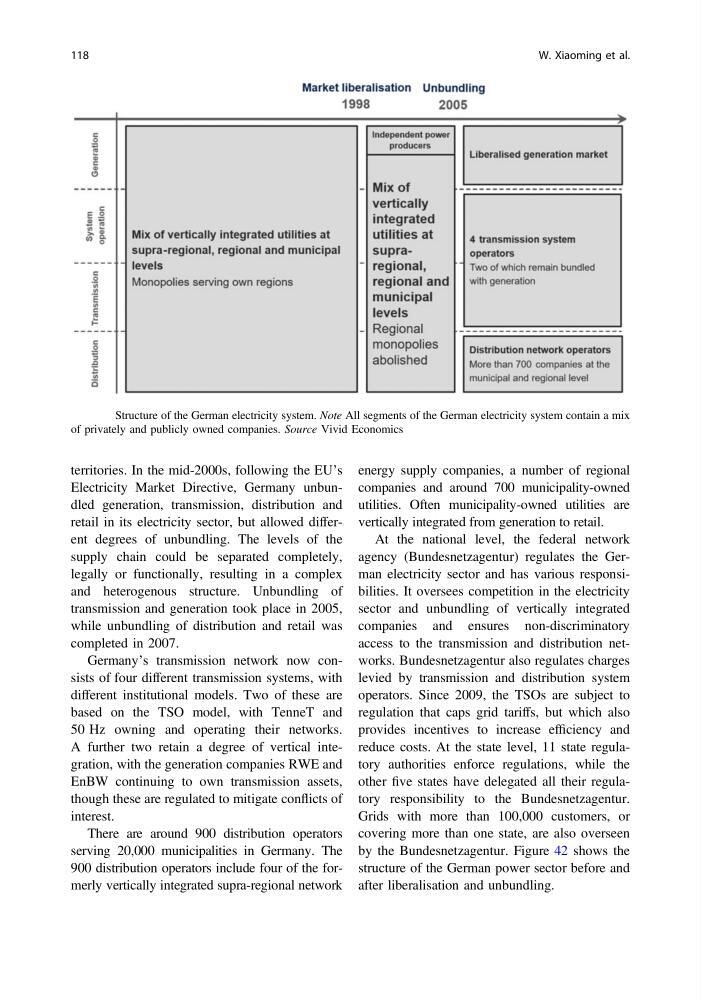
by the Bundesnetzagentur. Figure 42 shows the
structure of the German power sector before and
after liberalisation and unbundling.
Fig. 42 Structure of the German electricity system. Note All segments of the German electricity system contain a mix
of privately and publicly owned companies. Source Vivid Economics
118
W. Xiaoming et al.
Electricity Market Directive, Germany unbundled generation, transmission, distribution and
retail in its electricity sector, but allowed different degrees of unbundling. The levels of the
supply chain could be separated completely,
legally or functionally, resulting in a complex
and heterogenous structure. Unbundling of
transmission and generation took place in 2005,
while unbundling of distribution and retail was
completed in 2007.
Germany’s transmission network now consists of four different transmission systems, with
different institutional models. Two of these are
based on the TSO model, with TenneT and
50 Hz owning and operating their networks.
A further two retain a degree of vertical integration, with the generation companies RWE and
EnBW continuing to own transmission assets,
though these are regulated to mitigate conflicts of
interest.
There are around 900 distribution operators
serving 20,000 municipalities in Germany. The
900 distribution operators include four of the formerly vertically integrated supra-regional network
energy supply companies, a number of regional
companies and around 700 municipality-owned
utilities. Often municipality-owned utilities are
vertically integrated from generation to retail.
At the national level, the federal network
agency (Bundesnetzagentur) regulates the German electricity sector and has various responsibilities. It oversees competition in the electricity
sector and unbundling of vertically integrated
companies and ensures non-discriminatory
access to the transmission and distribution networks. Bundesnetzagentur also regulates charges
levied by transmission and distribution system
operators. Since 2009, the TSOs are subject to
regulation that caps grid tariffs, but which also
provides incentives to increase efficiency and
reduce costs. At the state level, 11 state regulatory authorities enforce regulations, while the
other five states have delegated all their regulatory responsibility to the Bundesnetzagentur.
Grids with more than 100,000 customers, or
covering more than one state, are also overseen
by the Bundesnetzagentur. Figure 42 shows the
structure of the German power sector before and
after liberalisation and unbundling.
Fig. 42 Structure of the German electricity system. Note All segments of the German electricity system contain a mix
of privately and publicly owned companies. Source Vivid Economics
118
W. Xiaoming et al.