

54
I. M. Ikram et al.
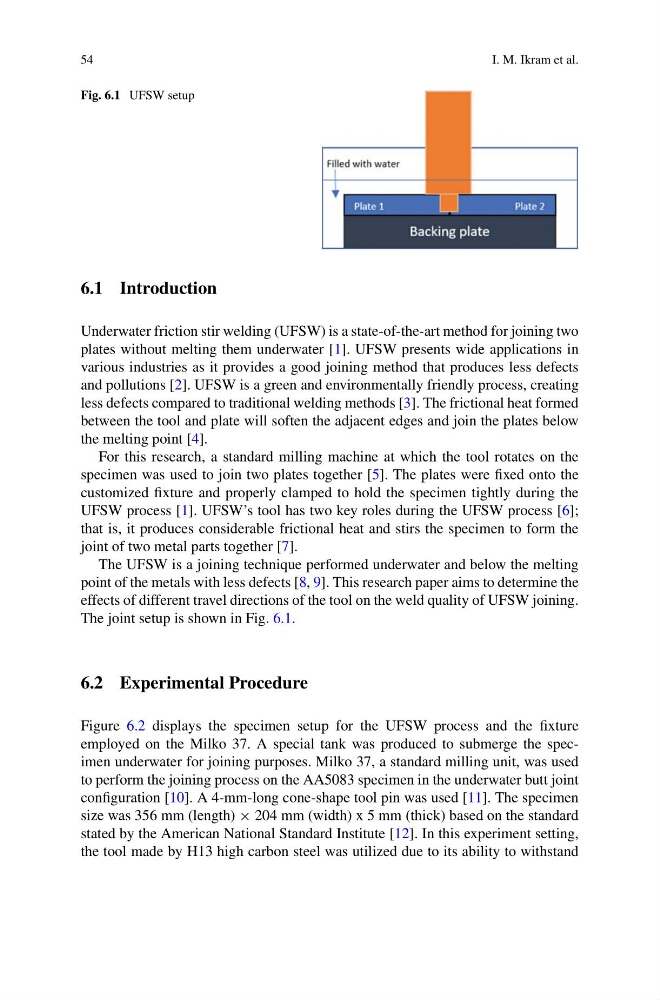
Fig. 6.1 UFSW setup
6.1 Introduction
Underwater friction stir welding (UFSW) is a state-of-the-art method for joining two
plates without melting them underwater [1]. UFSW presents wide applications in
various industries as it provides a good joining method that produces less defects
and pollutions [2]. UFSW is a green and environmentally friendly process, creating
less defects compared to traditional welding methods [3]. The frictional heat formed
between the tool and plate will soften the adjacent edges and join the plates below
the melting point [4].
For this research, a standard milling machine at which the tool rotates on the
specimen was used to join two plates together [5]. The plates were fixed onto the
customized fixture and properly clamped to hold the specimen tightly during the
UFSW process [1]. UFSW’s tool has two key roles during the UFSW process [6];
that is, it produces considerable frictional heat and stirs the specimen to form the
joint of two metal parts together [7].
The UFSW is a joining technique performed underwater and below the melting
point of the metals with less defects [8, 9]. This research paper aims to determine the
effects of different travel directions of the tool on the weld quality of UFSW joining.
The joint setup is shown in Fig. 6.1.
6.2 Experimental Procedure
Figure 6.2 displays the specimen setup for the UFSW process and the fixture
employed on the Milko 37. A special tank was produced to submerge the specimen underwater for joining purposes. Milko 37, a standard milling unit, was used
to perform the joining process on the AA5083 specimen in the underwater butt joint
configuration [10]. A 4-mm-long cone-shape tool pin was used [11]. The specimen
size was 356 mm (length) × 204 mm (width) x 5 mm (thick) based on the standard
stated by the American National Standard Institute [12]. In this experiment setting,
the tool made by H13 high carbon steel was utilized due to its ability to withstand
I. M. Ikram et al.
Fig. 6.1 UFSW setup
6.1 Introduction
Underwater friction stir welding (UFSW) is a state-of-the-art method for joining two
plates without melting them underwater [1]. UFSW presents wide applications in
various industries as it provides a good joining method that produces less defects
and pollutions [2]. UFSW is a green and environmentally friendly process, creating
less defects compared to traditional welding methods [3]. The frictional heat formed
between the tool and plate will soften the adjacent edges and join the plates below
the melting point [4].
For this research, a standard milling machine at which the tool rotates on the
specimen was used to join two plates together [5]. The plates were fixed onto the
customized fixture and properly clamped to hold the specimen tightly during the
UFSW process [1]. UFSW’s tool has two key roles during the UFSW process [6];
that is, it produces considerable frictional heat and stirs the specimen to form the
joint of two metal parts together [7].
The UFSW is a joining technique performed underwater and below the melting
point of the metals with less defects [8, 9]. This research paper aims to determine the
effects of different travel directions of the tool on the weld quality of UFSW joining.
The joint setup is shown in Fig. 6.1.
6.2 Experimental Procedure
Figure 6.2 displays the specimen setup for the UFSW process and the fixture
employed on the Milko 37. A special tank was produced to submerge the specimen underwater for joining purposes. Milko 37, a standard milling unit, was used
to perform the joining process on the AA5083 specimen in the underwater butt joint
configuration [10]. A 4-mm-long cone-shape tool pin was used [11]. The specimen
size was 356 mm (length) × 204 mm (width) x 5 mm (thick) based on the standard
stated by the American National Standard Institute [12]. In this experiment setting,
the tool made by H13 high carbon steel was utilized due to its ability to withstand