

26 Experimental Study on Mechanical Characterisation …
289
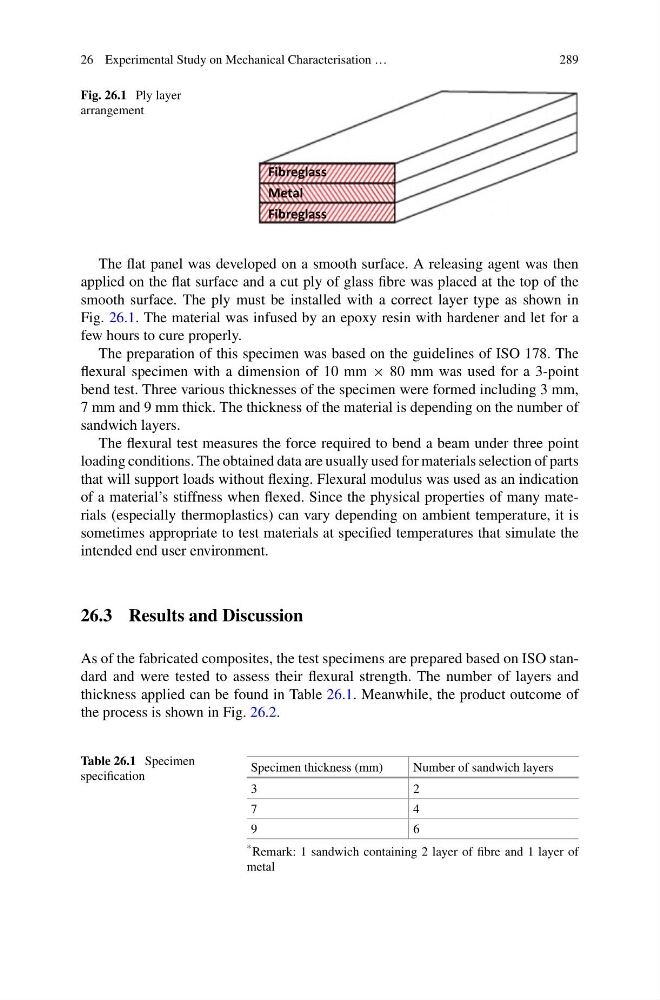
Fig. 26.1 Ply layer
arrangement
Fibreglass
Metal
Fibreglass
The flat panel was developed on a smooth surface. A releasing agent was then
applied on the flat surface and a cut ply of glass fibre was placed at the top of the
smooth surface. The ply must be installed with a correct layer type as shown in
Fig. 26.1. The material was infused by an epoxy resin with hardener and let for a
few hours to cure properly.
The preparation of this specimen was based on the guidelines of ISO 178. The
flexural specimen with a dimension of 10 mm × 80 mm was used for a 3-point
bend test. Three various thicknesses of the specimen were formed including 3 mm,
7 mm and 9 mm thick. The thickness of the material is depending on the number of
sandwich layers.
The flexural test measures the force required to bend a beam under three point
loading conditions. The obtained data are usually used for materials selection of parts
that will support loads without flexing. Flexural modulus was used as an indication
of a material’s stiffness when flexed. Since the physical properties of many materials (especially thermoplastics) can vary depending on ambient temperature, it is
sometimes appropriate to test materials at specified temperatures that simulate the
intended end user environment.
26.3 Results and Discussion
As of the fabricated composites, the test specimens are prepared based on ISO standard and were tested to assess their flexural strength. The number of layers and
thickness applied can be found in Table 26.1. Meanwhile, the product outcome of
the process is shown in Fig. 26.2.
Table 26.1 Specimen
specification
Specimen thickness (mm)
Number of sandwich layers
3
2
7
4
9
6
* Remark: 1 sandwich containing 2 layer of fibre and 1 layer of
metal
289
Fig. 26.1 Ply layer
arrangement
Fibreglass
Metal
Fibreglass
The flat panel was developed on a smooth surface. A releasing agent was then
applied on the flat surface and a cut ply of glass fibre was placed at the top of the
smooth surface. The ply must be installed with a correct layer type as shown in
Fig. 26.1. The material was infused by an epoxy resin with hardener and let for a
few hours to cure properly.
The preparation of this specimen was based on the guidelines of ISO 178. The
flexural specimen with a dimension of 10 mm × 80 mm was used for a 3-point
bend test. Three various thicknesses of the specimen were formed including 3 mm,
7 mm and 9 mm thick. The thickness of the material is depending on the number of
sandwich layers.
The flexural test measures the force required to bend a beam under three point
loading conditions. The obtained data are usually used for materials selection of parts
that will support loads without flexing. Flexural modulus was used as an indication
of a material’s stiffness when flexed. Since the physical properties of many materials (especially thermoplastics) can vary depending on ambient temperature, it is
sometimes appropriate to test materials at specified temperatures that simulate the
intended end user environment.
26.3 Results and Discussion
As of the fabricated composites, the test specimens are prepared based on ISO standard and were tested to assess their flexural strength. The number of layers and
thickness applied can be found in Table 26.1. Meanwhile, the product outcome of
the process is shown in Fig. 26.2.
Table 26.1 Specimen
specification
Specimen thickness (mm)
Number of sandwich layers
3
2
7
4
9
6
* Remark: 1 sandwich containing 2 layer of fibre and 1 layer of
metal