

272
A. F. Azhar et al.
Keywords Friction stir welding · AA5083 · Butt joint, macrostructure · Milling
machine
24.1 Introduction
Welding is the most crucial process in manufacturing and fabrication industries.
In 1991, the evolution of friction stir welding (FSW) technique was discovered by
Wayne Thomas, TWI Ltd [1, 2]. This is to overcome the problem faced by using
conventional techniques which indirectly improve the mechanical properties of the
joining material [3, 4]. The FSW process generates heat from the frictional force
through a high rotating non-consumable tool that plunges into the specimen surface.
The butted specimens were joined together in a plastic mode [5]. The milling machine
is most similar to this friction stir welding machine. The tool consists of two important parts such as pin and shoulder. The pin works as joining tool by stirring the
soften material while the shoulder generates heat from the surface of the shoulder.
In this present study, the process of butt joining started with two plates which are
clamped together by utilizing a fixture. This fixture is needed in order to prevent
the specimens from gaping aside during the process of plunging and joining. The
tool is rotated at high speed and slowly plunges by force into the specimen until the
tool’s shoulder makes contacts with the surface of the specimen. Before applying the
desired transverse speed, the dwell time is required in order to achieve the plasticized
mode. Slight flash usually forms around the tool shoulder showing that the material
is soft enough for the joining process. The FSW process leaves an end hole at the
end of the weld created by the pin of the tool after it is withdrawn from specimen
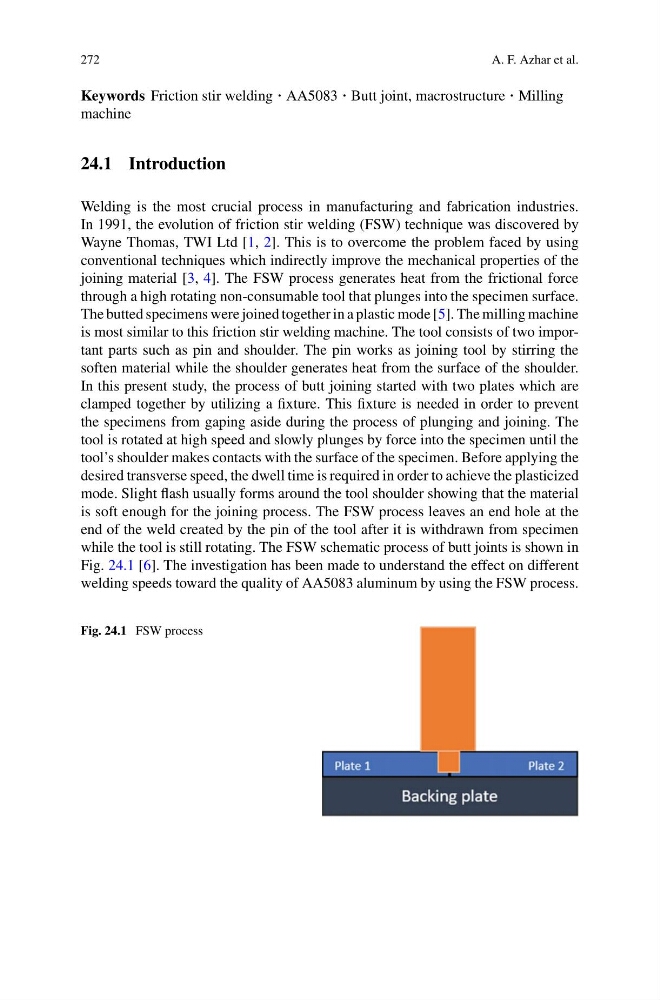
while the tool is still rotating. The FSW schematic process of butt joints is shown in
Fig. 24.1 [6]. The investigation has been made to understand the effect on different
welding speeds toward the quality of AA5083 aluminum by using the FSW process.
Fig. 24.1 FSW process
A. F. Azhar et al.
Keywords Friction stir welding · AA5083 · Butt joint, macrostructure · Milling
machine
24.1 Introduction
Welding is the most crucial process in manufacturing and fabrication industries.
In 1991, the evolution of friction stir welding (FSW) technique was discovered by
Wayne Thomas, TWI Ltd [1, 2]. This is to overcome the problem faced by using
conventional techniques which indirectly improve the mechanical properties of the
joining material [3, 4]. The FSW process generates heat from the frictional force
through a high rotating non-consumable tool that plunges into the specimen surface.
The butted specimens were joined together in a plastic mode [5]. The milling machine
is most similar to this friction stir welding machine. The tool consists of two important parts such as pin and shoulder. The pin works as joining tool by stirring the
soften material while the shoulder generates heat from the surface of the shoulder.
In this present study, the process of butt joining started with two plates which are
clamped together by utilizing a fixture. This fixture is needed in order to prevent
the specimens from gaping aside during the process of plunging and joining. The
tool is rotated at high speed and slowly plunges by force into the specimen until the
tool’s shoulder makes contacts with the surface of the specimen. Before applying the
desired transverse speed, the dwell time is required in order to achieve the plasticized
mode. Slight flash usually forms around the tool shoulder showing that the material
is soft enough for the joining process. The FSW process leaves an end hole at the
end of the weld created by the pin of the tool after it is withdrawn from specimen
while the tool is still rotating. The FSW schematic process of butt joints is shown in
Fig. 24.1 [6]. The investigation has been made to understand the effect on different
welding speeds toward the quality of AA5083 aluminum by using the FSW process.
Fig. 24.1 FSW process