

22 Experimental Study of Friction Stir Welding on Dissimilar …
259
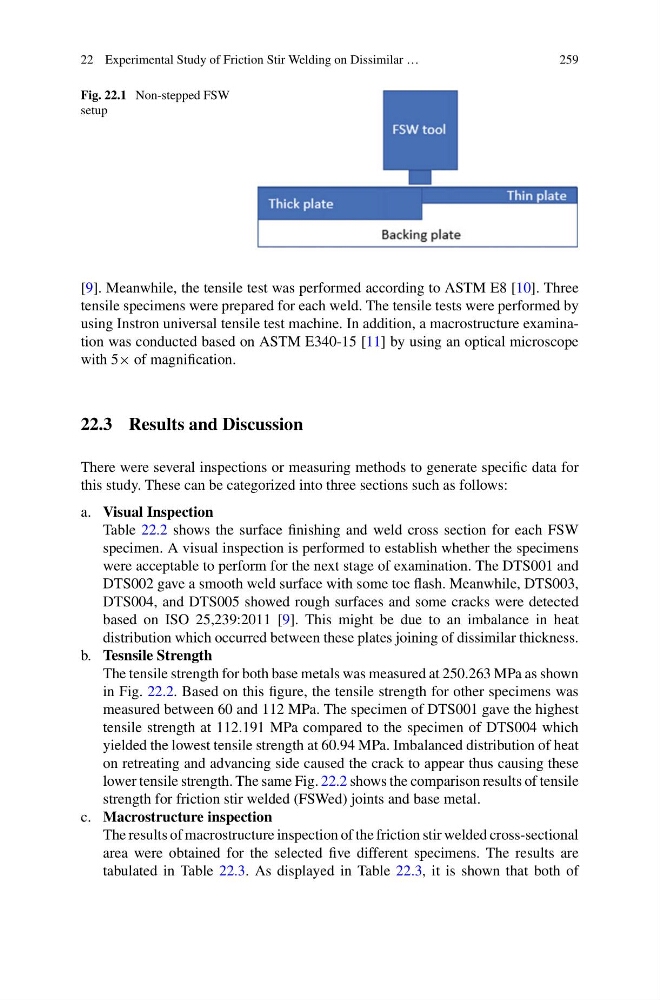
Fig. 22.1 Non-stepped FSW
setup
[9]. Meanwhile, the tensile test was performed according to ASTM E8 [10]. Three
tensile specimens were prepared for each weld. The tensile tests were performed by
using Instron universal tensile test machine. In addition, a macrostructure examination was conducted based on ASTM E340-15 [11] by using an optical microscope
with 5× of magnification.
22.3 Results and Discussion
There were several inspections or measuring methods to generate specific data for
this study. These can be categorized into three sections such as follows:
a. Visual Inspection
Table 22.2 shows the surface finishing and weld cross section for each FSW
specimen. A visual inspection is performed to establish whether the specimens
were acceptable to perform for the next stage of examination. The DTS001 and
DTS002 gave a smooth weld surface with some toe flash. Meanwhile, DTS003,
DTS004, and DTS005 showed rough surfaces and some cracks were detected
based on ISO 25,239:2011 [9]. This might be due to an imbalance in heat
distribution which occurred between these plates joining of dissimilar thickness.
b. Tesnsile Strength
The tensile strength for both base metals was measured at 250.263 MPa as shown
in Fig. 22.2. Based on this figure, the tensile strength for other specimens was
measured between 60 and 112 MPa. The specimen of DTS001 gave the highest
tensile strength at 112.191 MPa compared to the specimen of DTS004 which
yielded the lowest tensile strength at 60.94 MPa. Imbalanced distribution of heat
on retreating and advancing side caused the crack to appear thus causing these
lower tensile strength. The same Fig. 22.2 shows the comparison results of tensile
strength for friction stir welded (FSWed) joints and base metal.
c. Macrostructure inspection
The results of macrostructure inspection of the friction stir welded cross-sectional
area were obtained for the selected five different specimens. The results are
tabulated in Table 22.3. As displayed in Table 22.3, it is shown that both of
259
Fig. 22.1 Non-stepped FSW
setup
[9]. Meanwhile, the tensile test was performed according to ASTM E8 [10]. Three
tensile specimens were prepared for each weld. The tensile tests were performed by
using Instron universal tensile test machine. In addition, a macrostructure examination was conducted based on ASTM E340-15 [11] by using an optical microscope
with 5× of magnification.
22.3 Results and Discussion
There were several inspections or measuring methods to generate specific data for
this study. These can be categorized into three sections such as follows:
a. Visual Inspection
Table 22.2 shows the surface finishing and weld cross section for each FSW
specimen. A visual inspection is performed to establish whether the specimens
were acceptable to perform for the next stage of examination. The DTS001 and
DTS002 gave a smooth weld surface with some toe flash. Meanwhile, DTS003,
DTS004, and DTS005 showed rough surfaces and some cracks were detected
based on ISO 25,239:2011 [9]. This might be due to an imbalance in heat
distribution which occurred between these plates joining of dissimilar thickness.
b. Tesnsile Strength
The tensile strength for both base metals was measured at 250.263 MPa as shown
in Fig. 22.2. Based on this figure, the tensile strength for other specimens was
measured between 60 and 112 MPa. The specimen of DTS001 gave the highest
tensile strength at 112.191 MPa compared to the specimen of DTS004 which
yielded the lowest tensile strength at 60.94 MPa. Imbalanced distribution of heat
on retreating and advancing side caused the crack to appear thus causing these
lower tensile strength. The same Fig. 22.2 shows the comparison results of tensile
strength for friction stir welded (FSWed) joints and base metal.
c. Macrostructure inspection
The results of macrostructure inspection of the friction stir welded cross-sectional
area were obtained for the selected five different specimens. The results are
tabulated in Table 22.3. As displayed in Table 22.3, it is shown that both of