

246
A. M. Arof et al.
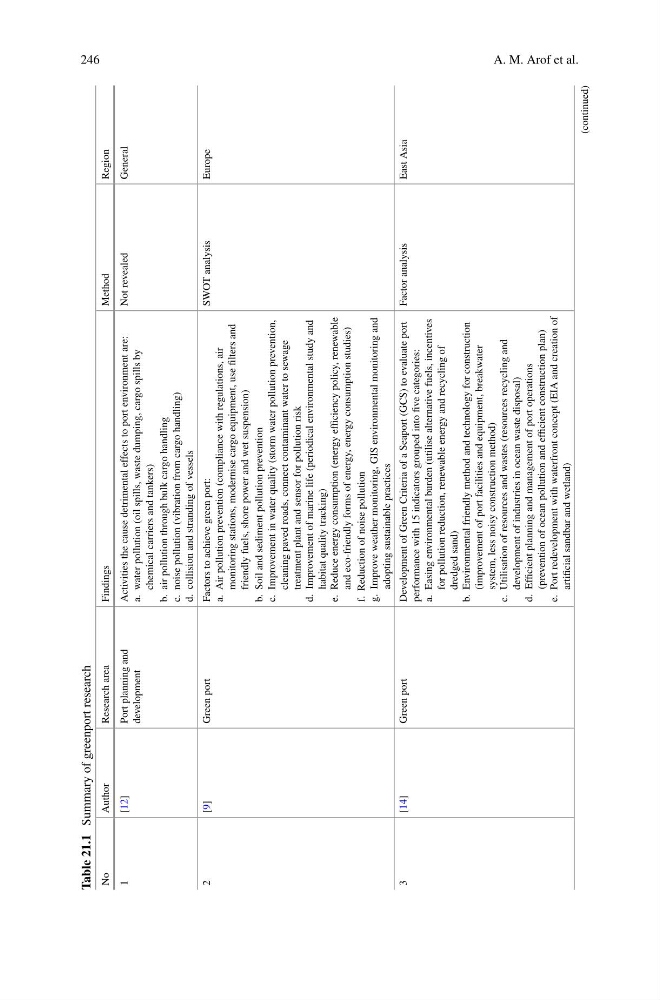
Table 21.1
Summary of greenport research
No
Author
Research area
Findings
Method
Region
1
[12]
Port planning and
development
Activities the cause detrimental effects to port environment are:
a. water pollution (oil spills, waste dumping, cargo spills by
chemical carriers and tankers)
b. air pollution through bulk cargo handling
c. noise pollution (vibration from cargo handling)
d. collision and stranding of vessels
Not revealed
General
2
[9]
Green port
Factors to achieve green port:
a. Air pollution prevention (compliance with regulations, air
monitoring stations, modernise cargo equipment, use filters and
friendly fuels, shore power and wet suspension)
b. Soil and sediment pollution prevention
c. Improvement in water quality (storm water pollution prevention,
cleaning paved roads, connect contaminant water to sewage
treatment plant and sensor for pollution risk
d. Improvement of marine life (periodical environmental study and
habitat quality tracking)
e. Reduce energy consumption (energy efficiency policy, renewable
and eco-friendly forms of energy, energy consumption studies)
f. Reduction of noise pollution
g. Improve weather monitoring, GIS environmental monitoring and
adopting sustainable practices
SWOT analysis
Europe
3
[14]
Green port
Development of Green Criteria of a Seaport (GCS) to evaluate port
performance with 15 indicators grouped into five categories:
a. Easing environmental burden (utilise alternative fuels, incentives
for pollution reduction, renewable energy and recycling of
dredged sand)
b. Environmental friendly method and technology for construction
(improvement of port facilities and equipment, breakwater
system, less noisy construction method)
c. Utilisation of resources and wastes (resources recycling and
development of industries in ocean waste disposal)
d. Efficient planning and management of port operations
(prevention of ocean pollution and efficient construction plan)
e. Port redevelopment with waterfront concept (EIA and creation of
artificial sandbar and wetland)
Factor analysis
East Asia
(continued)
A. M. Arof et al.
Table 21.1
Summary of greenport research
No
Author
Research area
Findings
Method
Region
1
[12]
Port planning and
development
Activities the cause detrimental effects to port environment are:
a. water pollution (oil spills, waste dumping, cargo spills by
chemical carriers and tankers)
b. air pollution through bulk cargo handling
c. noise pollution (vibration from cargo handling)
d. collision and stranding of vessels
Not revealed
General
2
[9]
Green port
Factors to achieve green port:
a. Air pollution prevention (compliance with regulations, air
monitoring stations, modernise cargo equipment, use filters and
friendly fuels, shore power and wet suspension)
b. Soil and sediment pollution prevention
c. Improvement in water quality (storm water pollution prevention,
cleaning paved roads, connect contaminant water to sewage
treatment plant and sensor for pollution risk
d. Improvement of marine life (periodical environmental study and
habitat quality tracking)
e. Reduce energy consumption (energy efficiency policy, renewable
and eco-friendly forms of energy, energy consumption studies)
f. Reduction of noise pollution
g. Improve weather monitoring, GIS environmental monitoring and
adopting sustainable practices
SWOT analysis
Europe
3
[14]
Green port
Development of Green Criteria of a Seaport (GCS) to evaluate port
performance with 15 indicators grouped into five categories:
a. Easing environmental burden (utilise alternative fuels, incentives
for pollution reduction, renewable energy and recycling of
dredged sand)
b. Environmental friendly method and technology for construction
(improvement of port facilities and equipment, breakwater
system, less noisy construction method)
c. Utilisation of resources and wastes (resources recycling and
development of industries in ocean waste disposal)
d. Efficient planning and management of port operations
(prevention of ocean pollution and efficient construction plan)
e. Port redevelopment with waterfront concept (EIA and creation of
artificial sandbar and wetland)
Factor analysis
East Asia
(continued)