

232
M. R. Zoolfakar and M. A. A. Jesmin
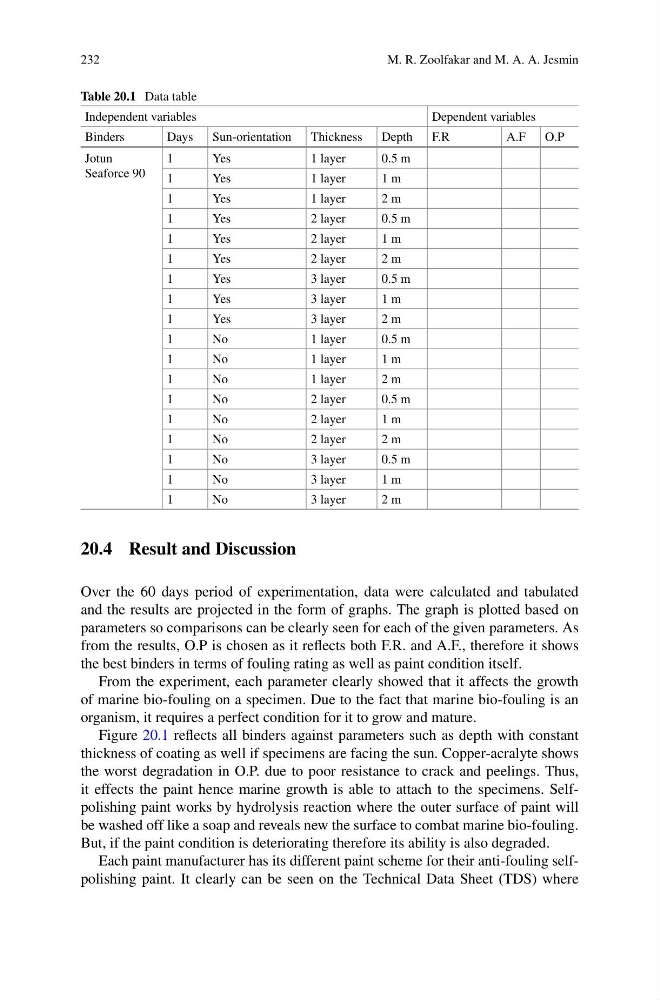
Table 20.1 Data table
Independent variables
Dependent variables
Binders
Days
Sun-orientation
Thickness
Depth
F.R
A.F
O.P
Jotun
Seaforce 90
1
Yes
1 layer
0.5 m
1
Yes
1 layer
1 m
1
Yes
1 layer
2 m
1
Yes
2 layer
0.5 m
1
Yes
2 layer
1 m
1
Yes
2 layer
2 m
1
Yes
3 layer
0.5 m
1
Yes
3 layer
1 m
1
Yes
3 layer
2 m
1
No
1 layer
0.5 m
1
No
1 layer
1 m
1
No
1 layer
2 m
1
No
2 layer
0.5 m
1
No
2 layer
1 m
1
No
2 layer
2 m
1
No
3 layer
0.5 m
1
No
3 layer
1 m
1
No
3 layer
2 m
20.4 Result and Discussion
Over the 60 days period of experimentation, data were calculated and tabulated
and the results are projected in the form of graphs. The graph is plotted based on
parameters so comparisons can be clearly seen for each of the given parameters. As
from the results, O.P is chosen as it reflects both F.R. and A.F., therefore it shows
the best binders in terms of fouling rating as well as paint condition itself.
From the experiment, each parameter clearly showed that it affects the growth
of marine bio-fouling on a specimen. Due to the fact that marine bio-fouling is an
organism, it requires a perfect condition for it to grow and mature.
Figure 20.1 reflects all binders against parameters such as depth with constant
thickness of coating as well if specimens are facing the sun. Copper-acralyte shows
the worst degradation in O.P. due to poor resistance to crack and peelings. Thus,
it effects the paint hence marine growth is able to attach to the specimens. Selfpolishing paint works by hydrolysis reaction where the outer surface of paint will
be washed off like a soap and reveals new the surface to combat marine bio-fouling.
But, if the paint condition is deteriorating therefore its ability is also degraded.
Each paint manufacturer has its different paint scheme for their anti-fouling selfpolishing paint. It clearly can be seen on the Technical Data Sheet (TDS) where
M. R. Zoolfakar and M. A. A. Jesmin
Table 20.1 Data table
Independent variables
Dependent variables
Binders
Days
Sun-orientation
Thickness
Depth
F.R
A.F
O.P
Jotun
Seaforce 90
1
Yes
1 layer
0.5 m
1
Yes
1 layer
1 m
1
Yes
1 layer
2 m
1
Yes
2 layer
0.5 m
1
Yes
2 layer
1 m
1
Yes
2 layer
2 m
1
Yes
3 layer
0.5 m
1
Yes
3 layer
1 m
1
Yes
3 layer
2 m
1
No
1 layer
0.5 m
1
No
1 layer
1 m
1
No
1 layer
2 m
1
No
2 layer
0.5 m
1
No
2 layer
1 m
1
No
2 layer
2 m
1
No
3 layer
0.5 m
1
No
3 layer
1 m
1
No
3 layer
2 m
20.4 Result and Discussion
Over the 60 days period of experimentation, data were calculated and tabulated
and the results are projected in the form of graphs. The graph is plotted based on
parameters so comparisons can be clearly seen for each of the given parameters. As
from the results, O.P is chosen as it reflects both F.R. and A.F., therefore it shows
the best binders in terms of fouling rating as well as paint condition itself.
From the experiment, each parameter clearly showed that it affects the growth
of marine bio-fouling on a specimen. Due to the fact that marine bio-fouling is an
organism, it requires a perfect condition for it to grow and mature.
Figure 20.1 reflects all binders against parameters such as depth with constant
thickness of coating as well if specimens are facing the sun. Copper-acralyte shows
the worst degradation in O.P. due to poor resistance to crack and peelings. Thus,
it effects the paint hence marine growth is able to attach to the specimens. Selfpolishing paint works by hydrolysis reaction where the outer surface of paint will
be washed off like a soap and reveals new the surface to combat marine bio-fouling.
But, if the paint condition is deteriorating therefore its ability is also degraded.
Each paint manufacturer has its different paint scheme for their anti-fouling selfpolishing paint. It clearly can be seen on the Technical Data Sheet (TDS) where