

16 Mitigating Engine Exhaust Emission …
175
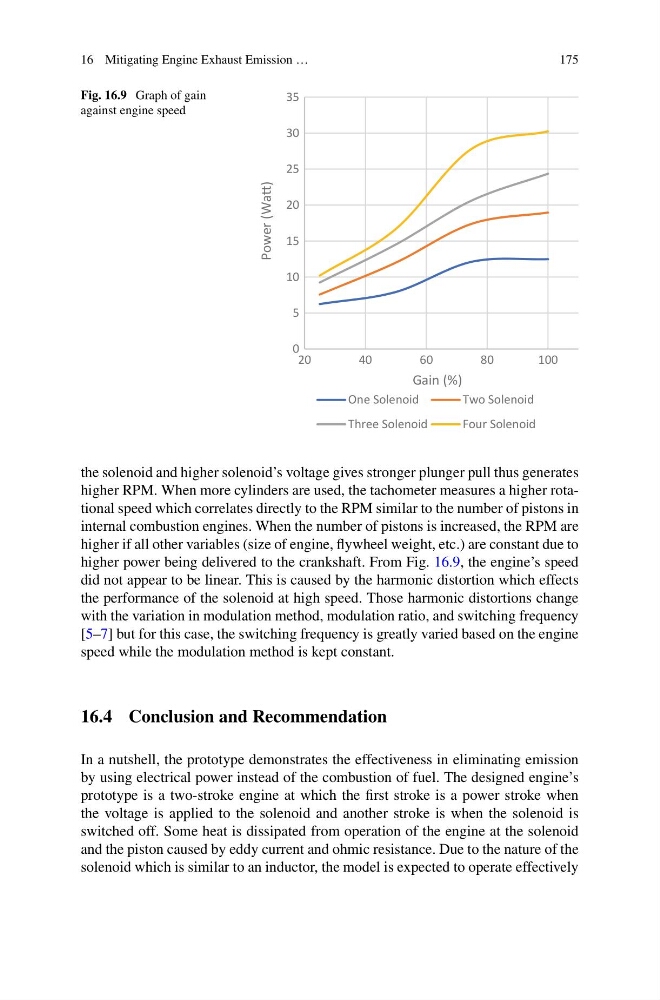
Fig. 16.9 Graph of gain
against engine speed
0
5
10
15
20
25
30
35
20
40
60
80
100
Power (WaƩ)
Gain (%)
One Solenoid
Two Solenoid
Three Solenoid
Four Solenoid
the solenoid and higher solenoid’s voltage gives stronger plunger pull thus generates
higher RPM. When more cylinders are used, the tachometer measures a higher rotational speed which correlates directly to the RPM similar to the number of pistons in
internal combustion engines. When the number of pistons is increased, the RPM are
higher if all other variables (size of engine, flywheel weight, etc.) are constant due to
higher power being delivered to the crankshaft. From Fig. 16.9, the engine’s speed
did not appear to be linear. This is caused by the harmonic distortion which effects
the performance of the solenoid at high speed. Those harmonic distortions change
with the variation in modulation method, modulation ratio, and switching frequency
[5–7] but for this case, the switching frequency is greatly varied based on the engine
speed while the modulation method is kept constant.
16.4 Conclusion and Recommendation
In a nutshell, the prototype demonstrates the effectiveness in eliminating emission
by using electrical power instead of the combustion of fuel. The designed engine’s
prototype is a two-stroke engine at which the first stroke is a power stroke when
the voltage is applied to the solenoid and another stroke is when the solenoid is
switched off. Some heat is dissipated from operation of the engine at the solenoid
and the piston caused by eddy current and ohmic resistance. Due to the nature of the
solenoid which is similar to an inductor, the model is expected to operate effectively
175
Fig. 16.9 Graph of gain
against engine speed
0
5
10
15
20
25
30
35
20
40
60
80
100
Power (WaƩ)
Gain (%)
One Solenoid
Two Solenoid
Three Solenoid
Four Solenoid
the solenoid and higher solenoid’s voltage gives stronger plunger pull thus generates
higher RPM. When more cylinders are used, the tachometer measures a higher rotational speed which correlates directly to the RPM similar to the number of pistons in
internal combustion engines. When the number of pistons is increased, the RPM are
higher if all other variables (size of engine, flywheel weight, etc.) are constant due to
higher power being delivered to the crankshaft. From Fig. 16.9, the engine’s speed
did not appear to be linear. This is caused by the harmonic distortion which effects
the performance of the solenoid at high speed. Those harmonic distortions change
with the variation in modulation method, modulation ratio, and switching frequency
[5–7] but for this case, the switching frequency is greatly varied based on the engine
speed while the modulation method is kept constant.
16.4 Conclusion and Recommendation
In a nutshell, the prototype demonstrates the effectiveness in eliminating emission
by using electrical power instead of the combustion of fuel. The designed engine’s
prototype is a two-stroke engine at which the first stroke is a power stroke when
the voltage is applied to the solenoid and another stroke is when the solenoid is
switched off. Some heat is dissipated from operation of the engine at the solenoid
and the piston caused by eddy current and ohmic resistance. Due to the nature of the
solenoid which is similar to an inductor, the model is expected to operate effectively