

84
N. Khalid et al.
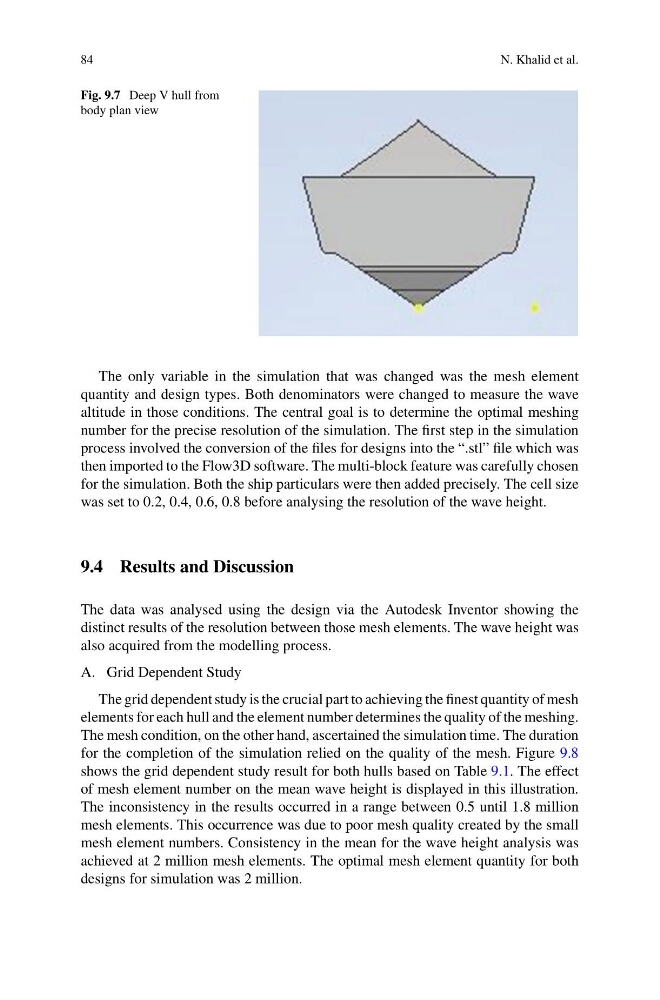
Fig. 9.7 Deep V hull from
body plan view
The only variable in the simulation that was changed was the mesh element
quantity and design types. Both denominators were changed to measure the wave
altitude in those conditions. The central goal is to determine the optimal meshing
number for the precise resolution of the simulation. The first step in the simulation
process involved the conversion of the files for designs into the “.stl” file which was
then imported to the Flow3D software. The multi-block feature was carefully chosen
for the simulation. Both the ship particulars were then added precisely. The cell size
was set to 0.2, 0.4, 0.6, 0.8 before analysing the resolution of the wave height.
9.4 Results and Discussion
The data was analysed using the design via the Autodesk Inventor showing the
distinct results of the resolution between those mesh elements. The wave height was
also acquired from the modelling process.
A. Grid Dependent Study
The grid dependent study is the crucial part to achieving the finest quantity of mesh
elements for each hull and the element number determines the quality of the meshing.
The mesh condition, on the other hand, ascertained the simulation time. The duration
for the completion of the simulation relied on the quality of the mesh. Figure 9.8
shows the grid dependent study result for both hulls based on Table 9.1. The effect
of mesh element number on the mean wave height is displayed in this illustration.
The inconsistency in the results occurred in a range between 0.5 until 1.8 million
mesh elements. This occurrence was due to poor mesh quality created by the small
mesh element numbers. Consistency in the mean for the wave height analysis was
achieved at 2 million mesh elements. The optimal mesh element quantity for both
designs for simulation was 2 million.
N. Khalid et al.
Fig. 9.7 Deep V hull from
body plan view
The only variable in the simulation that was changed was the mesh element
quantity and design types. Both denominators were changed to measure the wave
altitude in those conditions. The central goal is to determine the optimal meshing
number for the precise resolution of the simulation. The first step in the simulation
process involved the conversion of the files for designs into the “.stl” file which was
then imported to the Flow3D software. The multi-block feature was carefully chosen
for the simulation. Both the ship particulars were then added precisely. The cell size
was set to 0.2, 0.4, 0.6, 0.8 before analysing the resolution of the wave height.
9.4 Results and Discussion
The data was analysed using the design via the Autodesk Inventor showing the
distinct results of the resolution between those mesh elements. The wave height was
also acquired from the modelling process.
A. Grid Dependent Study
The grid dependent study is the crucial part to achieving the finest quantity of mesh
elements for each hull and the element number determines the quality of the meshing.
The mesh condition, on the other hand, ascertained the simulation time. The duration
for the completion of the simulation relied on the quality of the mesh. Figure 9.8
shows the grid dependent study result for both hulls based on Table 9.1. The effect
of mesh element number on the mean wave height is displayed in this illustration.
The inconsistency in the results occurred in a range between 0.5 until 1.8 million
mesh elements. This occurrence was due to poor mesh quality created by the small
mesh element numbers. Consistency in the mean for the wave height analysis was
achieved at 2 million mesh elements. The optimal mesh element quantity for both
designs for simulation was 2 million.