

Studies on Designing Adaptive Sportswear for Differently …
73
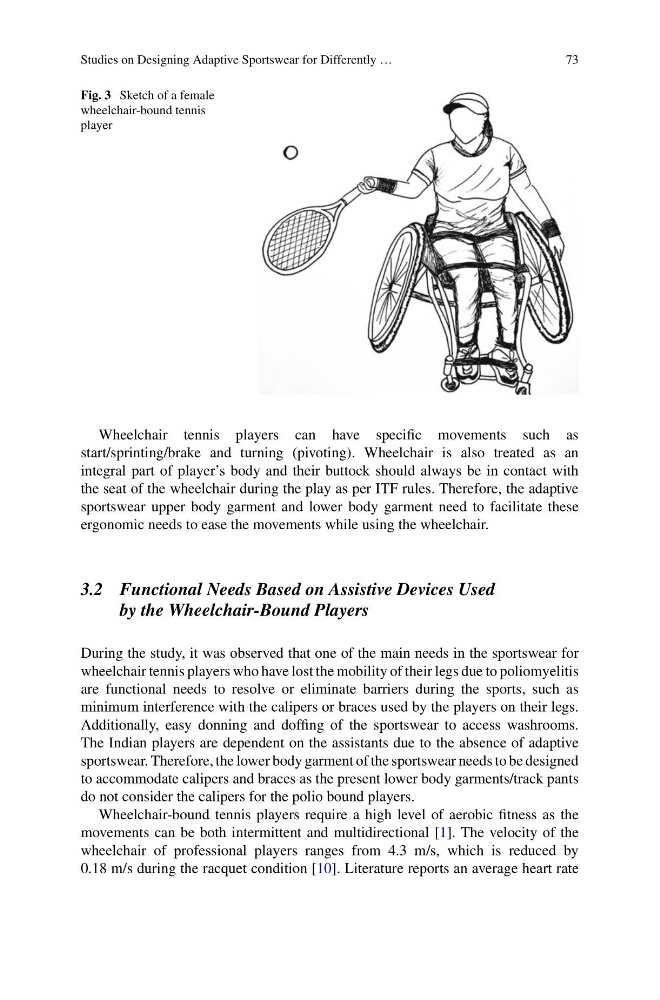
Fig. 3 Sketch of a female
wheelchair-bound tennis
player
Wheelchair tennis players can have specific movements such as
start/sprinting/brake and turning (pivoting). Wheelchair is also treated as an
integral part of player’s body and their buttock should always be in contact with
the seat of the wheelchair during the play as per ITF rules. Therefore, the adaptive
sportswear upper body garment and lower body garment need to facilitate these
ergonomic needs to ease the movements while using the wheelchair.
3.2 Functional Needs Based on Assistive Devices Used
by the Wheelchair-Bound Players
During the study, it was observed that one of the main needs in the sportswear for
wheelchair tennis players who have lost the mobility of their legs due to poliomyelitis
are functional needs to resolve or eliminate barriers during the sports, such as
minimum interference with the calipers or braces used by the players on their legs.
Additionally, easy donning and doffing of the sportswear to access washrooms.
The Indian players are dependent on the assistants due to the absence of adaptive
sportswear. Therefore, the lower body garment of the sportswear needs to be designed
to accommodate calipers and braces as the present lower body garments/track pants
do not consider the calipers for the polio bound players.
Wheelchair-bound tennis players require a high level of aerobic fitness as the
movements can be both intermittent and multidirectional [1]. The velocity of the
wheelchair of professional players ranges from 4.3 m/s, which is reduced by
0.18 m/s during the racquet condition [10]. Literature reports an average heart rate
73
Fig. 3 Sketch of a female
wheelchair-bound tennis
player
Wheelchair tennis players can have specific movements such as
start/sprinting/brake and turning (pivoting). Wheelchair is also treated as an
integral part of player’s body and their buttock should always be in contact with
the seat of the wheelchair during the play as per ITF rules. Therefore, the adaptive
sportswear upper body garment and lower body garment need to facilitate these
ergonomic needs to ease the movements while using the wheelchair.
3.2 Functional Needs Based on Assistive Devices Used
by the Wheelchair-Bound Players
During the study, it was observed that one of the main needs in the sportswear for
wheelchair tennis players who have lost the mobility of their legs due to poliomyelitis
are functional needs to resolve or eliminate barriers during the sports, such as
minimum interference with the calipers or braces used by the players on their legs.
Additionally, easy donning and doffing of the sportswear to access washrooms.
The Indian players are dependent on the assistants due to the absence of adaptive
sportswear. Therefore, the lower body garment of the sportswear needs to be designed
to accommodate calipers and braces as the present lower body garments/track pants
do not consider the calipers for the polio bound players.
Wheelchair-bound tennis players require a high level of aerobic fitness as the
movements can be both intermittent and multidirectional [1]. The velocity of the
wheelchair of professional players ranges from 4.3 m/s, which is reduced by
0.18 m/s during the racquet condition [10]. Literature reports an average heart rate