

Development of a Unique Stab and Impact Resistant Material …
57
2 Materials and Methods
The study was divided into three parts. In the first part, a survey was conducted
amongst the paramilitary personnel to understand their difficulties, requirements,
etc., related to body protector. In the second study, various samples of body protectors
were procured and analyzed using prevailing paramilitary specification as well as
VPAM KDIW 2004, Edition 2011 standard. In the last study, some polymeric and
composite material were tried to replace the existing material being used in the body
protector, to improve upon its stab and impact resistance properties.
2.1 Part-1: Survey of Paramilitary Personal
To get first-hand information about the present body protector from paramilitary
personnel, a survey is conducted using well-designed questionnaire. During the
designing of questionnaire it was taken into consideration that it would cover all
the aspects which influence the safety of soldiers. This questionnaire included the
following information related to name, age, length of working hours, native place,
problem faced with body protector during riot control operation, etc.
These questionnaires were filled on the basis of interview of individual. A total
of 95 personnel including male and female personnel were interviewed.
2.2 Part-2: Analysis of Body Protector Samples
In the second study, 25 samples of body protectors coded as S 1 to S 25 from users as
well as manufacturer ends were procured. Thickness of these materials was determined using screw gauge. The thickness varies from 0.3 to 0.45 mm. The material of various parts of the body protectors was identified using Differential Scanning Calorimeters (DSC Q 20, TA Instrument) and Fourier-transform infrared spectroscopy (FTIR Perkin Elmer UATR Two). The stab and impact properties of these
samples were tested as per VPAM KDIW 2004, Edition 2011 standard. As per this
standard, the drop mass (5 kg including test tool for stab-knife and 2.5 kg including
test tool for impact-block) is allowed to fall on sample of body protector from certain
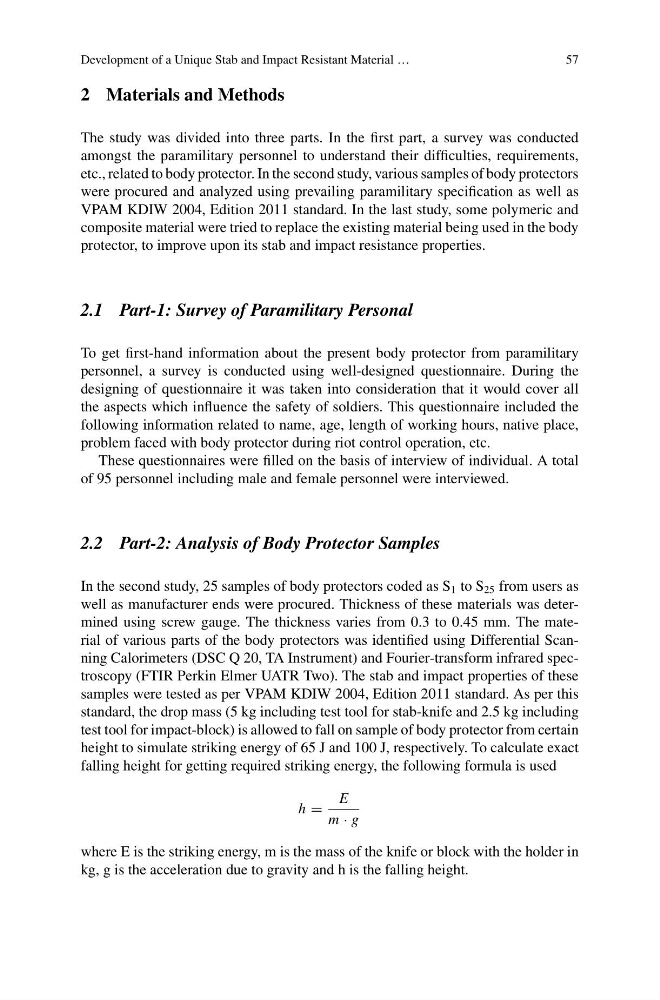
height to simulate striking energy of 65 J and 100 J, respectively. To calculate exact
falling height for getting required striking energy, the following formula is used
h =
E
m · g
where E is the striking energy, m is the mass of the knife or block with the holder in
kg, g is the acceleration due to gravity and h is the falling height.
57
2 Materials and Methods
The study was divided into three parts. In the first part, a survey was conducted
amongst the paramilitary personnel to understand their difficulties, requirements,
etc., related to body protector. In the second study, various samples of body protectors
were procured and analyzed using prevailing paramilitary specification as well as
VPAM KDIW 2004, Edition 2011 standard. In the last study, some polymeric and
composite material were tried to replace the existing material being used in the body
protector, to improve upon its stab and impact resistance properties.
2.1 Part-1: Survey of Paramilitary Personal
To get first-hand information about the present body protector from paramilitary
personnel, a survey is conducted using well-designed questionnaire. During the
designing of questionnaire it was taken into consideration that it would cover all
the aspects which influence the safety of soldiers. This questionnaire included the
following information related to name, age, length of working hours, native place,
problem faced with body protector during riot control operation, etc.
These questionnaires were filled on the basis of interview of individual. A total
of 95 personnel including male and female personnel were interviewed.
2.2 Part-2: Analysis of Body Protector Samples
In the second study, 25 samples of body protectors coded as S 1 to S 25 from users as
well as manufacturer ends were procured. Thickness of these materials was determined using screw gauge. The thickness varies from 0.3 to 0.45 mm. The material of various parts of the body protectors was identified using Differential Scanning Calorimeters (DSC Q 20, TA Instrument) and Fourier-transform infrared spectroscopy (FTIR Perkin Elmer UATR Two). The stab and impact properties of these
samples were tested as per VPAM KDIW 2004, Edition 2011 standard. As per this
standard, the drop mass (5 kg including test tool for stab-knife and 2.5 kg including
test tool for impact-block) is allowed to fall on sample of body protector from certain
height to simulate striking energy of 65 J and 100 J, respectively. To calculate exact
falling height for getting required striking energy, the following formula is used
h =
E
m · g
where E is the striking energy, m is the mass of the knife or block with the holder in
kg, g is the acceleration due to gravity and h is the falling height.