

Exploring the Need for Functional Clothing …
49
4 Results
4.1 Participants
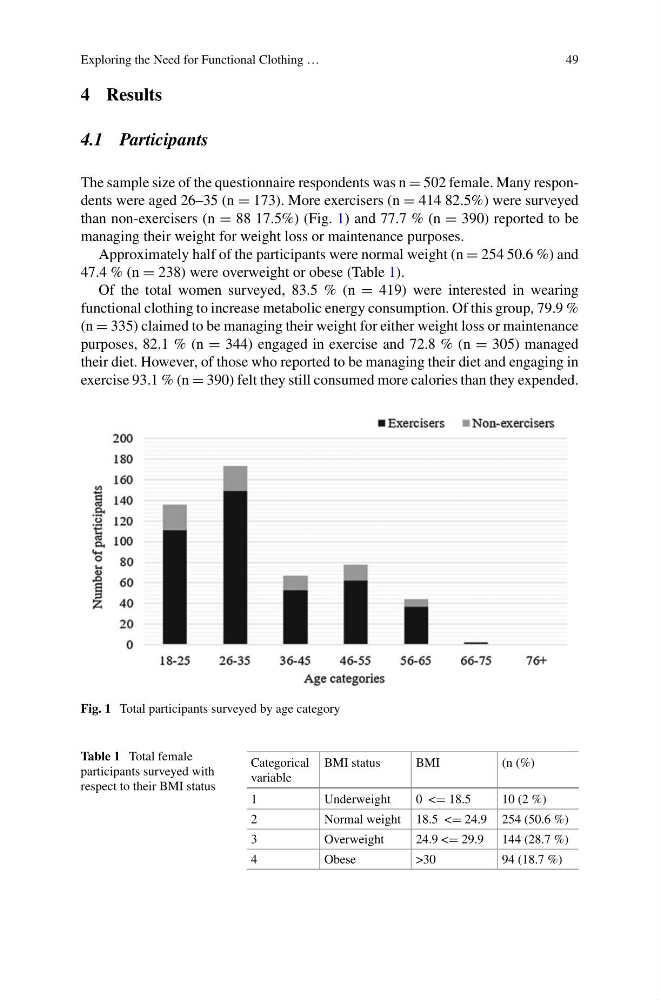
The sample size of the questionnaire respondents was n = 502 female. Many respondents were aged 26–35 (n = 173). More exercisers (n = 414 82.5%) were surveyed
than non-exercisers (n = 88 17.5%) (Fig. 1) and 77.7 % (n = 390) reported to be
managing their weight for weight loss or maintenance purposes.
Approximately half of the participants were normal weight (n = 254 50.6 %) and
47.4 % (n = 238) were overweight or obese (Table 1).
Of the total women surveyed, 83.5 % (n = 419) were interested in wearing
functional clothing to increase metabolic energy consumption. Of this group, 79.9 %
(n = 335) claimed to be managing their weight for either weight loss or maintenance
purposes, 82.1 % (n = 344) engaged in exercise and 72.8 % (n = 305) managed
their diet. However, of those who reported to be managing their diet and engaging in
exercise 93.1 % (n = 390) felt they still consumed more calories than they expended.
Fig. 1 Total participants surveyed by age category
Table 1 Total female
participants surveyed with
respect to their BMI status
Categorical
variable
BMI status
BMI
(n (%)
1
Underweight
0 <= 18.5
10 (2 %)
2
Normal weight 18.5 <= 24.9 254 (50.6 %)
3
Overweight
24.9 <= 29.9 144 (28.7 %)
4
Obese
>30
94 (18.7 %)
49
4 Results
4.1 Participants
The sample size of the questionnaire respondents was n = 502 female. Many respondents were aged 26–35 (n = 173). More exercisers (n = 414 82.5%) were surveyed
than non-exercisers (n = 88 17.5%) (Fig. 1) and 77.7 % (n = 390) reported to be
managing their weight for weight loss or maintenance purposes.
Approximately half of the participants were normal weight (n = 254 50.6 %) and
47.4 % (n = 238) were overweight or obese (Table 1).
Of the total women surveyed, 83.5 % (n = 419) were interested in wearing
functional clothing to increase metabolic energy consumption. Of this group, 79.9 %
(n = 335) claimed to be managing their weight for either weight loss or maintenance
purposes, 82.1 % (n = 344) engaged in exercise and 72.8 % (n = 305) managed
their diet. However, of those who reported to be managing their diet and engaging in
exercise 93.1 % (n = 390) felt they still consumed more calories than they expended.
Fig. 1 Total participants surveyed by age category
Table 1 Total female
participants surveyed with
respect to their BMI status
Categorical
variable
BMI status
BMI
(n (%)
1
Underweight
0 <= 18.5
10 (2 %)
2
Normal weight 18.5 <= 24.9 254 (50.6 %)
3
Overweight
24.9 <= 29.9 144 (28.7 %)
4
Obese
>30
94 (18.7 %)