

Moisture Management Properties of Ring Vis …
39
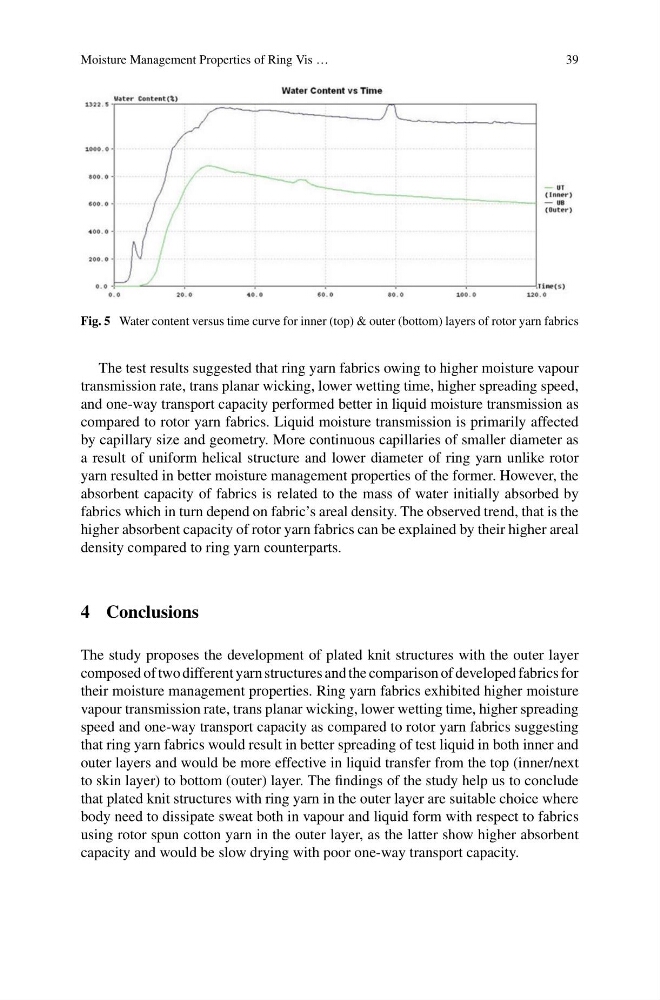
Fig. 5 Water content versus time curve for inner (top) & outer (bottom) layers of rotor yarn fabrics
The test results suggested that ring yarn fabrics owing to higher moisture vapour
transmission rate, trans planar wicking, lower wetting time, higher spreading speed,
and one-way transport capacity performed better in liquid moisture transmission as
compared to rotor yarn fabrics. Liquid moisture transmission is primarily affected
by capillary size and geometry. More continuous capillaries of smaller diameter as
a result of uniform helical structure and lower diameter of ring yarn unlike rotor
yarn resulted in better moisture management properties of the former. However, the
absorbent capacity of fabrics is related to the mass of water initially absorbed by
fabrics which in turn depend on fabric’s areal density. The observed trend, that is the
higher absorbent capacity of rotor yarn fabrics can be explained by their higher areal
density compared to ring yarn counterparts.
4 Conclusions
The study proposes the development of plated knit structures with the outer layer
composed of two different yarn structures and the comparison of developed fabrics for
their moisture management properties. Ring yarn fabrics exhibited higher moisture
vapour transmission rate, trans planar wicking, lower wetting time, higher spreading
speed and one-way transport capacity as compared to rotor yarn fabrics suggesting
that ring yarn fabrics would result in better spreading of test liquid in both inner and
outer layers and would be more effective in liquid transfer from the top (inner/next
to skin layer) to bottom (outer) layer. The findings of the study help us to conclude
that plated knit structures with ring yarn in the outer layer are suitable choice where
body need to dissipate sweat both in vapour and liquid form with respect to fabrics
using rotor spun cotton yarn in the outer layer, as the latter show higher absorbent
capacity and would be slow drying with poor one-way transport capacity.
39
Fig. 5 Water content versus time curve for inner (top) & outer (bottom) layers of rotor yarn fabrics
The test results suggested that ring yarn fabrics owing to higher moisture vapour
transmission rate, trans planar wicking, lower wetting time, higher spreading speed,
and one-way transport capacity performed better in liquid moisture transmission as
compared to rotor yarn fabrics. Liquid moisture transmission is primarily affected
by capillary size and geometry. More continuous capillaries of smaller diameter as
a result of uniform helical structure and lower diameter of ring yarn unlike rotor
yarn resulted in better moisture management properties of the former. However, the
absorbent capacity of fabrics is related to the mass of water initially absorbed by
fabrics which in turn depend on fabric’s areal density. The observed trend, that is the
higher absorbent capacity of rotor yarn fabrics can be explained by their higher areal
density compared to ring yarn counterparts.
4 Conclusions
The study proposes the development of plated knit structures with the outer layer
composed of two different yarn structures and the comparison of developed fabrics for
their moisture management properties. Ring yarn fabrics exhibited higher moisture
vapour transmission rate, trans planar wicking, lower wetting time, higher spreading
speed and one-way transport capacity as compared to rotor yarn fabrics suggesting
that ring yarn fabrics would result in better spreading of test liquid in both inner and
outer layers and would be more effective in liquid transfer from the top (inner/next
to skin layer) to bottom (outer) layer. The findings of the study help us to conclude
that plated knit structures with ring yarn in the outer layer are suitable choice where
body need to dissipate sweat both in vapour and liquid form with respect to fabrics
using rotor spun cotton yarn in the outer layer, as the latter show higher absorbent
capacity and would be slow drying with poor one-way transport capacity.