

38
Y. Jhanji et al.
areal density and bulk density and hence more water absorption by rotor yarn fabrics
as compared to their ring yarn counterparts.
3.4 Moisture Management Properties
Table 4 shows the moisture management indices of test samples. It was observed
that top (inner layer) and bottom (outer layer) wetting time was higher for rotor
yarn fabrics compared to their ring yarn counterparts suggesting that former would
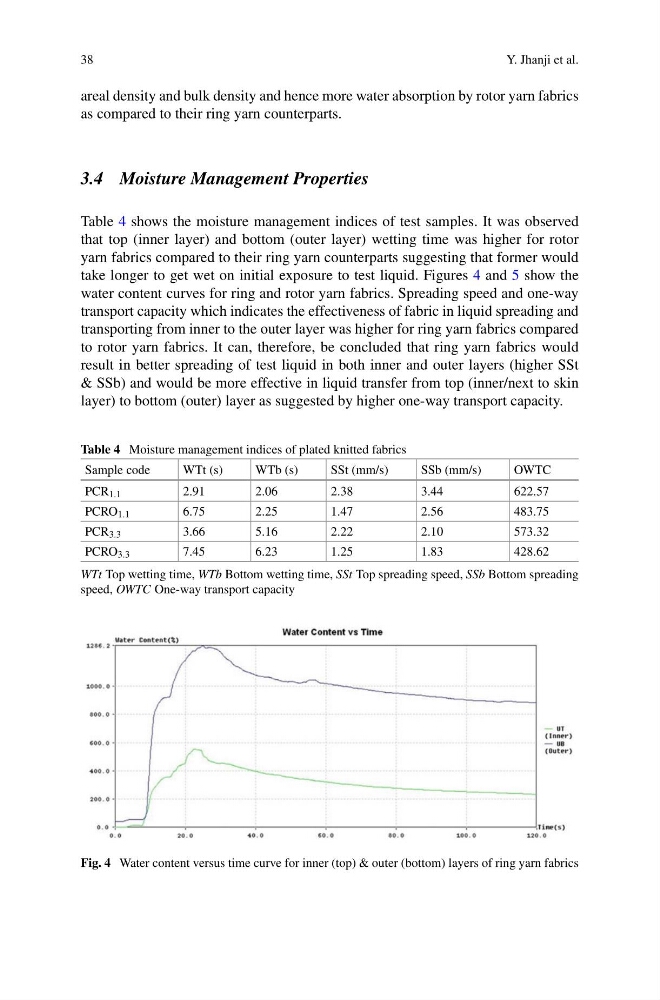
take longer to get wet on initial exposure to test liquid. Figures 4 and 5 show the
water content curves for ring and rotor yarn fabrics. Spreading speed and one-way
transport capacity which indicates the effectiveness of fabric in liquid spreading and
transporting from inner to the outer layer was higher for ring yarn fabrics compared
to rotor yarn fabrics. It can, therefore, be concluded that ring yarn fabrics would
result in better spreading of test liquid in both inner and outer layers (higher SSt
& SSb) and would be more effective in liquid transfer from top (inner/next to skin
layer) to bottom (outer) layer as suggested by higher one-way transport capacity.
Table 4 Moisture management indices of plated knitted fabrics
Sample code
WTt (s)
WTb (s)
SSt (mm/s)
SSb (mm/s)
OWTC
PCR 1.1
2.91
2.06
2.38
3.44
622.57
PCRO 1.1
6.75
2.25
1.47
2.56
483.75
PCR 3.3
3.66
5.16
2.22
2.10
573.32
PCRO 3.3
7.45
6.23
1.25
1.83
428.62
WTt Top wetting time, WTb Bottom wetting time, SSt Top spreading speed, SSb Bottom spreading
speed, OWTC One-way transport capacity
Fig. 4 Water content versus time curve for inner (top) & outer (bottom) layers of ring yarn fabrics
Y. Jhanji et al.
areal density and bulk density and hence more water absorption by rotor yarn fabrics
as compared to their ring yarn counterparts.
3.4 Moisture Management Properties
Table 4 shows the moisture management indices of test samples. It was observed
that top (inner layer) and bottom (outer layer) wetting time was higher for rotor
yarn fabrics compared to their ring yarn counterparts suggesting that former would
take longer to get wet on initial exposure to test liquid. Figures 4 and 5 show the
water content curves for ring and rotor yarn fabrics. Spreading speed and one-way
transport capacity which indicates the effectiveness of fabric in liquid spreading and
transporting from inner to the outer layer was higher for ring yarn fabrics compared
to rotor yarn fabrics. It can, therefore, be concluded that ring yarn fabrics would
result in better spreading of test liquid in both inner and outer layers (higher SSt
& SSb) and would be more effective in liquid transfer from top (inner/next to skin
layer) to bottom (outer) layer as suggested by higher one-way transport capacity.
Table 4 Moisture management indices of plated knitted fabrics
Sample code
WTt (s)
WTb (s)
SSt (mm/s)
SSb (mm/s)
OWTC
PCR 1.1
2.91
2.06
2.38
3.44
622.57
PCRO 1.1
6.75
2.25
1.47
2.56
483.75
PCR 3.3
3.66
5.16
2.22
2.10
573.32
PCRO 3.3
7.45
6.23
1.25
1.83
428.62
WTt Top wetting time, WTb Bottom wetting time, SSt Top spreading speed, SSb Bottom spreading
speed, OWTC One-way transport capacity
Fig. 4 Water content versus time curve for inner (top) & outer (bottom) layers of ring yarn fabrics