

Green Manufacturing Model for Indian Apparel Industry …
197
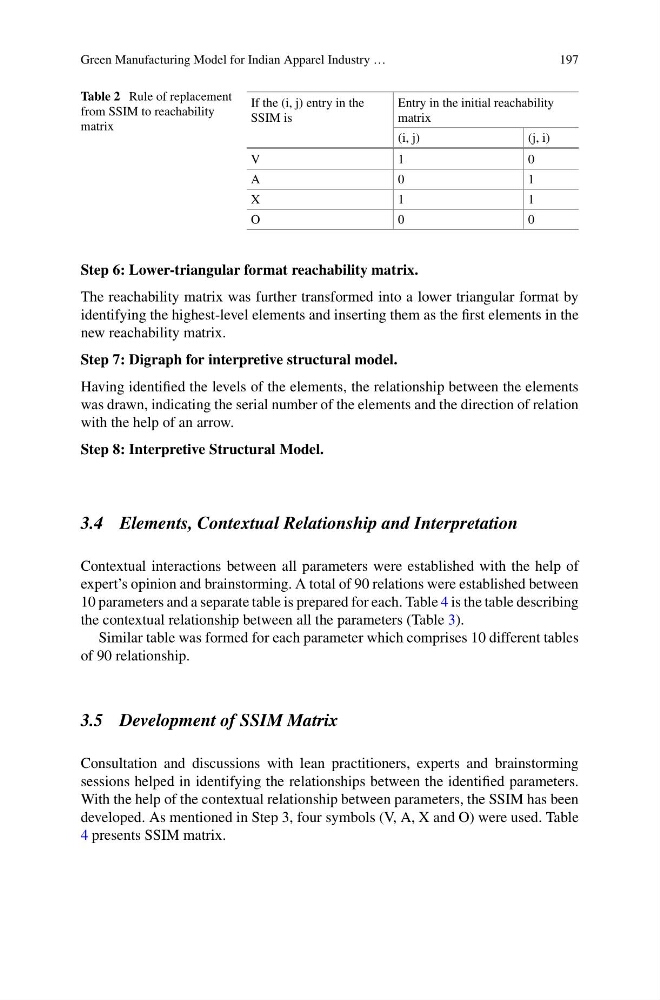
Table 2 Rule of replacement
from SSIM to reachability
matrix
If the (i, j) entry in the
SSIM is
Entry in the initial reachability
matrix
(i, j)
(j, i)
V
1
0
A
0
1
X
1
1
O
0
0
Step 6: Lower-triangular format reachability matrix.
The reachability matrix was further transformed into a lower triangular format by
identifying the highest-level elements and inserting them as the first elements in the
new reachability matrix.
Step 7: Digraph for interpretive structural model.
Having identified the levels of the elements, the relationship between the elements
was drawn, indicating the serial number of the elements and the direction of relation
with the help of an arrow.
Step 8: Interpretive Structural Model.
3.4 Elements, Contextual Relationship and Interpretation
Contextual interactions between all parameters were established with the help of
expert’s opinion and brainstorming. A total of 90 relations were established between
10 parameters and a separate table is prepared for each. Table 4 is the table describing
the contextual relationship between all the parameters (Table 3).
Similar table was formed for each parameter which comprises 10 different tables
of 90 relationship.
3.5 Development of SSIM Matrix
Consultation and discussions with lean practitioners, experts and brainstorming
sessions helped in identifying the relationships between the identified parameters.
With the help of the contextual relationship between parameters, the SSIM has been
developed. As mentioned in Step 3, four symbols (V, A, X and O) were used. Table
4 presents SSIM matrix.
197
Table 2 Rule of replacement
from SSIM to reachability
matrix
If the (i, j) entry in the
SSIM is
Entry in the initial reachability
matrix
(i, j)
(j, i)
V
1
0
A
0
1
X
1
1
O
0
0
Step 6: Lower-triangular format reachability matrix.
The reachability matrix was further transformed into a lower triangular format by
identifying the highest-level elements and inserting them as the first elements in the
new reachability matrix.
Step 7: Digraph for interpretive structural model.
Having identified the levels of the elements, the relationship between the elements
was drawn, indicating the serial number of the elements and the direction of relation
with the help of an arrow.
Step 8: Interpretive Structural Model.
3.4 Elements, Contextual Relationship and Interpretation
Contextual interactions between all parameters were established with the help of
expert’s opinion and brainstorming. A total of 90 relations were established between
10 parameters and a separate table is prepared for each. Table 4 is the table describing
the contextual relationship between all the parameters (Table 3).
Similar table was formed for each parameter which comprises 10 different tables
of 90 relationship.
3.5 Development of SSIM Matrix
Consultation and discussions with lean practitioners, experts and brainstorming
sessions helped in identifying the relationships between the identified parameters.
With the help of the contextual relationship between parameters, the SSIM has been
developed. As mentioned in Step 3, four symbols (V, A, X and O) were used. Table
4 presents SSIM matrix.