

Developing Organic Fabric from Aquatic Cellulosic Waste
183
Table 2 Fineness of lotus fiber
Fiber
Denier
Tex
Cotton count (Ne) (Indirect system)
Lotus Fiber
32
3.5
166 s
Table 3 Fiber strength
Fiber sample
Maximum load (gf)
Extension at maximum
(mm)
Stress g/den
Strain (%)
Lotus fiber
161.52
1.5589
5.0476
1.5589
Fiber fineness:
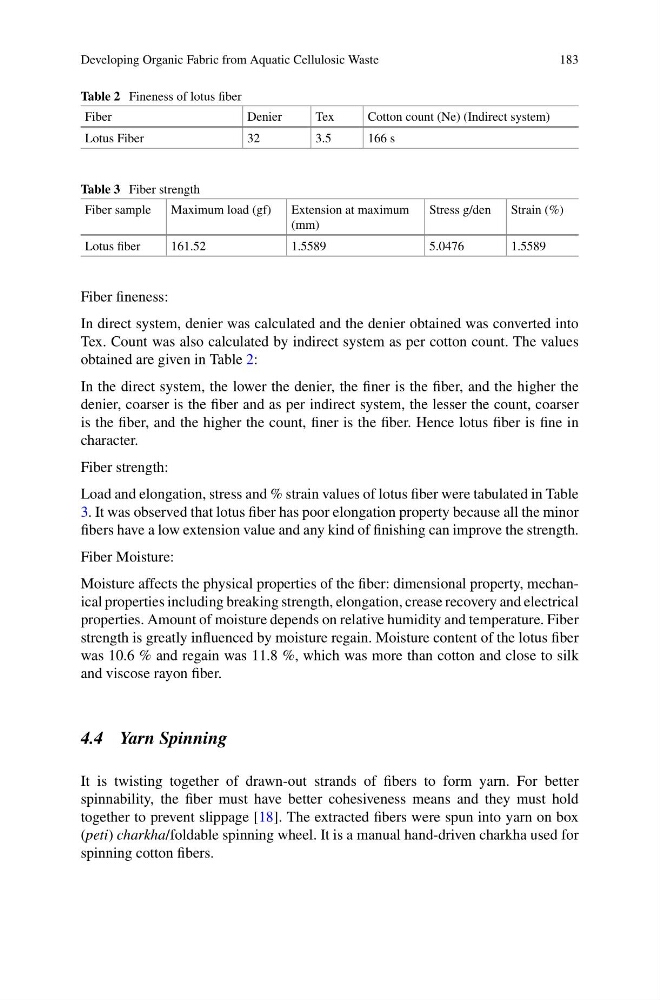
In direct system, denier was calculated and the denier obtained was converted into
Tex. Count was also calculated by indirect system as per cotton count. The values
obtained are given in Table 2:
In the direct system, the lower the denier, the finer is the fiber, and the higher the
denier, coarser is the fiber and as per indirect system, the lesser the count, coarser
is the fiber, and the higher the count, finer is the fiber. Hence lotus fiber is fine in
character.
Fiber strength:
Load and elongation, stress and % strain values of lotus fiber were tabulated in Table
3. It was observed that lotus fiber has poor elongation property because all the minor
fibers have a low extension value and any kind of finishing can improve the strength.
Fiber Moisture:
Moisture affects the physical properties of the fiber: dimensional property, mechanical properties including breaking strength, elongation, crease recovery and electrical
properties. Amount of moisture depends on relative humidity and temperature. Fiber
strength is greatly influenced by moisture regain. Moisture content of the lotus fiber
was 10.6 % and regain was 11.8 %, which was more than cotton and close to silk
and viscose rayon fiber.
4.4 Yarn Spinning
It is twisting together of drawn-out strands of fibers to form yarn. For better
spinnability, the fiber must have better cohesiveness means and they must hold
together to prevent slippage [18]. The extracted fibers were spun into yarn on box
(peti) charkha/foldable spinning wheel. It is a manual hand-driven charkha used for
spinning cotton fibers.
183
Table 2 Fineness of lotus fiber
Fiber
Denier
Tex
Cotton count (Ne) (Indirect system)
Lotus Fiber
32
3.5
166 s
Table 3 Fiber strength
Fiber sample
Maximum load (gf)
Extension at maximum
(mm)
Stress g/den
Strain (%)
Lotus fiber
161.52
1.5589
5.0476
1.5589
Fiber fineness:
In direct system, denier was calculated and the denier obtained was converted into
Tex. Count was also calculated by indirect system as per cotton count. The values
obtained are given in Table 2:
In the direct system, the lower the denier, the finer is the fiber, and the higher the
denier, coarser is the fiber and as per indirect system, the lesser the count, coarser
is the fiber, and the higher the count, finer is the fiber. Hence lotus fiber is fine in
character.
Fiber strength:
Load and elongation, stress and % strain values of lotus fiber were tabulated in Table
3. It was observed that lotus fiber has poor elongation property because all the minor
fibers have a low extension value and any kind of finishing can improve the strength.
Fiber Moisture:
Moisture affects the physical properties of the fiber: dimensional property, mechanical properties including breaking strength, elongation, crease recovery and electrical
properties. Amount of moisture depends on relative humidity and temperature. Fiber
strength is greatly influenced by moisture regain. Moisture content of the lotus fiber
was 10.6 % and regain was 11.8 %, which was more than cotton and close to silk
and viscose rayon fiber.
4.4 Yarn Spinning
It is twisting together of drawn-out strands of fibers to form yarn. For better
spinnability, the fiber must have better cohesiveness means and they must hold
together to prevent slippage [18]. The extracted fibers were spun into yarn on box
(peti) charkha/foldable spinning wheel. It is a manual hand-driven charkha used for
spinning cotton fibers.