

Development of Ecofriendly Multifunctional Textiles …
157
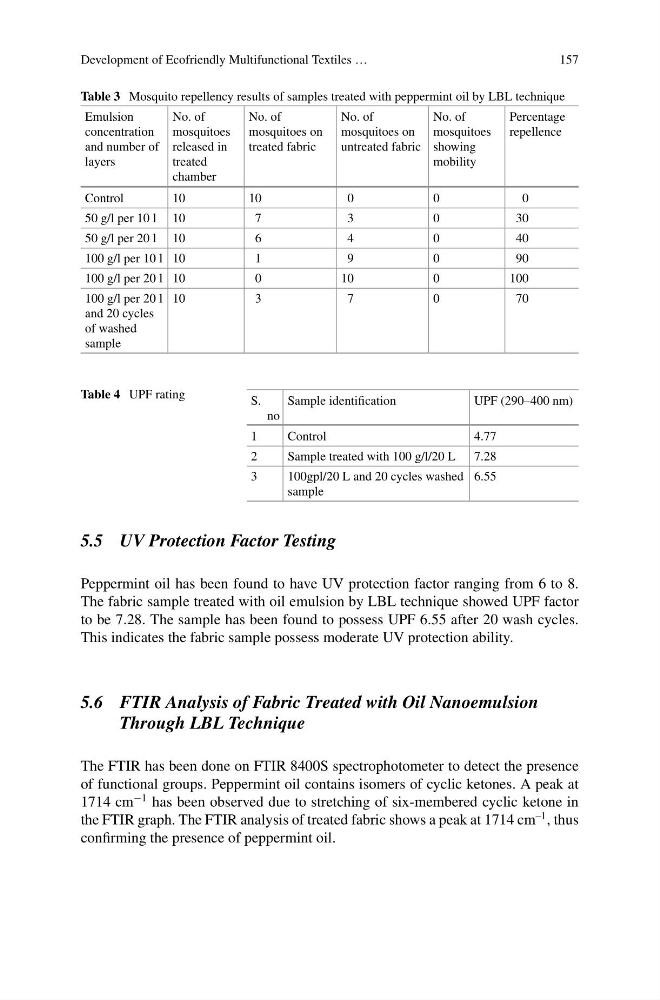
Table 3 Mosquito repellency results of samples treated with peppermint oil by LBL technique
Emulsion
concentration
and number of
layers
No. of
mosquitoes
released in
treated
chamber
No. of
mosquitoes on
treated fabric
No. of
mosquitoes on
untreated fabric
No. of
mosquitoes
showing
mobility
Percentage
repellence
Control
10
10
0
0
0
50 g/l per 10 l 10
7
3
0
30
50 g/l per 20 l 10
6
4
0
40
100 g/l per 10 l 10
1
9
0
90
100 g/l per 20 l 10
0
10
0
100
100 g/l per 20 l
and 20 cycles
of washed
sample
10
3
7
0
70
Table 4 UPF rating
S.
no
Sample identification
UPF (290–400 nm)
1
Control
4.77
2
Sample treated with 100 g/l/20 L 7.28
3
100gpl/20 L and 20 cycles washed
sample
6.55
5.5 UV Protection Factor Testing
Peppermint oil has been found to have UV protection factor ranging from 6 to 8.
The fabric sample treated with oil emulsion by LBL technique showed UPF factor
to be 7.28. The sample has been found to possess UPF 6.55 after 20 wash cycles.
This indicates the fabric sample possess moderate UV protection ability.
5.6 FTIR Analysis of Fabric Treated with Oil Nanoemulsion
Through LBL Technique
The FTIR has been done on FTIR 8400S spectrophotometer to detect the presence
of functional groups. Peppermint oil contains isomers of cyclic ketones. A peak at
1714 cm
−1 has been observed due to stretching of six-membered cyclic ketone in
the FTIR graph. The FTIR analysis of treated fabric shows a peak at 1714 cm
–1 , thus
confirming the presence of peppermint oil.
157
Table 3 Mosquito repellency results of samples treated with peppermint oil by LBL technique
Emulsion
concentration
and number of
layers
No. of
mosquitoes
released in
treated
chamber
No. of
mosquitoes on
treated fabric
No. of
mosquitoes on
untreated fabric
No. of
mosquitoes
showing
mobility
Percentage
repellence
Control
10
10
0
0
0
50 g/l per 10 l 10
7
3
0
30
50 g/l per 20 l 10
6
4
0
40
100 g/l per 10 l 10
1
9
0
90
100 g/l per 20 l 10
0
10
0
100
100 g/l per 20 l
and 20 cycles
of washed
sample
10
3
7
0
70
Table 4 UPF rating
S.
no
Sample identification
UPF (290–400 nm)
1
Control
4.77
2
Sample treated with 100 g/l/20 L 7.28
3
100gpl/20 L and 20 cycles washed
sample
6.55
5.5 UV Protection Factor Testing
Peppermint oil has been found to have UV protection factor ranging from 6 to 8.
The fabric sample treated with oil emulsion by LBL technique showed UPF factor
to be 7.28. The sample has been found to possess UPF 6.55 after 20 wash cycles.
This indicates the fabric sample possess moderate UV protection ability.
5.6 FTIR Analysis of Fabric Treated with Oil Nanoemulsion
Through LBL Technique
The FTIR has been done on FTIR 8400S spectrophotometer to detect the presence
of functional groups. Peppermint oil contains isomers of cyclic ketones. A peak at
1714 cm
−1 has been observed due to stretching of six-membered cyclic ketone in
the FTIR graph. The FTIR analysis of treated fabric shows a peak at 1714 cm
–1 , thus
confirming the presence of peppermint oil.