

154
P. Wankhade et al.
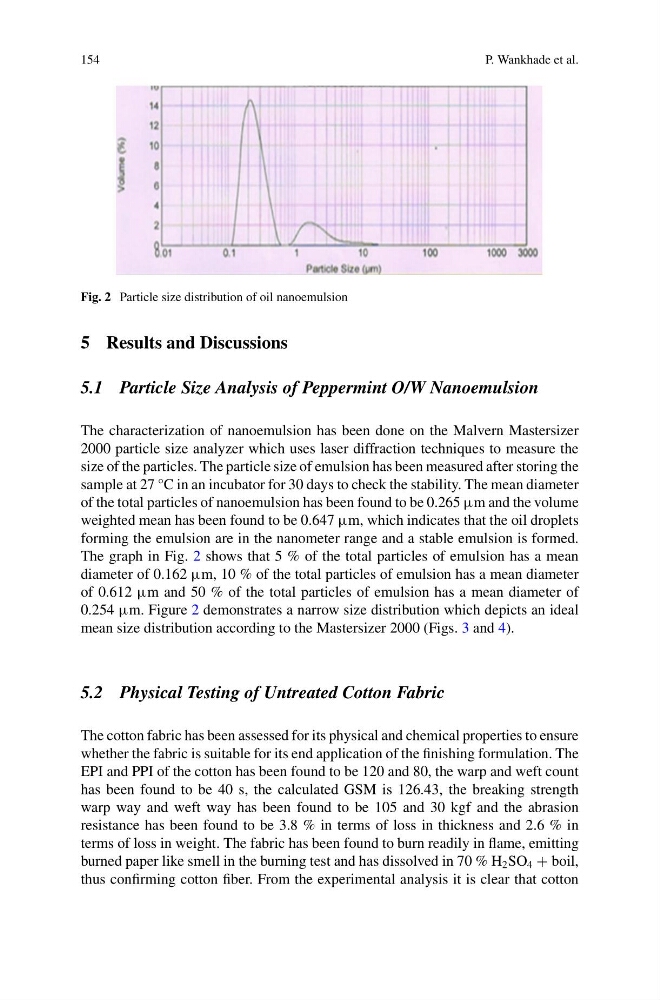
Fig. 2 Particle size distribution of oil nanoemulsion
5 Results and Discussions
5.1 Particle Size Analysis of Peppermint O/W Nanoemulsion
The characterization of nanoemulsion has been done on the Malvern Mastersizer
2000 particle size analyzer which uses laser diffraction techniques to measure the
size of the particles. The particle size of emulsion has been measured after storing the
sample at 27 °C in an incubator for 30 days to check the stability. The mean diameter
of the total particles of nanoemulsion has been found to be 0.265 µm and the volume
weighted mean has been found to be 0.647 µm, which indicates that the oil droplets
forming the emulsion are in the nanometer range and a stable emulsion is formed.
The graph in Fig. 2 shows that 5 % of the total particles of emulsion has a mean
diameter of 0.162 µm, 10 % of the total particles of emulsion has a mean diameter
of 0.612 µm and 50 % of the total particles of emulsion has a mean diameter of
0.254 µm. Figure 2 demonstrates a narrow size distribution which depicts an ideal
mean size distribution according to the Mastersizer 2000 (Figs. 3 and 4).
5.2 Physical Testing of Untreated Cotton Fabric
The cotton fabric has been assessed for its physical and chemical properties to ensure
whether the fabric is suitable for its end application of the finishing formulation. The
EPI and PPI of the cotton has been found to be 120 and 80, the warp and weft count
has been found to be 40 s, the calculated GSM is 126.43, the breaking strength
warp way and weft way has been found to be 105 and 30 kgf and the abrasion
resistance has been found to be 3.8 % in terms of loss in thickness and 2.6 % in
terms of loss in weight. The fabric has been found to burn readily in flame, emitting
burned paper like smell in the burning test and has dissolved in 70 % H 2 SO 4 + boil,
thus confirming cotton fiber. From the experimental analysis it is clear that cotton
P. Wankhade et al.
Fig. 2 Particle size distribution of oil nanoemulsion
5 Results and Discussions
5.1 Particle Size Analysis of Peppermint O/W Nanoemulsion
The characterization of nanoemulsion has been done on the Malvern Mastersizer
2000 particle size analyzer which uses laser diffraction techniques to measure the
size of the particles. The particle size of emulsion has been measured after storing the
sample at 27 °C in an incubator for 30 days to check the stability. The mean diameter
of the total particles of nanoemulsion has been found to be 0.265 µm and the volume
weighted mean has been found to be 0.647 µm, which indicates that the oil droplets
forming the emulsion are in the nanometer range and a stable emulsion is formed.
The graph in Fig. 2 shows that 5 % of the total particles of emulsion has a mean
diameter of 0.162 µm, 10 % of the total particles of emulsion has a mean diameter
of 0.612 µm and 50 % of the total particles of emulsion has a mean diameter of
0.254 µm. Figure 2 demonstrates a narrow size distribution which depicts an ideal
mean size distribution according to the Mastersizer 2000 (Figs. 3 and 4).
5.2 Physical Testing of Untreated Cotton Fabric
The cotton fabric has been assessed for its physical and chemical properties to ensure
whether the fabric is suitable for its end application of the finishing formulation. The
EPI and PPI of the cotton has been found to be 120 and 80, the warp and weft count
has been found to be 40 s, the calculated GSM is 126.43, the breaking strength
warp way and weft way has been found to be 105 and 30 kgf and the abrasion
resistance has been found to be 3.8 % in terms of loss in thickness and 2.6 % in
terms of loss in weight. The fabric has been found to burn readily in flame, emitting
burned paper like smell in the burning test and has dissolved in 70 % H 2 SO 4 + boil,
thus confirming cotton fiber. From the experimental analysis it is clear that cotton