

Development of Ecofriendly Multifunctional Textiles …
153
Step 1
Step 2
Step 3
Step 4
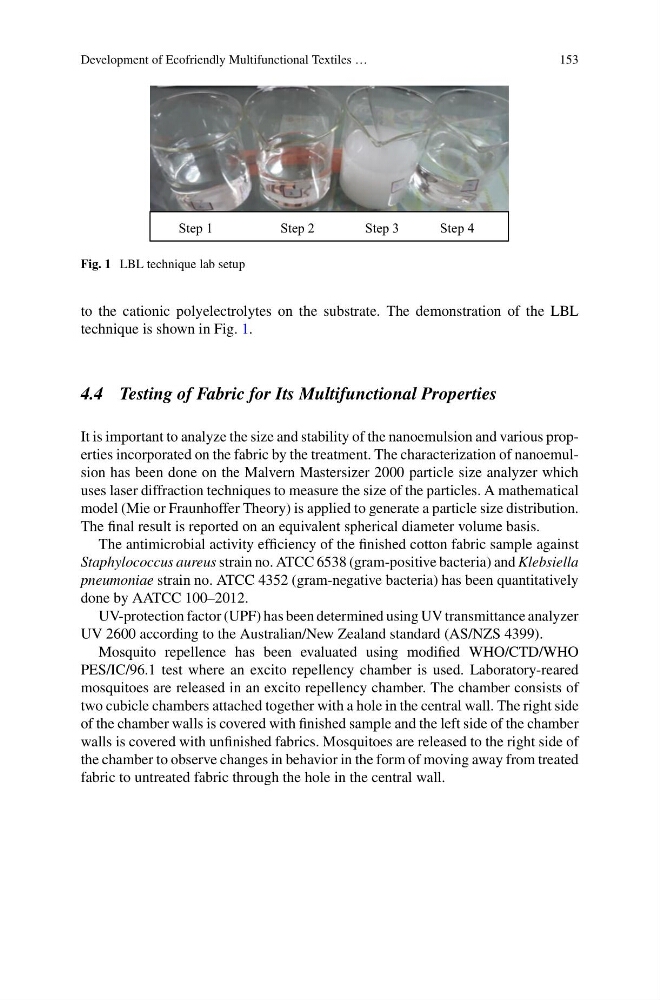
Fig. 1 LBL technique lab setup
to the cationic polyelectrolytes on the substrate. The demonstration of the LBL
technique is shown in Fig. 1.
4.4 Testing of Fabric for Its Multifunctional Properties
It is important to analyze the size and stability of the nanoemulsion and various properties incorporated on the fabric by the treatment. The characterization of nanoemulsion has been done on the Malvern Mastersizer 2000 particle size analyzer which
uses laser diffraction techniques to measure the size of the particles. A mathematical
model (Mie or Fraunhoffer Theory) is applied to generate a particle size distribution.
The final result is reported on an equivalent spherical diameter volume basis.
The antimicrobial activity efficiency of the finished cotton fabric sample against
Staphylococcus aureus strain no. ATCC 6538 (gram-positive bacteria) and Klebsiella
pneumoniae strain no. ATCC 4352 (gram-negative bacteria) has been quantitatively
done by AATCC 100–2012.
UV-protection factor (UPF) has been determined using UV transmittance analyzer
UV 2600 according to the Australian/New Zealand standard (AS/NZS 4399).
Mosquito repellence has been evaluated using modified WHO/CTD/WHO
PES/IC/96.1 test where an excito repellency chamber is used. Laboratory-reared
mosquitoes are released in an excito repellency chamber. The chamber consists of
two cubicle chambers attached together with a hole in the central wall. The right side
of the chamber walls is covered with finished sample and the left side of the chamber
walls is covered with unfinished fabrics. Mosquitoes are released to the right side of
the chamber to observe changes in behavior in the form of moving away from treated
fabric to untreated fabric through the hole in the central wall.
153
Step 1
Step 2
Step 3
Step 4
Fig. 1 LBL technique lab setup
to the cationic polyelectrolytes on the substrate. The demonstration of the LBL
technique is shown in Fig. 1.
4.4 Testing of Fabric for Its Multifunctional Properties
It is important to analyze the size and stability of the nanoemulsion and various properties incorporated on the fabric by the treatment. The characterization of nanoemulsion has been done on the Malvern Mastersizer 2000 particle size analyzer which
uses laser diffraction techniques to measure the size of the particles. A mathematical
model (Mie or Fraunhoffer Theory) is applied to generate a particle size distribution.
The final result is reported on an equivalent spherical diameter volume basis.
The antimicrobial activity efficiency of the finished cotton fabric sample against
Staphylococcus aureus strain no. ATCC 6538 (gram-positive bacteria) and Klebsiella
pneumoniae strain no. ATCC 4352 (gram-negative bacteria) has been quantitatively
done by AATCC 100–2012.
UV-protection factor (UPF) has been determined using UV transmittance analyzer
UV 2600 according to the Australian/New Zealand standard (AS/NZS 4399).
Mosquito repellence has been evaluated using modified WHO/CTD/WHO
PES/IC/96.1 test where an excito repellency chamber is used. Laboratory-reared
mosquitoes are released in an excito repellency chamber. The chamber consists of
two cubicle chambers attached together with a hole in the central wall. The right side
of the chamber walls is covered with finished sample and the left side of the chamber
walls is covered with unfinished fabrics. Mosquitoes are released to the right side of
the chamber to observe changes in behavior in the form of moving away from treated
fabric to untreated fabric through the hole in the central wall.