

Application of Protective Finishes on Denim and Analysis …
137
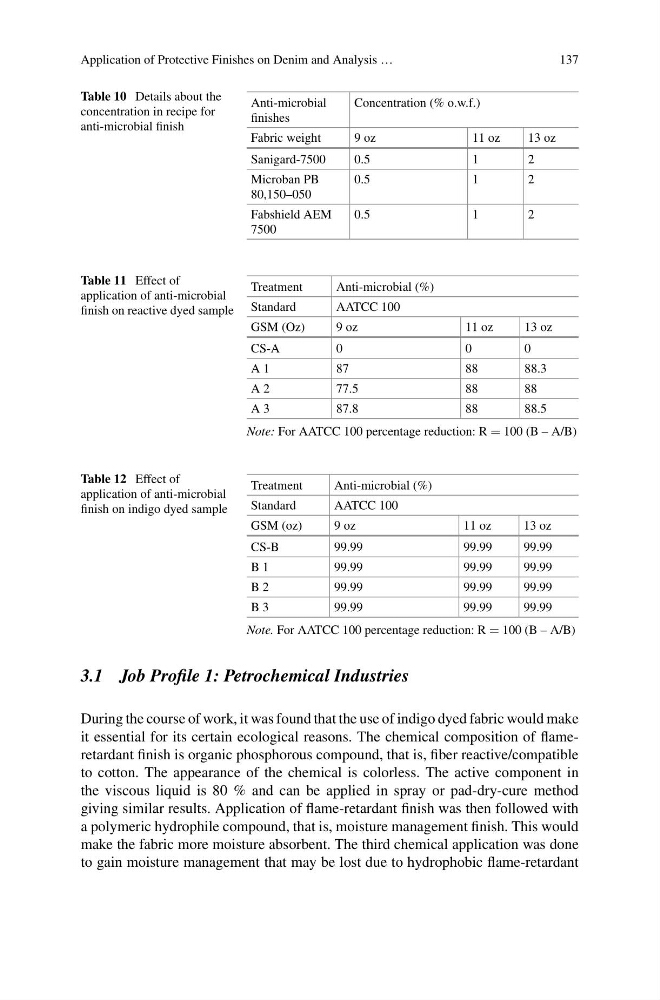
Table 10 Details about the
concentration in recipe for
anti-microbial finish
Anti-microbial
finishes
Concentration (% o.w.f.)
Fabric weight
9 oz
11 oz
13 oz
Sanigard-7500
0.5
1
2
Microban PB
80,150–050
0.5
1
2
Fabshield AEM
7500
0.5
1
2
Table 11 Effect of
application of anti-microbial
finish on reactive dyed sample
Treatment
Anti-microbial (%)
Standard
AATCC 100
GSM (Oz)
9 oz
11 oz
13 oz
CS-A
0
0
0
A 1
87
88
88.3
A 2
77.5
88
88
A 3
87.8
88
88.5
Note: For AATCC 100 percentage reduction: R = 100 (B – A/B)
Table 12 Effect of
application of anti-microbial
finish on indigo dyed sample
Treatment
Anti-microbial (%)
Standard
AATCC 100
GSM (oz)
9 oz
11 oz
13 oz
CS-B
99.99
99.99
99.99
B 1
99.99
99.99
99.99
B 2
99.99
99.99
99.99
B 3
99.99
99.99
99.99
Note. For AATCC 100 percentage reduction: R = 100 (B – A/B)
3.1 Job Profile 1: Petrochemical Industries
During the course of work, it was found that the use of indigo dyed fabric would make
it essential for its certain ecological reasons. The chemical composition of flameretardant finish is organic phosphorous compound, that is, fiber reactive/compatible
to cotton. The appearance of the chemical is colorless. The active component in
the viscous liquid is 80 % and can be applied in spray or pad-dry-cure method
giving similar results. Application of flame-retardant finish was then followed with
a polymeric hydrophile compound, that is, moisture management finish. This would
make the fabric more moisture absorbent. The third chemical application was done
to gain moisture management that may be lost due to hydrophobic flame-retardant
137
Table 10 Details about the
concentration in recipe for
anti-microbial finish
Anti-microbial
finishes
Concentration (% o.w.f.)
Fabric weight
9 oz
11 oz
13 oz
Sanigard-7500
0.5
1
2
Microban PB
80,150–050
0.5
1
2
Fabshield AEM
7500
0.5
1
2
Table 11 Effect of
application of anti-microbial
finish on reactive dyed sample
Treatment
Anti-microbial (%)
Standard
AATCC 100
GSM (Oz)
9 oz
11 oz
13 oz
CS-A
0
0
0
A 1
87
88
88.3
A 2
77.5
88
88
A 3
87.8
88
88.5
Note: For AATCC 100 percentage reduction: R = 100 (B – A/B)
Table 12 Effect of
application of anti-microbial
finish on indigo dyed sample
Treatment
Anti-microbial (%)
Standard
AATCC 100
GSM (oz)
9 oz
11 oz
13 oz
CS-B
99.99
99.99
99.99
B 1
99.99
99.99
99.99
B 2
99.99
99.99
99.99
B 3
99.99
99.99
99.99
Note. For AATCC 100 percentage reduction: R = 100 (B – A/B)
3.1 Job Profile 1: Petrochemical Industries
During the course of work, it was found that the use of indigo dyed fabric would make
it essential for its certain ecological reasons. The chemical composition of flameretardant finish is organic phosphorous compound, that is, fiber reactive/compatible
to cotton. The appearance of the chemical is colorless. The active component in
the viscous liquid is 80 % and can be applied in spray or pad-dry-cure method
giving similar results. Application of flame-retardant finish was then followed with
a polymeric hydrophile compound, that is, moisture management finish. This would
make the fabric more moisture absorbent. The third chemical application was done
to gain moisture management that may be lost due to hydrophobic flame-retardant