

120
A. K. Samanta et al.
of ammonium sulfamate and urea combination with the pre-fixed amount of MgCl 2
catalyst and pre-fixed dosages of acrylic binder and PE-softener as an additive for
formulation 4, as discussed above). The concentration of catalyst and additives such
as binder and softener has a little role in fire-retardancy performance and similarly
the process and curing conditions were kept constant as an increase of the time or
temperature causes yellowing and degradation of jute fabric as revealed from the
above preliminary study.
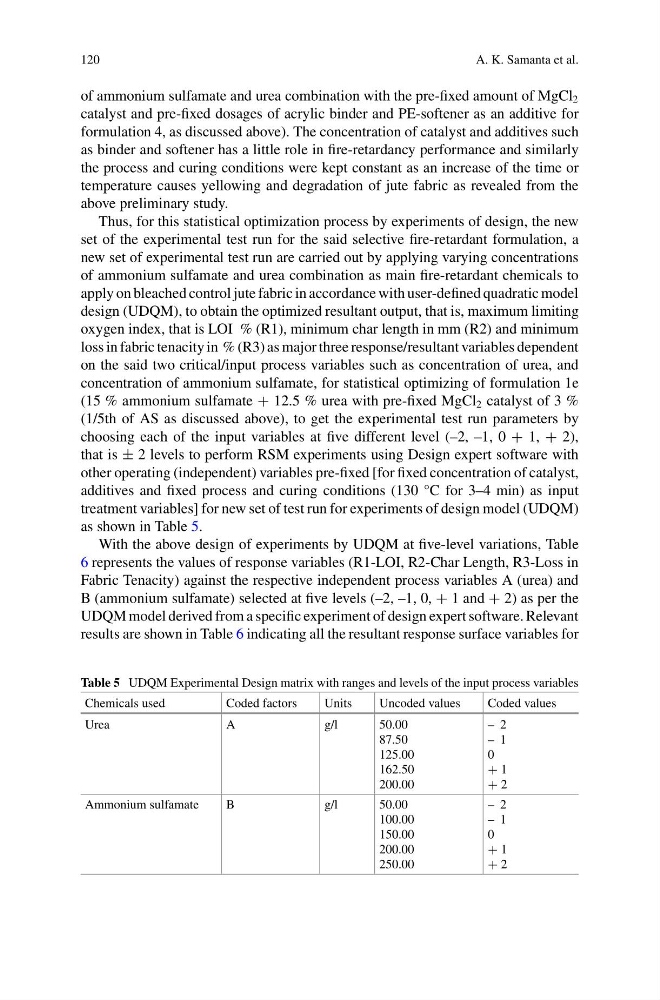
Thus, for this statistical optimization process by experiments of design, the new
set of the experimental test run for the said selective fire-retardant formulation, a
new set of experimental test run are carried out by applying varying concentrations
of ammonium sulfamate and urea combination as main fire-retardant chemicals to
apply on bleached control jute fabric in accordance with user-defined quadratic model
design (UDQM), to obtain the optimized resultant output, that is, maximum limiting
oxygen index, that is LOI % (R1), minimum char length in mm (R2) and minimum
loss in fabric tenacity in % (R3) as major three response/resultant variables dependent
on the said two critical/input process variables such as concentration of urea, and
concentration of ammonium sulfamate, for statistical optimizing of formulation 1e
(15 % ammonium sulfamate + 12.5 % urea with pre-fixed MgCl 2 catalyst of 3 %
(1/5th of AS as discussed above), to get the experimental test run parameters by
choosing each of the input variables at five different level (–2, –1, 0 + 1, + 2),
that is ± 2 levels to perform RSM experiments using Design expert software with
other operating (independent) variables pre-fixed [for fixed concentration of catalyst,
additives and fixed process and curing conditions (130 °C for 3–4 min) as input
treatment variables] for new set of test run for experiments of design model (UDQM)
as shown in Table 5.
With the above design of experiments by UDQM at five-level variations, Table
6 represents the values of response variables (R1-LOI, R2-Char Length, R3-Loss in
Fabric Tenacity) against the respective independent process variables A (urea) and
B (ammonium sulfamate) selected at five levels (–2, –1, 0, + 1 and + 2) as per the
UDQM model derived from a specific experiment of design expert software. Relevant
results are shown in Table 6 indicating all the resultant response surface variables for
Table 5 UDQM Experimental Design matrix with ranges and levels of the input process variables
Chemicals used
Coded factors
Units
Uncoded values
Coded values
Urea
A
g/l
50.00
87.50
125.00
162.50
200.00
– 2
– 1
0
+ 1
+ 2
Ammonium sulfamate
B
g/l
50.00
100.00
150.00
200.00
250.00
– 2
– 1
0
+ 1
+ 2
A. K. Samanta et al.
of ammonium sulfamate and urea combination with the pre-fixed amount of MgCl 2
catalyst and pre-fixed dosages of acrylic binder and PE-softener as an additive for
formulation 4, as discussed above). The concentration of catalyst and additives such
as binder and softener has a little role in fire-retardancy performance and similarly
the process and curing conditions were kept constant as an increase of the time or
temperature causes yellowing and degradation of jute fabric as revealed from the
above preliminary study.
Thus, for this statistical optimization process by experiments of design, the new
set of the experimental test run for the said selective fire-retardant formulation, a
new set of experimental test run are carried out by applying varying concentrations
of ammonium sulfamate and urea combination as main fire-retardant chemicals to
apply on bleached control jute fabric in accordance with user-defined quadratic model
design (UDQM), to obtain the optimized resultant output, that is, maximum limiting
oxygen index, that is LOI % (R1), minimum char length in mm (R2) and minimum
loss in fabric tenacity in % (R3) as major three response/resultant variables dependent
on the said two critical/input process variables such as concentration of urea, and
concentration of ammonium sulfamate, for statistical optimizing of formulation 1e
(15 % ammonium sulfamate + 12.5 % urea with pre-fixed MgCl 2 catalyst of 3 %
(1/5th of AS as discussed above), to get the experimental test run parameters by
choosing each of the input variables at five different level (–2, –1, 0 + 1, + 2),
that is ± 2 levels to perform RSM experiments using Design expert software with
other operating (independent) variables pre-fixed [for fixed concentration of catalyst,
additives and fixed process and curing conditions (130 °C for 3–4 min) as input
treatment variables] for new set of test run for experiments of design model (UDQM)
as shown in Table 5.
With the above design of experiments by UDQM at five-level variations, Table
6 represents the values of response variables (R1-LOI, R2-Char Length, R3-Loss in
Fabric Tenacity) against the respective independent process variables A (urea) and
B (ammonium sulfamate) selected at five levels (–2, –1, 0, + 1 and + 2) as per the
UDQM model derived from a specific experiment of design expert software. Relevant
results are shown in Table 6 indicating all the resultant response surface variables for
Table 5 UDQM Experimental Design matrix with ranges and levels of the input process variables
Chemicals used
Coded factors
Units
Uncoded values
Coded values
Urea
A
g/l
50.00
87.50
125.00
162.50
200.00
– 2
– 1
0
+ 1
+ 2
Ammonium sulfamate
B
g/l
50.00
100.00
150.00
200.00
250.00
– 2
– 1
0
+ 1
+ 2