

Statistical Optimization of Ammonium Sulfamate and Urea-Based Fire …
113
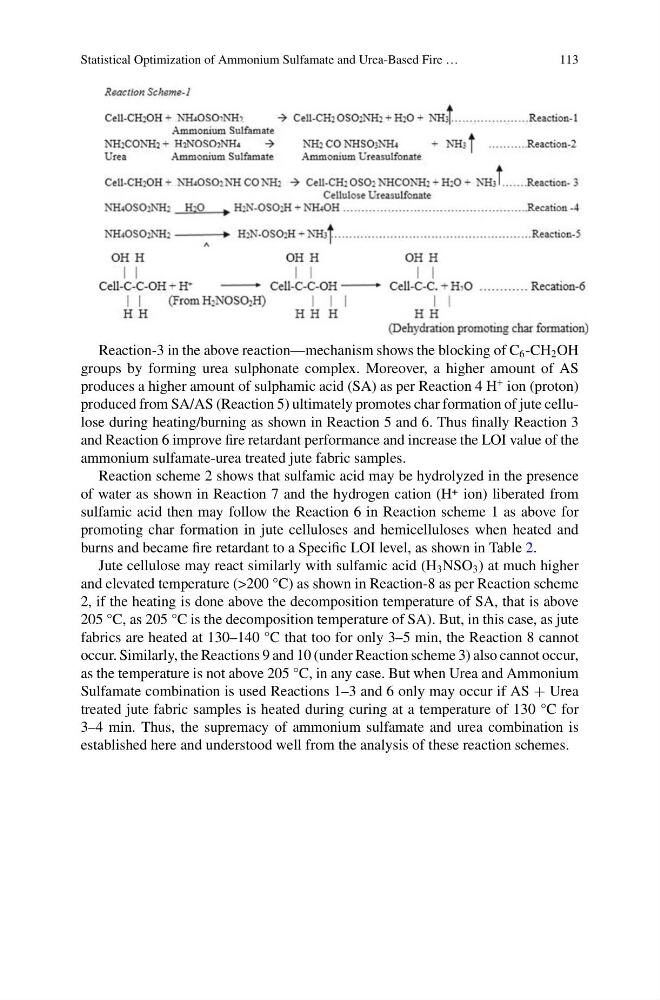
Reaction-3 in the above reaction—mechanism shows the blocking of C 6 -CH 2 OH
groups by forming urea sulphonate complex. Moreover, a higher amount of AS
produces a higher amount of sulphamic acid (SA) as per Reaction 4 H
+ ion (proton)
produced from SA/AS (Reaction 5) ultimately promotes char formation of jute cellulose during heating/burning as shown in Reaction 5 and 6. Thus finally Reaction 3
and Reaction 6 improve fire retardant performance and increase the LOI value of the
ammonium sulfamate-urea treated jute fabric samples.
Reaction scheme 2 shows that sulfamic acid may be hydrolyzed in the presence
of water as shown in Reaction 7 and the hydrogen cation (H + ion) liberated from
sulfamic acid then may follow the Reaction 6 in Reaction scheme 1 as above for
promoting char formation in jute celluloses and hemicelluloses when heated and
burns and became fire retardant to a Specific LOI level, as shown in Table 2.
Jute cellulose may react similarly with sulfamic acid (H 3 NSO 3 ) at much higher
and elevated temperature (>200 °C) as shown in Reaction-8 as per Reaction scheme
2, if the heating is done above the decomposition temperature of SA, that is above
205 °C, as 205 °C is the decomposition temperature of SA). But, in this case, as jute
fabrics are heated at 130–140 °C that too for only 3–5 min, the Reaction 8 cannot
occur. Similarly, the Reactions 9 and 10 (under Reaction scheme 3) also cannot occur,
as the temperature is not above 205 °C, in any case. But when Urea and Ammonium
Sulfamate combination is used Reactions 1–3 and 6 only may occur if AS + Urea
treated jute fabric samples is heated during curing at a temperature of 130 °C for
3–4 min. Thus, the supremacy of ammonium sulfamate and urea combination is
established here and understood well from the analysis of these reaction schemes.
113
Reaction-3 in the above reaction—mechanism shows the blocking of C 6 -CH 2 OH
groups by forming urea sulphonate complex. Moreover, a higher amount of AS
produces a higher amount of sulphamic acid (SA) as per Reaction 4 H
+ ion (proton)
produced from SA/AS (Reaction 5) ultimately promotes char formation of jute cellulose during heating/burning as shown in Reaction 5 and 6. Thus finally Reaction 3
and Reaction 6 improve fire retardant performance and increase the LOI value of the
ammonium sulfamate-urea treated jute fabric samples.
Reaction scheme 2 shows that sulfamic acid may be hydrolyzed in the presence
of water as shown in Reaction 7 and the hydrogen cation (H + ion) liberated from
sulfamic acid then may follow the Reaction 6 in Reaction scheme 1 as above for
promoting char formation in jute celluloses and hemicelluloses when heated and
burns and became fire retardant to a Specific LOI level, as shown in Table 2.
Jute cellulose may react similarly with sulfamic acid (H 3 NSO 3 ) at much higher
and elevated temperature (>200 °C) as shown in Reaction-8 as per Reaction scheme
2, if the heating is done above the decomposition temperature of SA, that is above
205 °C, as 205 °C is the decomposition temperature of SA). But, in this case, as jute
fabrics are heated at 130–140 °C that too for only 3–5 min, the Reaction 8 cannot
occur. Similarly, the Reactions 9 and 10 (under Reaction scheme 3) also cannot occur,
as the temperature is not above 205 °C, in any case. But when Urea and Ammonium
Sulfamate combination is used Reactions 1–3 and 6 only may occur if AS + Urea
treated jute fabric samples is heated during curing at a temperature of 130 °C for
3–4 min. Thus, the supremacy of ammonium sulfamate and urea combination is
established here and understood well from the analysis of these reaction schemes.