

Statistical Optimization of Ammonium Sulfamate and Urea-Based Fire …
105
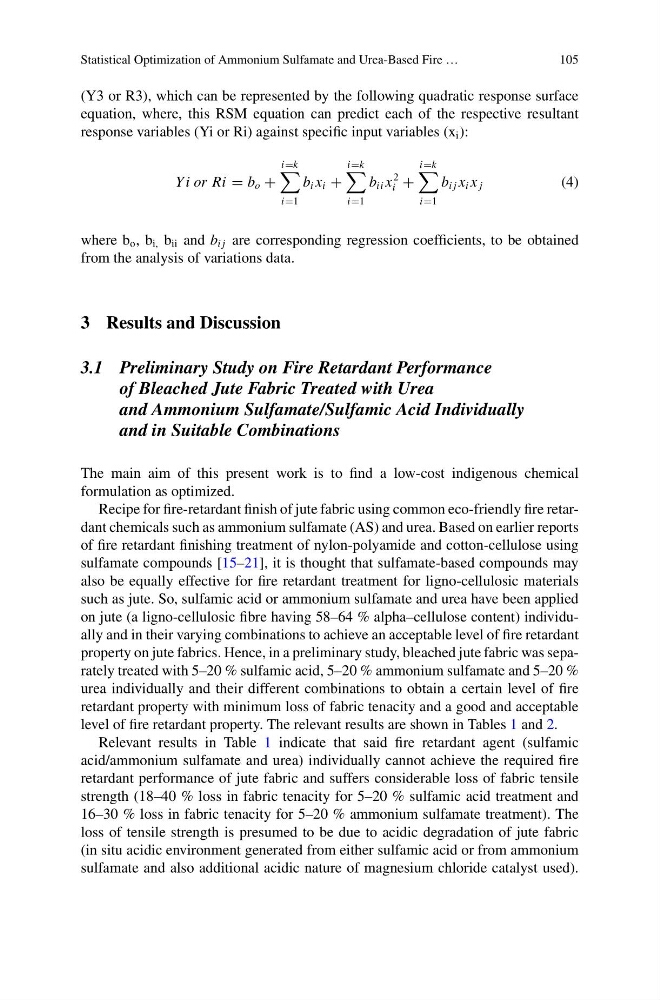
(Y3 or R3), which can be represented by the following quadratic response surface
equation, where, this RSM equation can predict each of the respective resultant
response variables (Yi or Ri) against specific input variables (x i ):
Y i or Ri = b o +
i=k
i=1
b i x i +
i=k
i=1
b ii x
2
i +
i=k
i=1
b i j x i x j
(4)
where b o , b i, b ii and b i j are corresponding regression coefficients, to be obtained
from the analysis of variations data.
3 Results and Discussion
3.1 Preliminary Study on Fire Retardant Performance
of Bleached Jute Fabric Treated with Urea
and Ammonium Sulfamate/Sulfamic Acid Individually
and in Suitable Combinations
The main aim of this present work is to find a low-cost indigenous chemical
formulation as optimized.
Recipe for fire-retardant finish of jute fabric using common eco-friendly fire retardant chemicals such as ammonium sulfamate (AS) and urea. Based on earlier reports
of fire retardant finishing treatment of nylon-polyamide and cotton-cellulose using
sulfamate compounds [15–21], it is thought that sulfamate-based compounds may
also be equally effective for fire retardant treatment for ligno-cellulosic materials
such as jute. So, sulfamic acid or ammonium sulfamate and urea have been applied
on jute (a ligno-cellulosic fibre having 58–64 % alpha–cellulose content) individually and in their varying combinations to achieve an acceptable level of fire retardant
property on jute fabrics. Hence, in a preliminary study, bleached jute fabric was separately treated with 5–20 % sulfamic acid, 5–20 % ammonium sulfamate and 5–20 %
urea individually and their different combinations to obtain a certain level of fire
retardant property with minimum loss of fabric tenacity and a good and acceptable
level of fire retardant property. The relevant results are shown in Tables 1 and 2.
Relevant results in Table 1 indicate that said fire retardant agent (sulfamic
acid/ammonium sulfamate and urea) individually cannot achieve the required fire
retardant performance of jute fabric and suffers considerable loss of fabric tensile
strength (18–40 % loss in fabric tenacity for 5–20 % sulfamic acid treatment and
16–30 % loss in fabric tenacity for 5–20 % ammonium sulfamate treatment). The
loss of tensile strength is presumed to be due to acidic degradation of jute fabric
(in situ acidic environment generated from either sulfamic acid or from ammonium
sulfamate and also additional acidic nature of magnesium chloride catalyst used).
105
(Y3 or R3), which can be represented by the following quadratic response surface
equation, where, this RSM equation can predict each of the respective resultant
response variables (Yi or Ri) against specific input variables (x i ):
Y i or Ri = b o +
i=k
i=1
b i x i +
i=k
i=1
b ii x
2
i +
i=k
i=1
b i j x i x j
(4)
where b o , b i, b ii and b i j are corresponding regression coefficients, to be obtained
from the analysis of variations data.
3 Results and Discussion
3.1 Preliminary Study on Fire Retardant Performance
of Bleached Jute Fabric Treated with Urea
and Ammonium Sulfamate/Sulfamic Acid Individually
and in Suitable Combinations
The main aim of this present work is to find a low-cost indigenous chemical
formulation as optimized.
Recipe for fire-retardant finish of jute fabric using common eco-friendly fire retardant chemicals such as ammonium sulfamate (AS) and urea. Based on earlier reports
of fire retardant finishing treatment of nylon-polyamide and cotton-cellulose using
sulfamate compounds [15–21], it is thought that sulfamate-based compounds may
also be equally effective for fire retardant treatment for ligno-cellulosic materials
such as jute. So, sulfamic acid or ammonium sulfamate and urea have been applied
on jute (a ligno-cellulosic fibre having 58–64 % alpha–cellulose content) individually and in their varying combinations to achieve an acceptable level of fire retardant
property on jute fabrics. Hence, in a preliminary study, bleached jute fabric was separately treated with 5–20 % sulfamic acid, 5–20 % ammonium sulfamate and 5–20 %
urea individually and their different combinations to obtain a certain level of fire
retardant property with minimum loss of fabric tenacity and a good and acceptable
level of fire retardant property. The relevant results are shown in Tables 1 and 2.
Relevant results in Table 1 indicate that said fire retardant agent (sulfamic
acid/ammonium sulfamate and urea) individually cannot achieve the required fire
retardant performance of jute fabric and suffers considerable loss of fabric tensile
strength (18–40 % loss in fabric tenacity for 5–20 % sulfamic acid treatment and
16–30 % loss in fabric tenacity for 5–20 % ammonium sulfamate treatment). The
loss of tensile strength is presumed to be due to acidic degradation of jute fabric
(in situ acidic environment generated from either sulfamic acid or from ammonium
sulfamate and also additional acidic nature of magnesium chloride catalyst used).