

Statistical Optimization of Ammonium Sulfamate and Urea-Based Fire …
103
tensile strength tester. Traverse speed was set at 100 mm/min using a pretension of
0.5 N. The gauge length of the jute fabric samples was 50 mm with the cut sample
dimension of 100 mm length × 20 mm width after raveled from two sides. Test
results reported was an average of 10 results for each case.
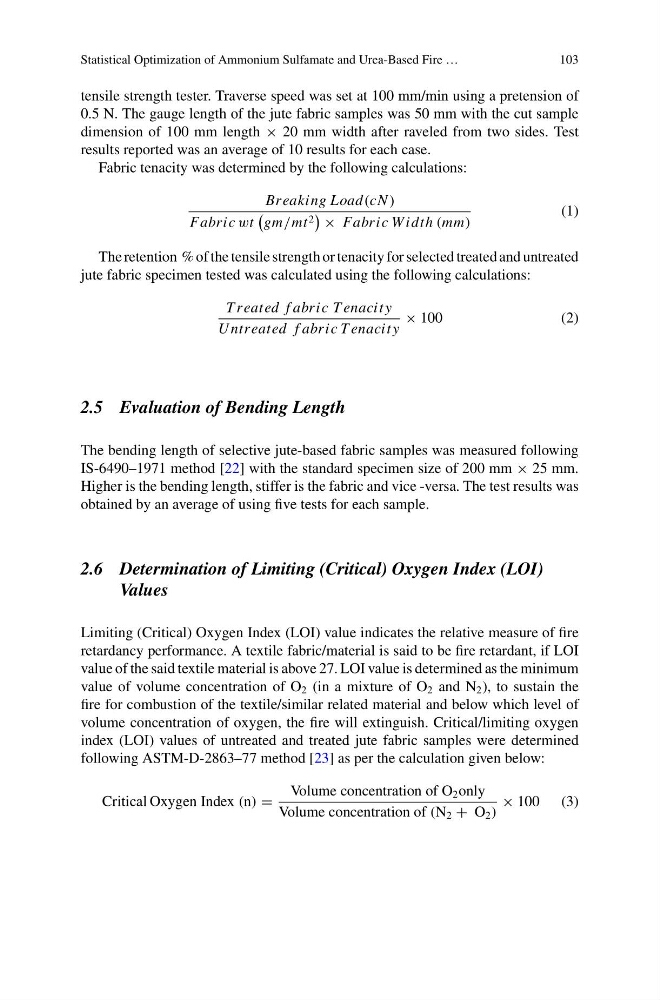
Fabric tenacity was determined by the following calculations:
Breaking Load(cN )
Fabric wt
gm/mt 2
× Fabric W idth (mm)
(1)
The retention % of the tensile strength or tenacity for selected treated and untreated
jute fabric specimen tested was calculated using the following calculations:
T reated f abric T enacit y
U ntreated f abric T enacit y
× 100
(2)
2.5 Evaluation of Bending Length
The bending length of selective jute-based fabric samples was measured following
IS-6490–1971 method [22] with the standard specimen size of 200 mm × 25 mm.
Higher is the bending length, stiffer is the fabric and vice -versa. The test results was
obtained by an average of using five tests for each sample.
2.6 Determination of Limiting (Critical) Oxygen Index (LOI)
Values
Limiting (Critical) Oxygen Index (LOI) value indicates the relative measure of fire
retardancy performance. A textile fabric/material is said to be fire retardant, if LOI
value of the said textile material is above 27. LOI value is determined as the minimum
value of volume concentration of O 2 (in a mixture of O 2 and N 2 ), to sustain the
fire for combustion of the textile/similar related material and below which level of
volume concentration of oxygen, the fire will extinguish. Critical/limiting oxygen
index (LOI) values of untreated and treated jute fabric samples were determined
following ASTM-D-2863–77 method [23] as per the calculation given below:
Critical Oxygen Index (n) =
Volume concentration of O 2 only
Volume concentration of (N 2 + O 2 )
× 100 (3)
103
tensile strength tester. Traverse speed was set at 100 mm/min using a pretension of
0.5 N. The gauge length of the jute fabric samples was 50 mm with the cut sample
dimension of 100 mm length × 20 mm width after raveled from two sides. Test
results reported was an average of 10 results for each case.
Fabric tenacity was determined by the following calculations:
Breaking Load(cN )
Fabric wt
gm/mt 2
× Fabric W idth (mm)
(1)
The retention % of the tensile strength or tenacity for selected treated and untreated
jute fabric specimen tested was calculated using the following calculations:
T reated f abric T enacit y
U ntreated f abric T enacit y
× 100
(2)
2.5 Evaluation of Bending Length
The bending length of selective jute-based fabric samples was measured following
IS-6490–1971 method [22] with the standard specimen size of 200 mm × 25 mm.
Higher is the bending length, stiffer is the fabric and vice -versa. The test results was
obtained by an average of using five tests for each sample.
2.6 Determination of Limiting (Critical) Oxygen Index (LOI)
Values
Limiting (Critical) Oxygen Index (LOI) value indicates the relative measure of fire
retardancy performance. A textile fabric/material is said to be fire retardant, if LOI
value of the said textile material is above 27. LOI value is determined as the minimum
value of volume concentration of O 2 (in a mixture of O 2 and N 2 ), to sustain the
fire for combustion of the textile/similar related material and below which level of
volume concentration of oxygen, the fire will extinguish. Critical/limiting oxygen
index (LOI) values of untreated and treated jute fabric samples were determined
following ASTM-D-2863–77 method [23] as per the calculation given below:
Critical Oxygen Index (n) =
Volume concentration of O 2 only
Volume concentration of (N 2 + O 2 )
× 100 (3)