

430
T. Sundararajan et al.
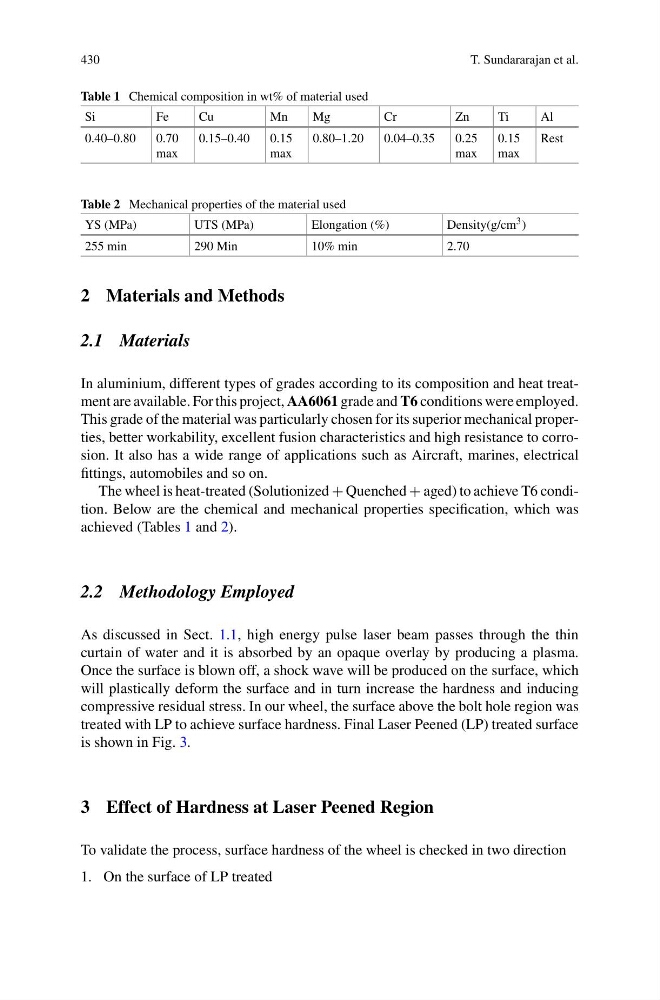
Table 1 Chemical composition in wt% of material used
Si
Fe
Cu
Mn
Mg
Cr
Zn
Ti
Al
0.40–0.80
0.70
max
0.15–0.40
0.15
max
0.80–1.20
0.04–0.35
0.25
max
0.15
max
Rest
Table 2 Mechanical properties of the material used
YS (MPa)
UTS (MPa)
Elongation (%)
Density(g/cm 3 )
255 min
290 Min
10% min
2.70
2 Materials and Methods
2.1 Materials
In aluminium, different types of grades according to its composition and heat treatment are available. For this project, AA6061 grade and T6 conditions were employed.
This grade of the material was particularly chosen for its superior mechanical properties, better workability, excellent fusion characteristics and high resistance to corrosion. It also has a wide range of applications such as Aircraft, marines, electrical
fittings, automobiles and so on.
The wheel is heat-treated (Solutionized + Quenched + aged) to achieve T6 condition. Below are the chemical and mechanical properties specification, which was
achieved (Tables 1 and 2).
2.2 Methodology Employed
As discussed in Sect. 1.1, high energy pulse laser beam passes through the thin
curtain of water and it is absorbed by an opaque overlay by producing a plasma.
Once the surface is blown off, a shock wave will be produced on the surface, which
will plastically deform the surface and in turn increase the hardness and inducing
compressive residual stress. In our wheel, the surface above the bolt hole region was
treated with LP to achieve surface hardness. Final Laser Peened (LP) treated surface
is shown in Fig. 3.
3 Effect of Hardness at Laser Peened Region
To validate the process, surface hardness of the wheel is checked in two direction
1. On the surface of LP treated
T. Sundararajan et al.
Table 1 Chemical composition in wt% of material used
Si
Fe
Cu
Mn
Mg
Cr
Zn
Ti
Al
0.40–0.80
0.70
max
0.15–0.40
0.15
max
0.80–1.20
0.04–0.35
0.25
max
0.15
max
Rest
Table 2 Mechanical properties of the material used
YS (MPa)
UTS (MPa)
Elongation (%)
Density(g/cm 3 )
255 min
290 Min
10% min
2.70
2 Materials and Methods
2.1 Materials
In aluminium, different types of grades according to its composition and heat treatment are available. For this project, AA6061 grade and T6 conditions were employed.
This grade of the material was particularly chosen for its superior mechanical properties, better workability, excellent fusion characteristics and high resistance to corrosion. It also has a wide range of applications such as Aircraft, marines, electrical
fittings, automobiles and so on.
The wheel is heat-treated (Solutionized + Quenched + aged) to achieve T6 condition. Below are the chemical and mechanical properties specification, which was
achieved (Tables 1 and 2).
2.2 Methodology Employed
As discussed in Sect. 1.1, high energy pulse laser beam passes through the thin
curtain of water and it is absorbed by an opaque overlay by producing a plasma.
Once the surface is blown off, a shock wave will be produced on the surface, which
will plastically deform the surface and in turn increase the hardness and inducing
compressive residual stress. In our wheel, the surface above the bolt hole region was
treated with LP to achieve surface hardness. Final Laser Peened (LP) treated surface
is shown in Fig. 3.
3 Effect of Hardness at Laser Peened Region
To validate the process, surface hardness of the wheel is checked in two direction
1. On the surface of LP treated