

394
J. Sundaram et al.
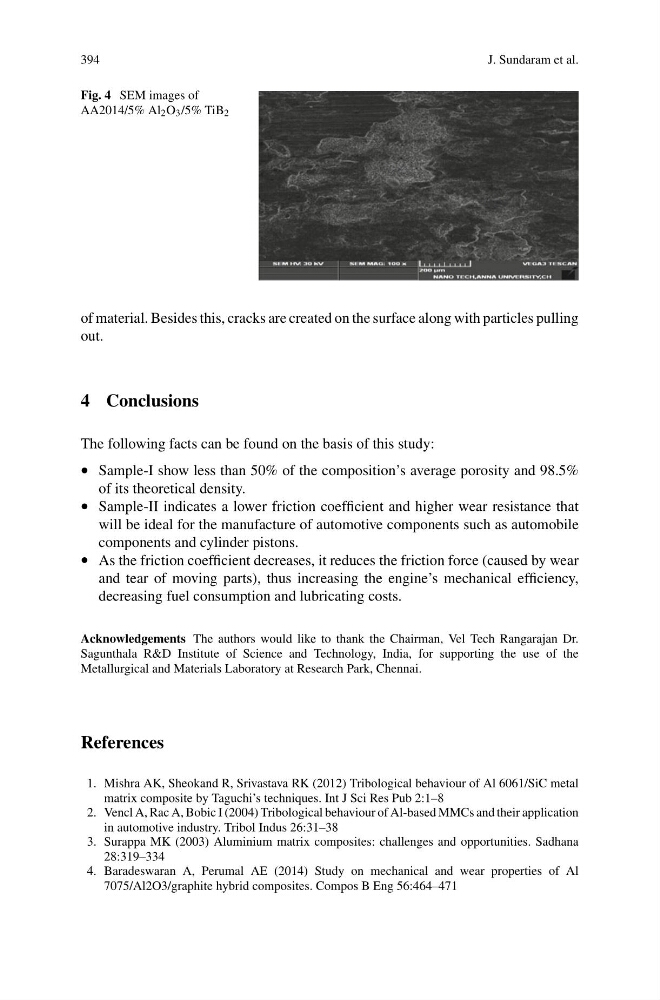
Fig. 4 SEM images of
AA2014/5% Al 2 O 3 /5% TiB 2
of material. Besides this, cracks are created on the surface along with particles pulling
out.
4 Conclusions
The following facts can be found on the basis of this study:
• Sample-I show less than 50% of the composition’s average porosity and 98.5%
of its theoretical density.
• Sample-II indicates a lower friction coefficient and higher wear resistance that
will be ideal for the manufacture of automotive components such as automobile
components and cylinder pistons.
• As the friction coefficient decreases, it reduces the friction force (caused by wear
and tear of moving parts), thus increasing the engine’s mechanical efficiency,
decreasing fuel consumption and lubricating costs.
Acknowledgements The authors would like to thank the Chairman, Vel Tech Rangarajan Dr.
Sagunthala R&D Institute of Science and Technology, India, for supporting the use of the
Metallurgical and Materials Laboratory at Research Park, Chennai.
References
1. Mishra AK, Sheokand R, Srivastava RK (2012) Tribological behaviour of Al 6061/SiC metal
matrix composite by Taguchi’s techniques. Int J Sci Res Pub 2:1–8
2. Vencl A, Rac A, Bobic I (2004) Tribological behaviour of Al-based MMCs and their application
in automotive industry. Tribol Indus 26:31–38
3. Surappa MK (2003) Aluminium matrix composites: challenges and opportunities. Sadhana
28:319–334
4. Baradeswaran A, Perumal AE (2014) Study on mechanical and wear properties of Al
7075/Al2O3/graphite hybrid composites. Compos B Eng 56:464–471
J. Sundaram et al.
Fig. 4 SEM images of
AA2014/5% Al 2 O 3 /5% TiB 2
of material. Besides this, cracks are created on the surface along with particles pulling
out.
4 Conclusions
The following facts can be found on the basis of this study:
• Sample-I show less than 50% of the composition’s average porosity and 98.5%
of its theoretical density.
• Sample-II indicates a lower friction coefficient and higher wear resistance that
will be ideal for the manufacture of automotive components such as automobile
components and cylinder pistons.
• As the friction coefficient decreases, it reduces the friction force (caused by wear
and tear of moving parts), thus increasing the engine’s mechanical efficiency,
decreasing fuel consumption and lubricating costs.
Acknowledgements The authors would like to thank the Chairman, Vel Tech Rangarajan Dr.
Sagunthala R&D Institute of Science and Technology, India, for supporting the use of the
Metallurgical and Materials Laboratory at Research Park, Chennai.
References
1. Mishra AK, Sheokand R, Srivastava RK (2012) Tribological behaviour of Al 6061/SiC metal
matrix composite by Taguchi’s techniques. Int J Sci Res Pub 2:1–8
2. Vencl A, Rac A, Bobic I (2004) Tribological behaviour of Al-based MMCs and their application
in automotive industry. Tribol Indus 26:31–38
3. Surappa MK (2003) Aluminium matrix composites: challenges and opportunities. Sadhana
28:319–334
4. Baradeswaran A, Perumal AE (2014) Study on mechanical and wear properties of Al
7075/Al2O3/graphite hybrid composites. Compos B Eng 56:464–471