

Wear Properties on AA2014/Al 2 O 3 /TiB 2 Hybrid Metal Matrix …
393
The wear rate depends upon the different factors like size of pin particle, applied
load, sliding velocity, sliding distance, surface hardness and fracture of toughness of
testing samples [6].
Canakci et al. reported using hard ceramic materials as reinforcement in metallic
matrix influence wear characteristics. Wear rate depreciated due to increase in volume
of hard phase and particle size. This is due to abrasive particles first protrude inside
the surface of specimen and slow move towards the surface which results continuous
grooves [10].
To calculate the wear loss, the pin-on-disc equipment was operated at a constant
sliding speed of 1.5 m/s and a constant sliding distance of 1000 m. Wear loss and
friction coefficient for AA2014, AA2014 + 5% Al 2 O 3 + 5% TiB 2 were calculated
for load of 20 N listed in Table 2.
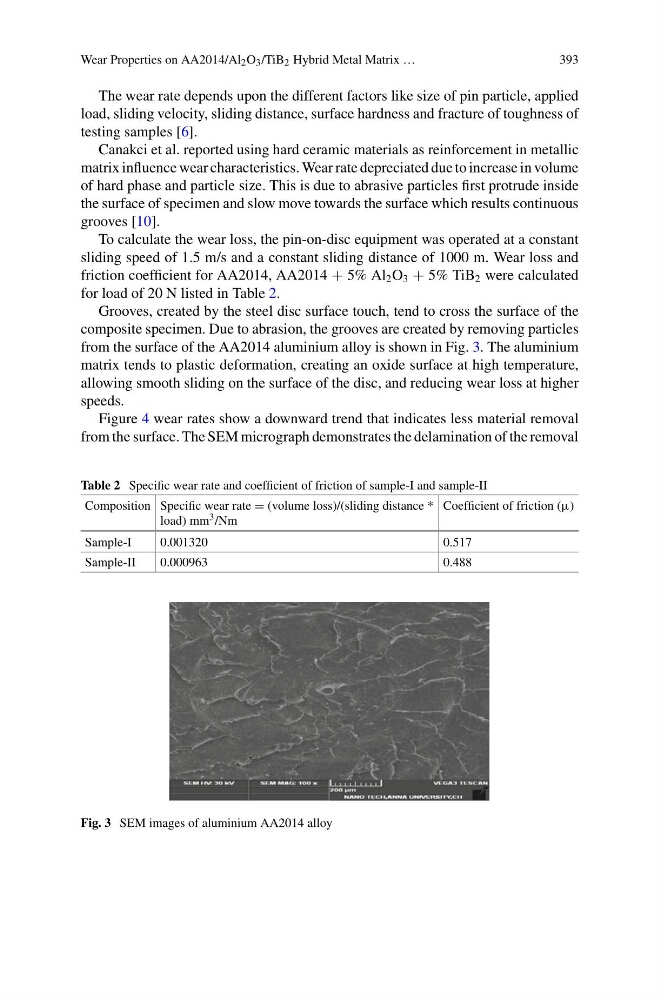
Grooves, created by the steel disc surface touch, tend to cross the surface of the
composite specimen. Due to abrasion, the grooves are created by removing particles
from the surface of the AA2014 aluminium alloy is shown in Fig. 3. The aluminium
matrix tends to plastic deformation, creating an oxide surface at high temperature,
allowing smooth sliding on the surface of the disc, and reducing wear loss at higher
speeds.
Figure 4 wear rates show a downward trend that indicates less material removal
from the surface. The SEM micrograph demonstrates the delamination of the removal
Table 2 Specific wear rate and coefficient of friction of sample-I and sample-II
Composition Specific wear rate = (volume loss)/(sliding distance *
load) mm 3 /Nm
Coefficient of friction (µ)
Sample-I
0.001320
0.517
Sample-II
0.000963
0.488
Fig. 3 SEM images of aluminium AA2014 alloy
393
The wear rate depends upon the different factors like size of pin particle, applied
load, sliding velocity, sliding distance, surface hardness and fracture of toughness of
testing samples [6].
Canakci et al. reported using hard ceramic materials as reinforcement in metallic
matrix influence wear characteristics. Wear rate depreciated due to increase in volume
of hard phase and particle size. This is due to abrasive particles first protrude inside
the surface of specimen and slow move towards the surface which results continuous
grooves [10].
To calculate the wear loss, the pin-on-disc equipment was operated at a constant
sliding speed of 1.5 m/s and a constant sliding distance of 1000 m. Wear loss and
friction coefficient for AA2014, AA2014 + 5% Al 2 O 3 + 5% TiB 2 were calculated
for load of 20 N listed in Table 2.
Grooves, created by the steel disc surface touch, tend to cross the surface of the
composite specimen. Due to abrasion, the grooves are created by removing particles
from the surface of the AA2014 aluminium alloy is shown in Fig. 3. The aluminium
matrix tends to plastic deformation, creating an oxide surface at high temperature,
allowing smooth sliding on the surface of the disc, and reducing wear loss at higher
speeds.
Figure 4 wear rates show a downward trend that indicates less material removal
from the surface. The SEM micrograph demonstrates the delamination of the removal
Table 2 Specific wear rate and coefficient of friction of sample-I and sample-II
Composition Specific wear rate = (volume loss)/(sliding distance *
load) mm 3 /Nm
Coefficient of friction (µ)
Sample-I
0.001320
0.517
Sample-II
0.000963
0.488
Fig. 3 SEM images of aluminium AA2014 alloy