

220
S. Gajjar et al.
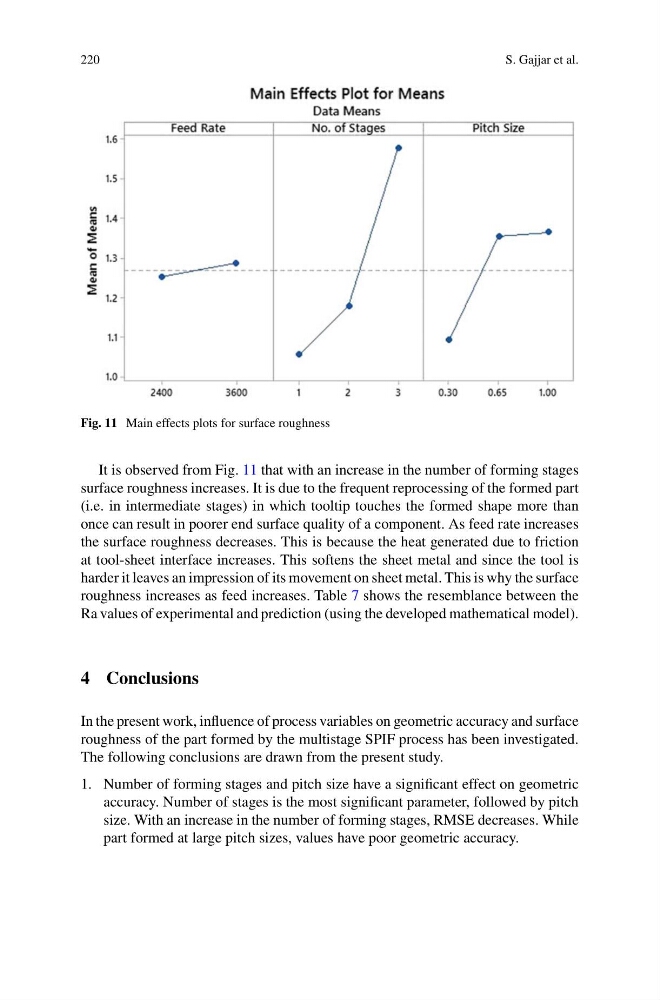
Fig. 11 Main effects plots for surface roughness
It is observed from Fig. 11 that with an increase in the number of forming stages
surface roughness increases. It is due to the frequent reprocessing of the formed part
(i.e. in intermediate stages) in which tooltip touches the formed shape more than
once can result in poorer end surface quality of a component. As feed rate increases
the surface roughness decreases. This is because the heat generated due to friction
at tool-sheet interface increases. This softens the sheet metal and since the tool is
harder it leaves an impression of its movement on sheet metal. This is why the surface
roughness increases as feed increases. Table 7 shows the resemblance between the
Ra values of experimental and prediction (using the developed mathematical model).
4 Conclusions
In the present work, influence of process variables on geometric accuracy and surface
roughness of the part formed by the multistage SPIF process has been investigated.
The following conclusions are drawn from the present study.
1. Number of forming stages and pitch size have a significant effect on geometric
accuracy. Number of stages is the most significant parameter, followed by pitch
size. With an increase in the number of forming stages, RMSE decreases. While
part formed at large pitch sizes, values have poor geometric accuracy.
S. Gajjar et al.
Fig. 11 Main effects plots for surface roughness
It is observed from Fig. 11 that with an increase in the number of forming stages
surface roughness increases. It is due to the frequent reprocessing of the formed part
(i.e. in intermediate stages) in which tooltip touches the formed shape more than
once can result in poorer end surface quality of a component. As feed rate increases
the surface roughness decreases. This is because the heat generated due to friction
at tool-sheet interface increases. This softens the sheet metal and since the tool is
harder it leaves an impression of its movement on sheet metal. This is why the surface
roughness increases as feed increases. Table 7 shows the resemblance between the
Ra values of experimental and prediction (using the developed mathematical model).
4 Conclusions
In the present work, influence of process variables on geometric accuracy and surface
roughness of the part formed by the multistage SPIF process has been investigated.
The following conclusions are drawn from the present study.
1. Number of forming stages and pitch size have a significant effect on geometric
accuracy. Number of stages is the most significant parameter, followed by pitch
size. With an increase in the number of forming stages, RMSE decreases. While
part formed at large pitch sizes, values have poor geometric accuracy.