

188
N. V. S. S. Sagar et al.
Table 5 Multistage Mass Optimization
Model
Frame mass (kg) von Mises stress
(MPa)
Max. principal
stress (MPa)
Total deformation
(mm)
Initial geometry
0.756
0.345
0.391
0.0217
Design optimized
model
0.460
0.807
0.923
0.0549
Topology
optimized model
0.434
0.809
1.127
0.0568
of 2 kg. It resulted in a geometry of least possible weight and capable of withstanding
the payload while satisfying all the loading and boundary conditions. Utilization of
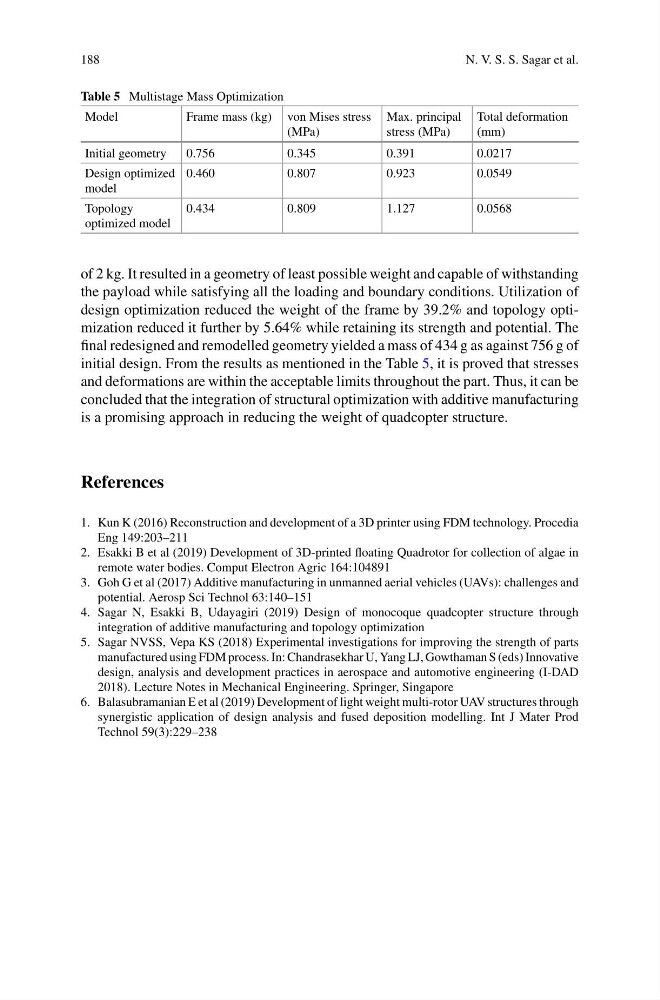
design optimization reduced the weight of the frame by 39.2% and topology optimization reduced it further by 5.64% while retaining its strength and potential. The
final redesigned and remodelled geometry yielded a mass of 434 g as against 756 g of
initial design. From the results as mentioned in the Table 5, it is proved that stresses
and deformations are within the acceptable limits throughout the part. Thus, it can be
concluded that the integration of structural optimization with additive manufacturing
is a promising approach in reducing the weight of quadcopter structure.
References
1. Kun K (2016) Reconstruction and development of a 3D printer using FDM technology. Procedia
Eng 149:203–211
2. Esakki B et al (2019) Development of 3D-printed floating Quadrotor for collection of algae in
remote water bodies. Comput Electron Agric 164:104891
3. Goh G et al (2017) Additive manufacturing in unmanned aerial vehicles (UAVs): challenges and
potential. Aerosp Sci Technol 63:140–151
4. Sagar N, Esakki B, Udayagiri (2019) Design of monocoque quadcopter structure through
integration of additive manufacturing and topology optimization
5. Sagar NVSS, Vepa KS (2018) Experimental investigations for improving the strength of parts
manufactured using FDM process. In: Chandrasekhar U, Yang LJ, Gowthaman S (eds) Innovative
design, analysis and development practices in aerospace and automotive engineering (I-DAD
2018). Lecture Notes in Mechanical Engineering. Springer, Singapore
6. Balasubramanian E et al (2019) Development of light weight multi-rotor UAV structures through
synergistic application of design analysis and fused deposition modelling. Int J Mater Prod
Technol 59(3):229–238
N. V. S. S. Sagar et al.
Table 5 Multistage Mass Optimization
Model
Frame mass (kg) von Mises stress
(MPa)
Max. principal
stress (MPa)
Total deformation
(mm)
Initial geometry
0.756
0.345
0.391
0.0217
Design optimized
model
0.460
0.807
0.923
0.0549
Topology
optimized model
0.434
0.809
1.127
0.0568
of 2 kg. It resulted in a geometry of least possible weight and capable of withstanding
the payload while satisfying all the loading and boundary conditions. Utilization of
design optimization reduced the weight of the frame by 39.2% and topology optimization reduced it further by 5.64% while retaining its strength and potential. The
final redesigned and remodelled geometry yielded a mass of 434 g as against 756 g of
initial design. From the results as mentioned in the Table 5, it is proved that stresses
and deformations are within the acceptable limits throughout the part. Thus, it can be
concluded that the integration of structural optimization with additive manufacturing
is a promising approach in reducing the weight of quadcopter structure.
References
1. Kun K (2016) Reconstruction and development of a 3D printer using FDM technology. Procedia
Eng 149:203–211
2. Esakki B et al (2019) Development of 3D-printed floating Quadrotor for collection of algae in
remote water bodies. Comput Electron Agric 164:104891
3. Goh G et al (2017) Additive manufacturing in unmanned aerial vehicles (UAVs): challenges and
potential. Aerosp Sci Technol 63:140–151
4. Sagar N, Esakki B, Udayagiri (2019) Design of monocoque quadcopter structure through
integration of additive manufacturing and topology optimization
5. Sagar NVSS, Vepa KS (2018) Experimental investigations for improving the strength of parts
manufactured using FDM process. In: Chandrasekhar U, Yang LJ, Gowthaman S (eds) Innovative
design, analysis and development practices in aerospace and automotive engineering (I-DAD
2018). Lecture Notes in Mechanical Engineering. Springer, Singapore
6. Balasubramanian E et al (2019) Development of light weight multi-rotor UAV structures through
synergistic application of design analysis and fused deposition modelling. Int J Mater Prod
Technol 59(3):229–238