

Multistage Mass Optimization of a Quadcopter Frame
187
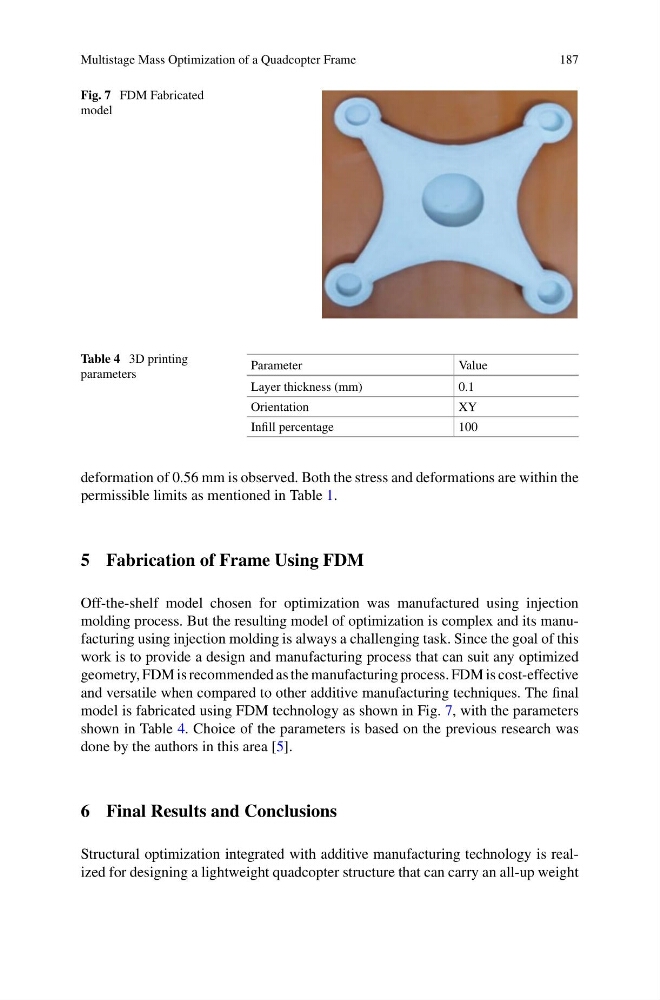
Fig. 7 FDM Fabricated
model
Table 4 3D printing
parameters
Parameter
Value
Layer thickness (mm)
0.1
Orientation
XY
Infill percentage
100
deformation of 0.56 mm is observed. Both the stress and deformations are within the
permissible limits as mentioned in Table 1.
5 Fabrication of Frame Using FDM
Off-the-shelf model chosen for optimization was manufactured using injection
molding process. But the resulting model of optimization is complex and its manufacturing using injection molding is always a challenging task. Since the goal of this
work is to provide a design and manufacturing process that can suit any optimized
geometry, FDM is recommended as the manufacturing process. FDM is cost-effective
and versatile when compared to other additive manufacturing techniques. The final
model is fabricated using FDM technology as shown in Fig. 7, with the parameters
shown in Table 4. Choice of the parameters is based on the previous research was
done by the authors in this area [5].
6 Final Results and Conclusions
Structural optimization integrated with additive manufacturing technology is realized for designing a lightweight quadcopter structure that can carry an all-up weight
187
Fig. 7 FDM Fabricated
model
Table 4 3D printing
parameters
Parameter
Value
Layer thickness (mm)
0.1
Orientation
XY
Infill percentage
100
deformation of 0.56 mm is observed. Both the stress and deformations are within the
permissible limits as mentioned in Table 1.
5 Fabrication of Frame Using FDM
Off-the-shelf model chosen for optimization was manufactured using injection
molding process. But the resulting model of optimization is complex and its manufacturing using injection molding is always a challenging task. Since the goal of this
work is to provide a design and manufacturing process that can suit any optimized
geometry, FDM is recommended as the manufacturing process. FDM is cost-effective
and versatile when compared to other additive manufacturing techniques. The final
model is fabricated using FDM technology as shown in Fig. 7, with the parameters
shown in Table 4. Choice of the parameters is based on the previous research was
done by the authors in this area [5].
6 Final Results and Conclusions
Structural optimization integrated with additive manufacturing technology is realized for designing a lightweight quadcopter structure that can carry an all-up weight