

Influence of Seam Threading of a Cricket Ball on Its Trajectory
167
velocities viz., 80, 100 and 120 km/h are simulated which yields a Reynolds number
range of 1 × 10
5 to 1.5 × 10
5 .
A steady-state simulation with pressure correction algorithm (SIMPLE) is setup.
Velocity and pressure residuals are set to 0.00001. In the case of the model with
seam and threading, three different sizes of threading are modelled on the sphere to
represent a two-piece cricket ball as closely as possible.
4 Results
Two aspects viz., (a) flow around the sphere models and (b) drag coefficient for
different geometries.
4.1 Flow Around Sphere Models
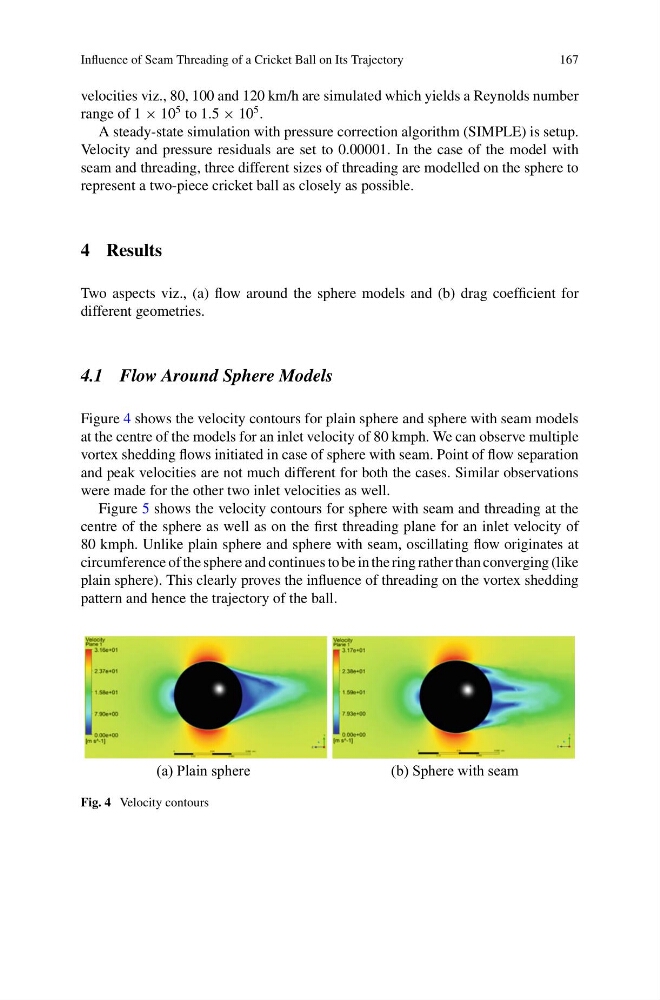
Figure 4 shows the velocity contours for plain sphere and sphere with seam models
at the centre of the models for an inlet velocity of 80 kmph. We can observe multiple
vortex shedding flows initiated in case of sphere with seam. Point of flow separation
and peak velocities are not much different for both the cases. Similar observations
were made for the other two inlet velocities as well.
Figure 5 shows the velocity contours for sphere with seam and threading at the
centre of the sphere as well as on the first threading plane for an inlet velocity of
80 kmph. Unlike plain sphere and sphere with seam, oscillating flow originates at
circumference of the sphere and continues to be in the ring rather than converging (like
plain sphere). This clearly proves the influence of threading on the vortex shedding
pattern and hence the trajectory of the ball.
(a) Plain sphere
(b) Sphere with seam
Fig. 4 Velocity contours
167
velocities viz., 80, 100 and 120 km/h are simulated which yields a Reynolds number
range of 1 × 10
5 to 1.5 × 10
5 .
A steady-state simulation with pressure correction algorithm (SIMPLE) is setup.
Velocity and pressure residuals are set to 0.00001. In the case of the model with
seam and threading, three different sizes of threading are modelled on the sphere to
represent a two-piece cricket ball as closely as possible.
4 Results
Two aspects viz., (a) flow around the sphere models and (b) drag coefficient for
different geometries.
4.1 Flow Around Sphere Models
Figure 4 shows the velocity contours for plain sphere and sphere with seam models
at the centre of the models for an inlet velocity of 80 kmph. We can observe multiple
vortex shedding flows initiated in case of sphere with seam. Point of flow separation
and peak velocities are not much different for both the cases. Similar observations
were made for the other two inlet velocities as well.
Figure 5 shows the velocity contours for sphere with seam and threading at the
centre of the sphere as well as on the first threading plane for an inlet velocity of
80 kmph. Unlike plain sphere and sphere with seam, oscillating flow originates at
circumference of the sphere and continues to be in the ring rather than converging (like
plain sphere). This clearly proves the influence of threading on the vortex shedding
pattern and hence the trajectory of the ball.
(a) Plain sphere
(b) Sphere with seam
Fig. 4 Velocity contours