

164
K. S. Vepa and N. V. S. S. Sagar
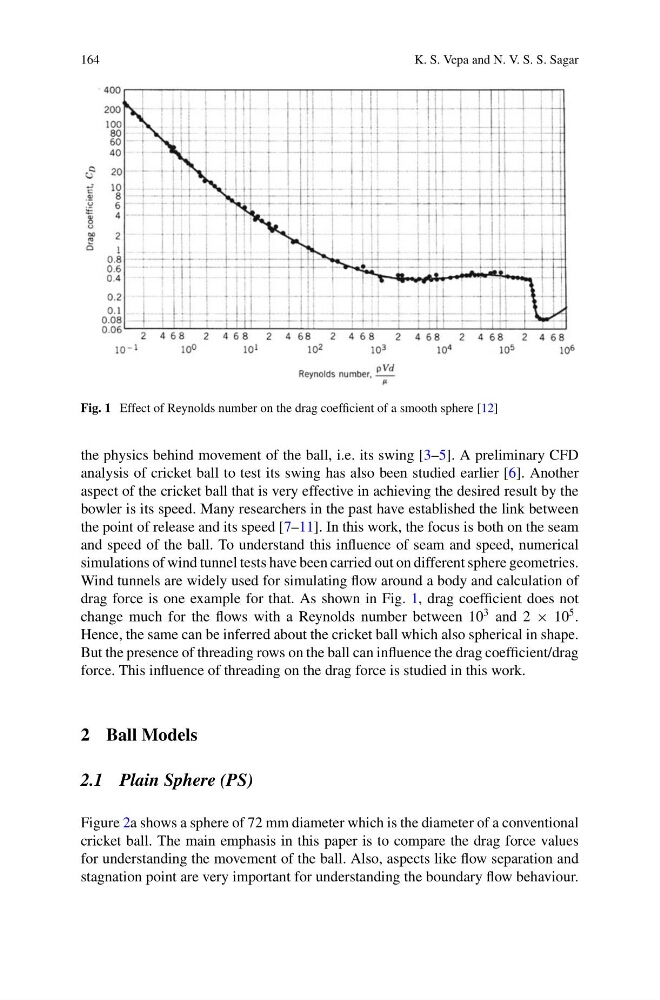
Fig. 1 Effect of Reynolds number on the drag coefficient of a smooth sphere [12]
the physics behind movement of the ball, i.e. its swing [3–5]. A preliminary CFD
analysis of cricket ball to test its swing has also been studied earlier [6]. Another
aspect of the cricket ball that is very effective in achieving the desired result by the
bowler is its speed. Many researchers in the past have established the link between
the point of release and its speed [7–11]. In this work, the focus is both on the seam
and speed of the ball. To understand this influence of seam and speed, numerical
simulations of wind tunnel tests have been carried out on different sphere geometries.
Wind tunnels are widely used for simulating flow around a body and calculation of
drag force is one example for that. As shown in Fig. 1, drag coefficient does not
change much for the flows with a Reynolds number between 10
3 and 2 × 10
5 .
Hence, the same can be inferred about the cricket ball which also spherical in shape.
But the presence of threading rows on the ball can influence the drag coefficient/drag
force. This influence of threading on the drag force is studied in this work.
2 Ball Models
2.1 Plain Sphere (PS)
Figure 2a shows a sphere of 72 mm diameter which is the diameter of a conventional
cricket ball. The main emphasis in this paper is to compare the drag force values
for understanding the movement of the ball. Also, aspects like flow separation and
stagnation point are very important for understanding the boundary flow behaviour.
K. S. Vepa and N. V. S. S. Sagar
Fig. 1 Effect of Reynolds number on the drag coefficient of a smooth sphere [12]
the physics behind movement of the ball, i.e. its swing [3–5]. A preliminary CFD
analysis of cricket ball to test its swing has also been studied earlier [6]. Another
aspect of the cricket ball that is very effective in achieving the desired result by the
bowler is its speed. Many researchers in the past have established the link between
the point of release and its speed [7–11]. In this work, the focus is both on the seam
and speed of the ball. To understand this influence of seam and speed, numerical
simulations of wind tunnel tests have been carried out on different sphere geometries.
Wind tunnels are widely used for simulating flow around a body and calculation of
drag force is one example for that. As shown in Fig. 1, drag coefficient does not
change much for the flows with a Reynolds number between 10
3 and 2 × 10
5 .
Hence, the same can be inferred about the cricket ball which also spherical in shape.
But the presence of threading rows on the ball can influence the drag coefficient/drag
force. This influence of threading on the drag force is studied in this work.
2 Ball Models
2.1 Plain Sphere (PS)
Figure 2a shows a sphere of 72 mm diameter which is the diameter of a conventional
cricket ball. The main emphasis in this paper is to compare the drag force values
for understanding the movement of the ball. Also, aspects like flow separation and
stagnation point are very important for understanding the boundary flow behaviour.