

5.1 Higher Order Moment Robust Filter Design for Multi-model Jumping System
79
J =
T
0
e
T
(t)e(t) − γ
2 ˜
S
T
(t, p) ˜
S(t, p) + ˙
V (t)
dt − V (t),
(5.24)
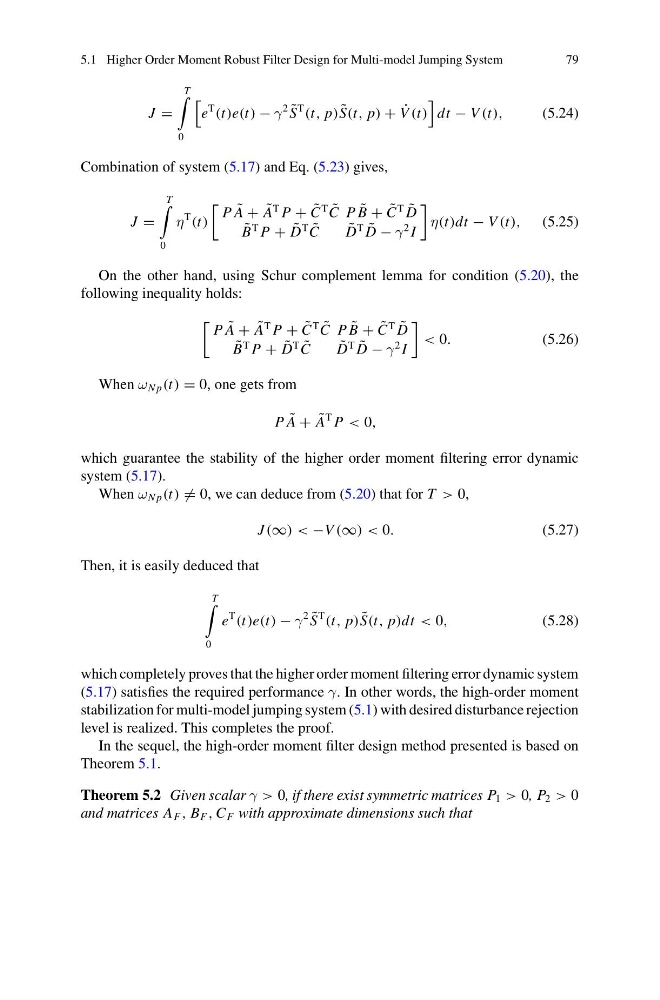
Combination of system (5.17) and Eq. (5.23) gives,
J =
T
0
η
T
(t)
P ˜
A + ˜
A
T P + ˜
C
T ˜
C P ˜
B + ˜
C
T ˜
D
˜
B
T P + ˜
D
T ˜
C
˜
D
T ˜
D − γ
2 I
η(t)dt − V (t), (5.25)
On the other hand, using Schur complement lemma for condition (5.20), the
following inequality holds:
P ˜
A + ˜
A
T P + ˜
C
T ˜
C P ˜
B + ˜
C
T ˜
D
˜
B
T P + ˜
D
T ˜
C
˜
D
T ˜
D − γ
2 I
< 0.
(5.26)
When ω N p (t) = 0, one gets from
P ˜
A + ˜
A
T P < 0,
which guarantee the stability of the higher order moment filtering error dynamic
system (5.17).
When ω N p (t) = 0, we can deduce from (5.20) that for T > 0,
J (∞) < −V (∞) < 0.
(5.27)
Then, it is easily deduced that
T
0
e
T
(t)e(t) − γ
2 ˜
S
T
(t, p) ˜
S(t, p)dt < 0,
(5.28)
which completely proves that the higher order moment filtering error dynamic system
(5.17) satisfies the required performance γ. In other words, the high-order moment
stabilization for multi-model jumping system (5.1) with desired disturbance rejection
level is realized. This completes the proof.
In the sequel, the high-order moment filter design method presented is based on
Theorem 5.1.
Theorem 5.2 Given scalar γ > 0, if there exist symmetric matrices P 1 > 0, P 2 > 0
and matrices A F , B F , C F with approximate dimensions such that
79
J =
T
0
e
T
(t)e(t) − γ
2 ˜
S
T
(t, p) ˜
S(t, p) + ˙
V (t)
dt − V (t),
(5.24)
Combination of system (5.17) and Eq. (5.23) gives,
J =
T
0
η
T
(t)
P ˜
A + ˜
A
T P + ˜
C
T ˜
C P ˜
B + ˜
C
T ˜
D
˜
B
T P + ˜
D
T ˜
C
˜
D
T ˜
D − γ
2 I
η(t)dt − V (t), (5.25)
On the other hand, using Schur complement lemma for condition (5.20), the
following inequality holds:
P ˜
A + ˜
A
T P + ˜
C
T ˜
C P ˜
B + ˜
C
T ˜
D
˜
B
T P + ˜
D
T ˜
C
˜
D
T ˜
D − γ
2 I
< 0.
(5.26)
When ω N p (t) = 0, one gets from
P ˜
A + ˜
A
T P < 0,
which guarantee the stability of the higher order moment filtering error dynamic
system (5.17).
When ω N p (t) = 0, we can deduce from (5.20) that for T > 0,
J (∞) < −V (∞) < 0.
(5.27)
Then, it is easily deduced that
T
0
e
T
(t)e(t) − γ
2 ˜
S
T
(t, p) ˜
S(t, p)dt < 0,
(5.28)
which completely proves that the higher order moment filtering error dynamic system
(5.17) satisfies the required performance γ. In other words, the high-order moment
stabilization for multi-model jumping system (5.1) with desired disturbance rejection
level is realized. This completes the proof.
In the sequel, the high-order moment filter design method presented is based on
Theorem 5.1.
Theorem 5.2 Given scalar γ > 0, if there exist symmetric matrices P 1 > 0, P 2 > 0
and matrices A F , B F , C F with approximate dimensions such that