

5.1 Higher Order Moment Robust Filter Design for Multi-model Jumping System
77
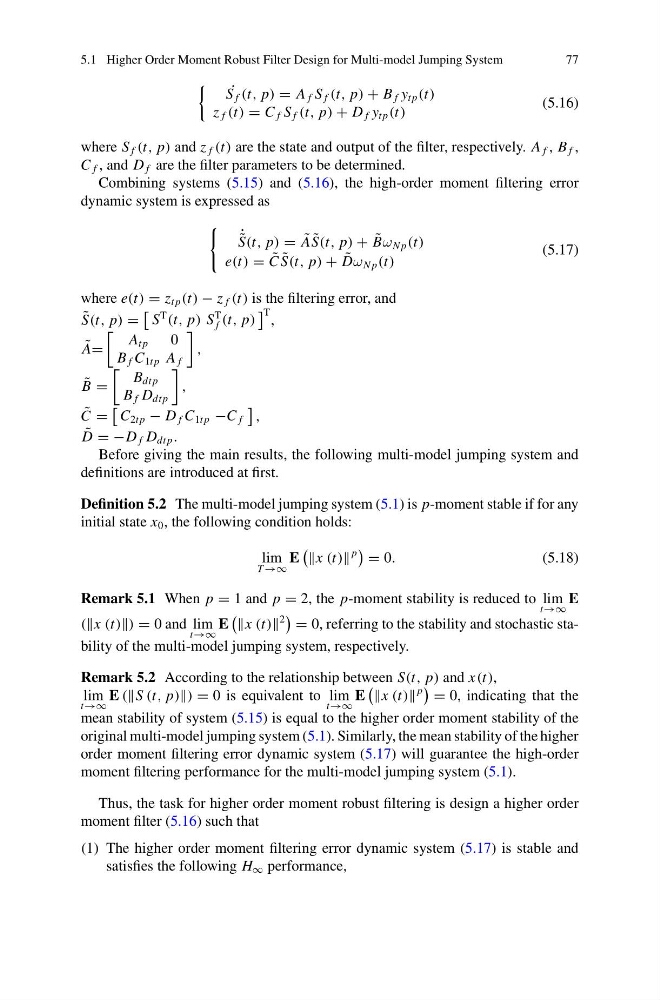
˙
S f (t, p) = A f S f (t, p) + B f y tp (t)
z f (t) = C f S f (t, p) + D f y tp (t)
(5.16)
where S f (t, p) and z f (t) are the state and output of the filter, respectively. A f , B f ,
C f , and D f are the filter parameters to be determined.
Combining systems (5.15) and (5.16), the high-order moment filtering error
dynamic system is expressed as
˙ ˜
S(t, p) = ˜
A ˜
S(t, p) + ˜
Bω N p (t)
e(t) = ˜
C ˜
S(t, p) + ˜
Dω N p (t)
(5.17)
where e(t) = z tp (t) − z f (t) is the filtering error, and
˜
S(t, p) =
S
T
(t, p) S
T
f (t, p)
T ,
˜
A=
A tp
0
B f C 1tp A f
,
˜
B =
B dt p
B f D dt p
,
˜
C =
C 2tp − D f C 1tp −C f
,
˜
D = −D f D dt p .
Before giving the main results, the following multi-model jumping system and
definitions are introduced at first.
Definition 5.2 The multi-model jumping system (5.1) is p-moment stable if for any
initial state x 0 , the following condition holds:
lim
T →∞
E
x (t)
p
= 0.
(5.18)
Remark 5.1 When p = 1 and p = 2, the p-moment stability is reduced to lim
t→∞
E
(x (t)) = 0 and lim
t→∞
E
x (t)
2
= 0, referring to the stability and stochastic stability of the multi-model jumping system, respectively.
Remark 5.2 According to the relationship between S(t, p) and x(t),
lim
t→∞
E (S (t, p)) = 0 is equivalent to lim
t→∞
E
x (t)
p
= 0, indicating that the
mean stability of system (5.15) is equal to the higher order moment stability of the
original multi-model jumping system (5.1). Similarly, the mean stability of the higher
order moment filtering error dynamic system (5.17) will guarantee the high-order
moment filtering performance for the multi-model jumping system (5.1).
Thus, the task for higher order moment robust filtering is design a higher order
moment filter (5.16) such that
(1) The higher order moment filtering error dynamic system (5.17) is stable and
satisfies the following H ∞ performance,
77
˙
S f (t, p) = A f S f (t, p) + B f y tp (t)
z f (t) = C f S f (t, p) + D f y tp (t)
(5.16)
where S f (t, p) and z f (t) are the state and output of the filter, respectively. A f , B f ,
C f , and D f are the filter parameters to be determined.
Combining systems (5.15) and (5.16), the high-order moment filtering error
dynamic system is expressed as
˙ ˜
S(t, p) = ˜
A ˜
S(t, p) + ˜
Bω N p (t)
e(t) = ˜
C ˜
S(t, p) + ˜
Dω N p (t)
(5.17)
where e(t) = z tp (t) − z f (t) is the filtering error, and
˜
S(t, p) =
S
T
(t, p) S
T
f (t, p)
T ,
˜
A=
A tp
0
B f C 1tp A f
,
˜
B =
B dt p
B f D dt p
,
˜
C =
C 2tp − D f C 1tp −C f
,
˜
D = −D f D dt p .
Before giving the main results, the following multi-model jumping system and
definitions are introduced at first.
Definition 5.2 The multi-model jumping system (5.1) is p-moment stable if for any
initial state x 0 , the following condition holds:
lim
T →∞
E
x (t)
p
= 0.
(5.18)
Remark 5.1 When p = 1 and p = 2, the p-moment stability is reduced to lim
t→∞
E
(x (t)) = 0 and lim
t→∞
E
x (t)
2
= 0, referring to the stability and stochastic stability of the multi-model jumping system, respectively.
Remark 5.2 According to the relationship between S(t, p) and x(t),
lim
t→∞
E (S (t, p)) = 0 is equivalent to lim
t→∞
E
x (t)
p
= 0, indicating that the
mean stability of system (5.15) is equal to the higher order moment stability of the
original multi-model jumping system (5.1). Similarly, the mean stability of the higher
order moment filtering error dynamic system (5.17) will guarantee the high-order
moment filtering performance for the multi-model jumping system (5.1).
Thus, the task for higher order moment robust filtering is design a higher order
moment filter (5.16) such that
(1) The higher order moment filtering error dynamic system (5.17) is stable and
satisfies the following H ∞ performance,