

58
4 Finite-Frequency Robust Filtering for Multi-model Jumping System
⎡
⎢
⎢
⎢
⎢
⎢
⎢
⎣
−Q 1 −Q 2 M 13 P 2 + j c Q 2 − F 3
0
0
∗ −Q 3 M 23 P 3 + j c Q 3 − F 3
0
0
∗
∗ M 33
M 34
F 1 B d + ¯
B F D d
C
T
2
∗
∗
∗
M 44
F 2 B d + ¯
B F D d − ¯
C
T
F
∗
∗
∗
∗
−γ
2 I
D d − ¯
D
T
F
∗
∗
∗
∗
∗
−I
⎤
⎥
⎥
⎥
⎥
⎥
⎥
⎦
< 0, (4.14)
where
M 13 = P 1 + j c Q 1 − F
T
1 ,
M 23 = P
T
2 + j c Q
T
2 − F 2 ,
M 33 = − 1 2 Q 1 + F 1 A + ¯
B F C 1 +
F 1 A + ¯
B F C 1
T ,
M 34 = − 1 2 Q 2 + ¯
A F +
F 2 A + ¯
B F C 1
T ,
M 44 = − 1 2 Q 1 + ¯
A F + ¯
A F
T .
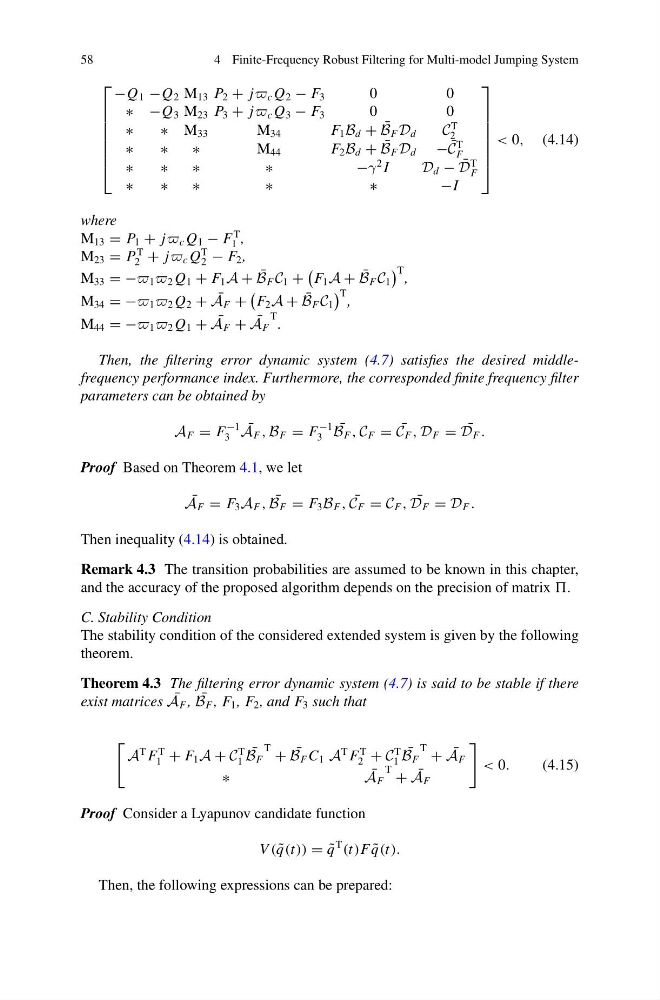
Then, the filtering error dynamic system (4.7) satisfies the desired middlefrequency performance index. Furthermore, the corresponded finite frequency filter
parameters can be obtained by
A F = F
−1
3
¯
A F , B F = F
−1
3
¯
B F , C F = ¯
C F , D F = ¯
D F .
Proof Based on Theorem 4.1, we let
¯
A F = F 3 A F , ¯
B F = F 3 B F , ¯
C F = C F , ¯
D F = D F .
Then inequality (4.14) is obtained.
Remark 4.3 The transition probabilities are assumed to be known in this chapter,
and the accuracy of the proposed algorithm depends on the precision of matrix .
C. Stability Condition
The stability condition of the considered extended system is given by the following
theorem.
Theorem 4.3 The filtering error dynamic system (4.7) is said to be stable if there
exist matrices ¯
A F , ¯
B F , F 1 , F 2 , and F 3 such that
A
T F
T
1 + F 1 A + C
T
1
¯
B F
T + ¯
B F C 1 A
T F
T
2 + C
T
1
¯
B F
T + ¯
A F
∗
¯
A F
T + ¯
A F
< 0.
(4.15)
Proof Consider a Lyapunov candidate function
V ( ˜
q(t)) = ˜
q
T
(t)F ˜
q(t).
Then, the following expressions can be prepared:
4 Finite-Frequency Robust Filtering for Multi-model Jumping System
⎡
⎢
⎢
⎢
⎢
⎢
⎢
⎣
−Q 1 −Q 2 M 13 P 2 + j c Q 2 − F 3
0
0
∗ −Q 3 M 23 P 3 + j c Q 3 − F 3
0
0
∗
∗ M 33
M 34
F 1 B d + ¯
B F D d
C
T
2
∗
∗
∗
M 44
F 2 B d + ¯
B F D d − ¯
C
T
F
∗
∗
∗
∗
−γ
2 I
D d − ¯
D
T
F
∗
∗
∗
∗
∗
−I
⎤
⎥
⎥
⎥
⎥
⎥
⎥
⎦
< 0, (4.14)
where
M 13 = P 1 + j c Q 1 − F
T
1 ,
M 23 = P
T
2 + j c Q
T
2 − F 2 ,
M 33 = − 1 2 Q 1 + F 1 A + ¯
B F C 1 +
F 1 A + ¯
B F C 1
T ,
M 34 = − 1 2 Q 2 + ¯
A F +
F 2 A + ¯
B F C 1
T ,
M 44 = − 1 2 Q 1 + ¯
A F + ¯
A F
T .
Then, the filtering error dynamic system (4.7) satisfies the desired middlefrequency performance index. Furthermore, the corresponded finite frequency filter
parameters can be obtained by
A F = F
−1
3
¯
A F , B F = F
−1
3
¯
B F , C F = ¯
C F , D F = ¯
D F .
Proof Based on Theorem 4.1, we let
¯
A F = F 3 A F , ¯
B F = F 3 B F , ¯
C F = C F , ¯
D F = D F .
Then inequality (4.14) is obtained.
Remark 4.3 The transition probabilities are assumed to be known in this chapter,
and the accuracy of the proposed algorithm depends on the precision of matrix .
C. Stability Condition
The stability condition of the considered extended system is given by the following
theorem.
Theorem 4.3 The filtering error dynamic system (4.7) is said to be stable if there
exist matrices ¯
A F , ¯
B F , F 1 , F 2 , and F 3 such that
A
T F
T
1 + F 1 A + C
T
1
¯
B F
T + ¯
B F C 1 A
T F
T
2 + C
T
1
¯
B F
T + ¯
A F
∗
¯
A F
T + ¯
A F
< 0.
(4.15)
Proof Consider a Lyapunov candidate function
V ( ˜
q(t)) = ˜
q
T
(t)F ˜
q(t).
Then, the following expressions can be prepared: