

22
2 Robust Filtering for Multi-model Jumping System
−β
t
t−h
e
T
(s)Qe(s)ds = θ
T
(t)) i θ(t) − β
t
t−h
e
T
(s)Qe(s)ds
(2.29)
where
θ(t) =
e
T
(t) ω
T
(t) e
T
(t − h)
T ,
i =
⎡
⎢
⎣
ℵ i P i B i + C
T
i D i P i A hi
∗ −γ
2 I + D
T
i D i 0
∗
∗
−Q
⎤
⎥
⎦,
ℵ i = P i A i + A
T
i P i +
N
j=1 π i j P j + Q − β P i + C
T
i C i .
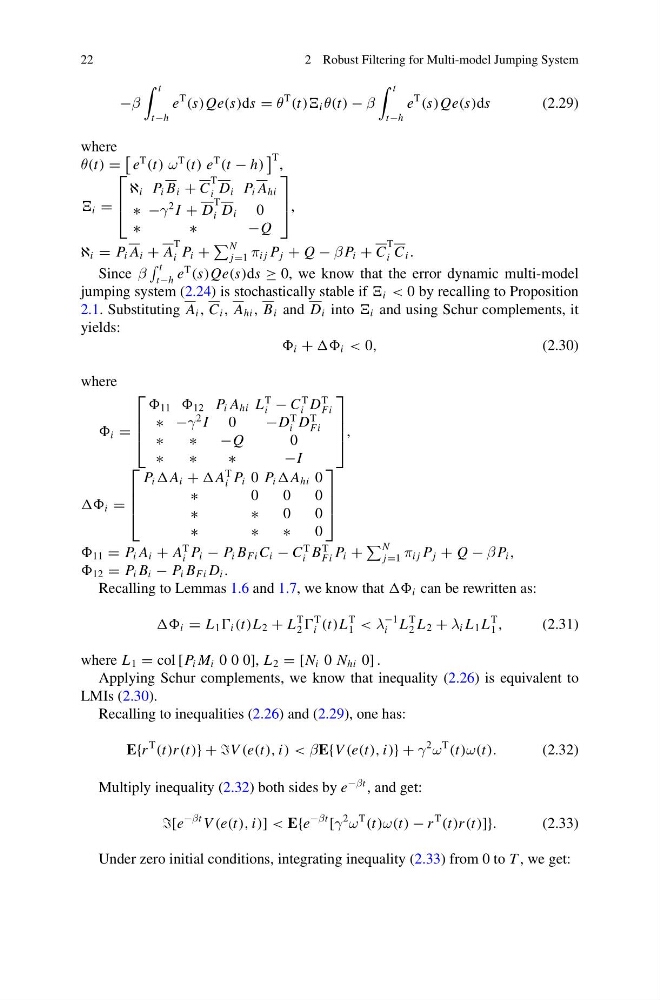
Since β
t
t−h e
T
(s)Qe(s)ds ≥ 0, we know that the error dynamic multi-model
jumping system (2.24) is stochastically stable if i < 0 by recalling to Proposition
2.1. Substituting A i , C i , A hi , B i and D i into i and using Schur complements, it
yields:
i + i < 0,
(2.30)
where
i =
⎡
⎢
⎢
⎣
11 12 P i A hi L
T
i − C
T
i D
T
Fi
∗ −γ
2 I 0
−D
T
i D
T
Fi
∗
∗
−Q
0
∗
∗
∗
−I
⎤
⎥
⎥
⎦ ,
i =
⎡
⎢
⎢
⎣
P i A i + A
T
i P i 0 P i A hi 0
∗
0
0
0
∗
∗
0
0
∗
∗
∗
0
⎤
⎥
⎥
⎦
11 = P i A i + A
T
i P i − P i B Fi C i − C
T
i B
T
Fi P i +
N
j=1 π i j P j + Q − β P i ,
12 = P i B i − P i B Fi D i .
Recalling to Lemmas 1.6 and 1.7, we know that i can be rewritten as:
i = L 1 i (t)L 2 + L
T
2
T
i (t)L
T
1 < λ
−1
i L
T
2 L 2 + λ i L 1 L
T
1 ,
(2.31)
where L 1 = col [P i M i 0 0 0], L 2 = [N i 0 N hi 0] .
Applying Schur complements, we know that inequality (2.26) is equivalent to
LMIs (2.30).
Recalling to inequalities (2.26) and (2.29), one has:
E{r
T
(t)r (t)} + +V (e(t), i) < βE{V (e(t), i)} + γ
2
ω
T
(t)ω(t).
(2.32)
Multiply inequality (2.32) both sides by e
−βt , and get:
[e
−βt V (e(t), i)] < E{e
−βt
[γ
2
ω
T
(t)ω(t) − r
T
(t)r (t)]}.
(2.33)
Under zero initial conditions, integrating inequality (2.33) from 0 to T , we get:
2 Robust Filtering for Multi-model Jumping System
−β
t
t−h
e
T
(s)Qe(s)ds = θ
T
(t)) i θ(t) − β
t
t−h
e
T
(s)Qe(s)ds
(2.29)
where
θ(t) =
e
T
(t) ω
T
(t) e
T
(t − h)
T ,
i =
⎡
⎢
⎣
ℵ i P i B i + C
T
i D i P i A hi
∗ −γ
2 I + D
T
i D i 0
∗
∗
−Q
⎤
⎥
⎦,
ℵ i = P i A i + A
T
i P i +
N
j=1 π i j P j + Q − β P i + C
T
i C i .
Since β
t
t−h e
T
(s)Qe(s)ds ≥ 0, we know that the error dynamic multi-model
jumping system (2.24) is stochastically stable if i < 0 by recalling to Proposition
2.1. Substituting A i , C i , A hi , B i and D i into i and using Schur complements, it
yields:
i + i < 0,
(2.30)
where
i =
⎡
⎢
⎢
⎣
11 12 P i A hi L
T
i − C
T
i D
T
Fi
∗ −γ
2 I 0
−D
T
i D
T
Fi
∗
∗
−Q
0
∗
∗
∗
−I
⎤
⎥
⎥
⎦ ,
i =
⎡
⎢
⎢
⎣
P i A i + A
T
i P i 0 P i A hi 0
∗
0
0
0
∗
∗
0
0
∗
∗
∗
0
⎤
⎥
⎥
⎦
11 = P i A i + A
T
i P i − P i B Fi C i − C
T
i B
T
Fi P i +
N
j=1 π i j P j + Q − β P i ,
12 = P i B i − P i B Fi D i .
Recalling to Lemmas 1.6 and 1.7, we know that i can be rewritten as:
i = L 1 i (t)L 2 + L
T
2
T
i (t)L
T
1 < λ
−1
i L
T
2 L 2 + λ i L 1 L
T
1 ,
(2.31)
where L 1 = col [P i M i 0 0 0], L 2 = [N i 0 N hi 0] .
Applying Schur complements, we know that inequality (2.26) is equivalent to
LMIs (2.30).
Recalling to inequalities (2.26) and (2.29), one has:
E{r
T
(t)r (t)} + +V (e(t), i) < βE{V (e(t), i)} + γ
2
ω
T
(t)ω(t).
(2.32)
Multiply inequality (2.32) both sides by e
−βt , and get:
[e
−βt V (e(t), i)] < E{e
−βt
[γ
2
ω
T
(t)ω(t) − r
T
(t)r (t)]}.
(2.33)
Under zero initial conditions, integrating inequality (2.33) from 0 to T , we get: