

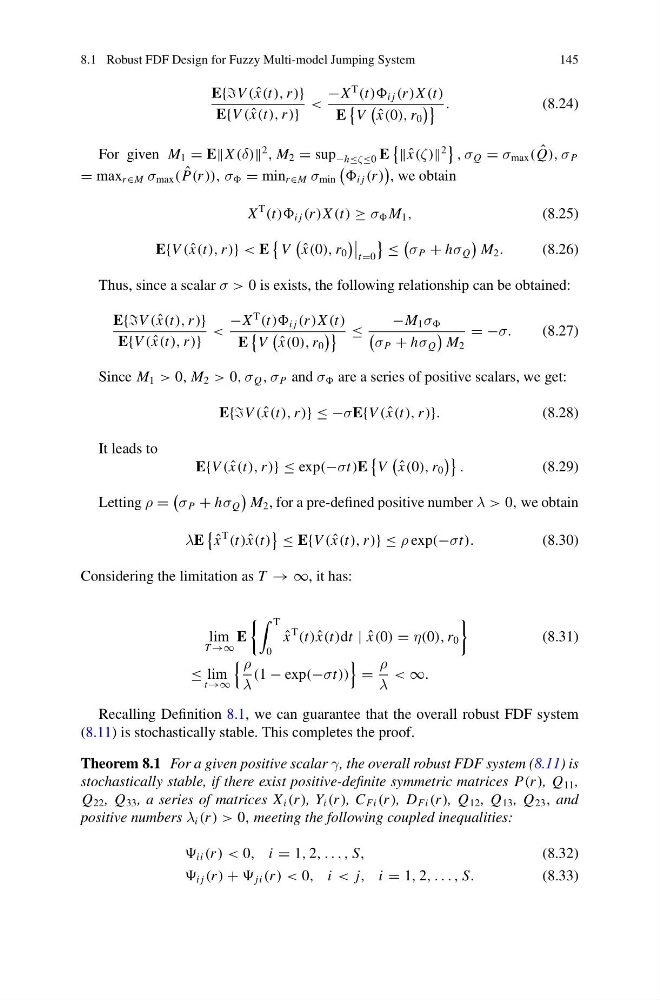
8.1 Robust FDF Design for Fuzzy Multi-model Jumping System
145
E{{V ( ˆ
x(t), r )}
E{V ( ˆ
x(t), r )}
<
−X
T
(t)) i j (r )X (t)
E
V
ˆ
x(0), r 0
.
(8.24)
For given M 1 = EX (δ)
2
, M 2 = sup −h≤ζ≤0 E
ˆ
x(ζ)
2
, σ Q = σ max ( ˆ
Q), σ P
= max r ∈M σ max ( ˆ
P(r )), σ = min r ∈M σ min
i j (r )
, we obtain
X
T
(t)) i j (r )X (t) ≥ σ M 1 ,
(8.25)
E{V ( ˆ
x(t), r )} < E
V
ˆ
x(0), r 0
t=0
≤
σ P + hσ Q
M 2 .
(8.26)
Thus, since a scalar σ > 0 is exists, the following relationship can be obtained:
E{{V ( ˆ
x(t), r )}
E{V ( ˆ
x(t), r )}
<
−X
T
(t)) i j (r )X (t)
E
V
ˆ
x(0), r 0
≤
−M 1 σ
σ P + hσ Q
M 2
= −σ.
(8.27)
Since M 1 > 0, M 2 > 0, σ Q , σ P and σ are a series of positive scalars, we get:
E{{V ( ˆ
x(t), r )} ≤ −σE{V ( ˆ
x(t), r )}.
(8.28)
It leads to
E{V ( ˆ
x(t), r )} ≤ exp(−σt)E
V
ˆ
x(0), r 0
.
(8.29)
Letting ρ =
σ P + hσ Q
M 2 , for a pre-defined positive number λ > 0, we obtain
λE
ˆ
x
T
(t) ˆ
x(t)
≤ E{V ( ˆ
x(t), r )} ≤ ρ exp(−σt).
(8.30)
Considering the limitation as T → ∞, it has:
lim
T →∞
E
T
0
ˆ
x
T
(t) ˆ
x(t)dt | ˆ
x(0) = η(0), r 0
(8.31)
≤ lim
t→∞
ρ
λ
(1 − exp(−σt))
=
ρ
λ
< ∞.
Recalling Definition 8.1, we can guarantee that the overall robust FDF system
(8.11) is stochastically stable. This completes the proof.
Theorem 8.1 For a given positive scalar γ, the overall robust FDF system (8.11) is
stochastically stable, if there exist positive-definite symmetric matrices P(r ), Q 11 ,
Q 22 , Q 33 , a series of matrices X i (r ), Y i (r ), C Fi (r ), D Fi (r ), Q 12 , Q 13 , Q 23 , and
positive numbers λ i (r ) > 0, meeting the following coupled inequalities:
ii (r ) < 0, i = 1, 2, . . . , S,
(8.32)
i j (r ) + ji (r ) < 0, i < j, i = 1, 2, . . . , S.
(8.33)
145
E{{V ( ˆ
x(t), r )}
E{V ( ˆ
x(t), r )}
<
−X
T
(t)) i j (r )X (t)
E
V
ˆ
x(0), r 0
.
(8.24)
For given M 1 = EX (δ)
2
, M 2 = sup −h≤ζ≤0 E
ˆ
x(ζ)
2
, σ Q = σ max ( ˆ
Q), σ P
= max r ∈M σ max ( ˆ
P(r )), σ = min r ∈M σ min
i j (r )
, we obtain
X
T
(t)) i j (r )X (t) ≥ σ M 1 ,
(8.25)
E{V ( ˆ
x(t), r )} < E
V
ˆ
x(0), r 0
t=0
≤
σ P + hσ Q
M 2 .
(8.26)
Thus, since a scalar σ > 0 is exists, the following relationship can be obtained:
E{{V ( ˆ
x(t), r )}
E{V ( ˆ
x(t), r )}
<
−X
T
(t)) i j (r )X (t)
E
V
ˆ
x(0), r 0
≤
−M 1 σ
σ P + hσ Q
M 2
= −σ.
(8.27)
Since M 1 > 0, M 2 > 0, σ Q , σ P and σ are a series of positive scalars, we get:
E{{V ( ˆ
x(t), r )} ≤ −σE{V ( ˆ
x(t), r )}.
(8.28)
It leads to
E{V ( ˆ
x(t), r )} ≤ exp(−σt)E
V
ˆ
x(0), r 0
.
(8.29)
Letting ρ =
σ P + hσ Q
M 2 , for a pre-defined positive number λ > 0, we obtain
λE
ˆ
x
T
(t) ˆ
x(t)
≤ E{V ( ˆ
x(t), r )} ≤ ρ exp(−σt).
(8.30)
Considering the limitation as T → ∞, it has:
lim
T →∞
E
T
0
ˆ
x
T
(t) ˆ
x(t)dt | ˆ
x(0) = η(0), r 0
(8.31)
≤ lim
t→∞
ρ
λ
(1 − exp(−σt))
=
ρ
λ
< ∞.
Recalling Definition 8.1, we can guarantee that the overall robust FDF system
(8.11) is stochastically stable. This completes the proof.
Theorem 8.1 For a given positive scalar γ, the overall robust FDF system (8.11) is
stochastically stable, if there exist positive-definite symmetric matrices P(r ), Q 11 ,
Q 22 , Q 33 , a series of matrices X i (r ), Y i (r ), C Fi (r ), D Fi (r ), Q 12 , Q 13 , Q 23 , and
positive numbers λ i (r ) > 0, meeting the following coupled inequalities:
ii (r ) < 0, i = 1, 2, . . . , S,
(8.32)
i j (r ) + ji (r ) < 0, i < j, i = 1, 2, . . . , S.
(8.33)