

102
6 Robust Fault Detection for Multi-model Jumping System
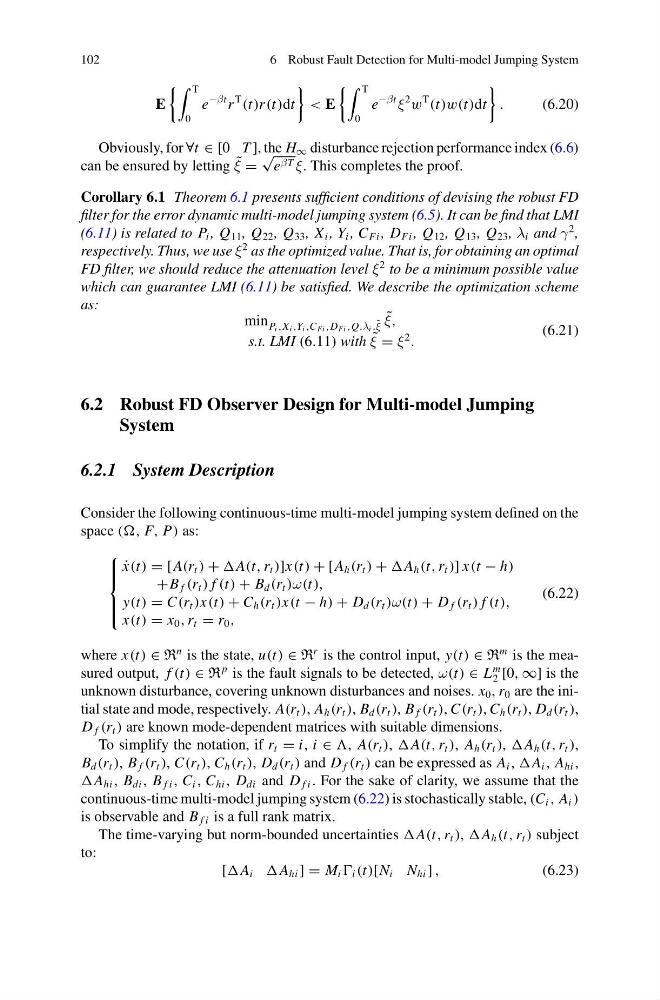
E
T
0
e
−βt r
T
(t)r (t)dt
< E
T
0
e
−βt
ξ
2
w
T
(t)w(t)dt
.
(6.20)
Obviously, for ∀t ∈ [0 T ], the H ∞ disturbance rejection performance index (6.6)
can be ensured by letting ˜
ξ =
√
e βT ξ. This completes the proof.
Corollary 6.1 Theorem 6.1 presents sufficient conditions of devising the robust FD
filter for the error dynamic multi-model jumping system (6.5). It can be find that LMI
(6.11) is related to P i , Q 11 , Q 22 , Q 33 , X i , Y i , C Fi , D Fi , Q 12 , Q 13 , Q 23 , λ i and γ
2 ,
respectively. Thus, we use ξ
2 as the optimized value. That is, for obtaining an optimal
FD filter, we should reduce the attenuation level ξ
2 to be a minimum possible value
which can guarantee LMI (6.11) be satisfied. We describe the optimization scheme
as:
min P i ,X i ,Y i ,C Fi ,D Fi ,Q,λ i , ˜
ξ
˜
ξ,
s.t. LMI (6.11) with ˜
ξ = ξ
2
.
(6.21)
6.2 Robust FD Observer Design for Multi-model Jumping
System
6.2.1 System Description
Consider the following continuous-time multi-model jumping system defined on the
space ((, F, P) as:
⎧
⎪ ⎪ ⎨
⎪ ⎪ ⎩
˙
x(t) = [A(r t ) + A(t, r t )]x(t) + [A h (r t ) + A h (t, r t )] x(t − h)
+B f (r t ) f (t) + B d (r t )ω(t),
y(t) = C(r t )x(t) + C h (r t )x(t − h) + D d (r t )ω(t) + D f (r t ) f (t),
x(t) = x 0 , r t = r 0 ,
(6.22)
where x(t) ∈ R
n is the state, u(t) ∈ R
r is the control input, y(t) ∈ R
m is the measured output, f (t) ∈ R
p is the fault signals to be detected, ω(t) ∈ L
m
2 [0, ∞] is the
unknown disturbance, covering unknown disturbances and noises. x 0 , r 0 are the initial state and mode, respectively. A(r t ), A h (r t ), B d (r t ), B f (r t ), C(r t ), C h (r t ), D d (r t ),
D f (r t ) are known mode-dependent matrices with suitable dimensions.
To simplify the notation, if r t = i, i ∈ , A(r t ), A(t, r t ), A h (r t ), A h (t, r t ),
B d (r t ), B f (r t ), C(r t ), C h (r t ), D d (r t ) and D f (r t ) can be expressed as A i , A i , A hi ,
A hi , B di , B f i , C i , C hi , D di and D f i . For the sake of clarity, we assume that the
continuous-time multi-model jumping system (6.22) is stochastically stable, (C i , A i )
is observable and B f i is a full rank matrix.
The time-varying but norm-bounded uncertainties A(t, r t ), A h (t, r t ) subject
to:
[A i A hi ] = M i i (t)[N i N hi ] ,
(6.23)
6 Robust Fault Detection for Multi-model Jumping System
E
T
0
e
−βt r
T
(t)r (t)dt
< E
T
0
e
−βt
ξ
2
w
T
(t)w(t)dt
.
(6.20)
Obviously, for ∀t ∈ [0 T ], the H ∞ disturbance rejection performance index (6.6)
can be ensured by letting ˜
ξ =
√
e βT ξ. This completes the proof.
Corollary 6.1 Theorem 6.1 presents sufficient conditions of devising the robust FD
filter for the error dynamic multi-model jumping system (6.5). It can be find that LMI
(6.11) is related to P i , Q 11 , Q 22 , Q 33 , X i , Y i , C Fi , D Fi , Q 12 , Q 13 , Q 23 , λ i and γ
2 ,
respectively. Thus, we use ξ
2 as the optimized value. That is, for obtaining an optimal
FD filter, we should reduce the attenuation level ξ
2 to be a minimum possible value
which can guarantee LMI (6.11) be satisfied. We describe the optimization scheme
as:
min P i ,X i ,Y i ,C Fi ,D Fi ,Q,λ i , ˜
ξ
˜
ξ,
s.t. LMI (6.11) with ˜
ξ = ξ
2
.
(6.21)
6.2 Robust FD Observer Design for Multi-model Jumping
System
6.2.1 System Description
Consider the following continuous-time multi-model jumping system defined on the
space ((, F, P) as:
⎧
⎪ ⎪ ⎨
⎪ ⎪ ⎩
˙
x(t) = [A(r t ) + A(t, r t )]x(t) + [A h (r t ) + A h (t, r t )] x(t − h)
+B f (r t ) f (t) + B d (r t )ω(t),
y(t) = C(r t )x(t) + C h (r t )x(t − h) + D d (r t )ω(t) + D f (r t ) f (t),
x(t) = x 0 , r t = r 0 ,
(6.22)
where x(t) ∈ R
n is the state, u(t) ∈ R
r is the control input, y(t) ∈ R
m is the measured output, f (t) ∈ R
p is the fault signals to be detected, ω(t) ∈ L
m
2 [0, ∞] is the
unknown disturbance, covering unknown disturbances and noises. x 0 , r 0 are the initial state and mode, respectively. A(r t ), A h (r t ), B d (r t ), B f (r t ), C(r t ), C h (r t ), D d (r t ),
D f (r t ) are known mode-dependent matrices with suitable dimensions.
To simplify the notation, if r t = i, i ∈ , A(r t ), A(t, r t ), A h (r t ), A h (t, r t ),
B d (r t ), B f (r t ), C(r t ), C h (r t ), D d (r t ) and D f (r t ) can be expressed as A i , A i , A hi ,
A hi , B di , B f i , C i , C hi , D di and D f i . For the sake of clarity, we assume that the
continuous-time multi-model jumping system (6.22) is stochastically stable, (C i , A i )
is observable and B f i is a full rank matrix.
The time-varying but norm-bounded uncertainties A(t, r t ), A h (t, r t ) subject
to:
[A i A hi ] = M i i (t)[N i N hi ] ,
(6.23)