

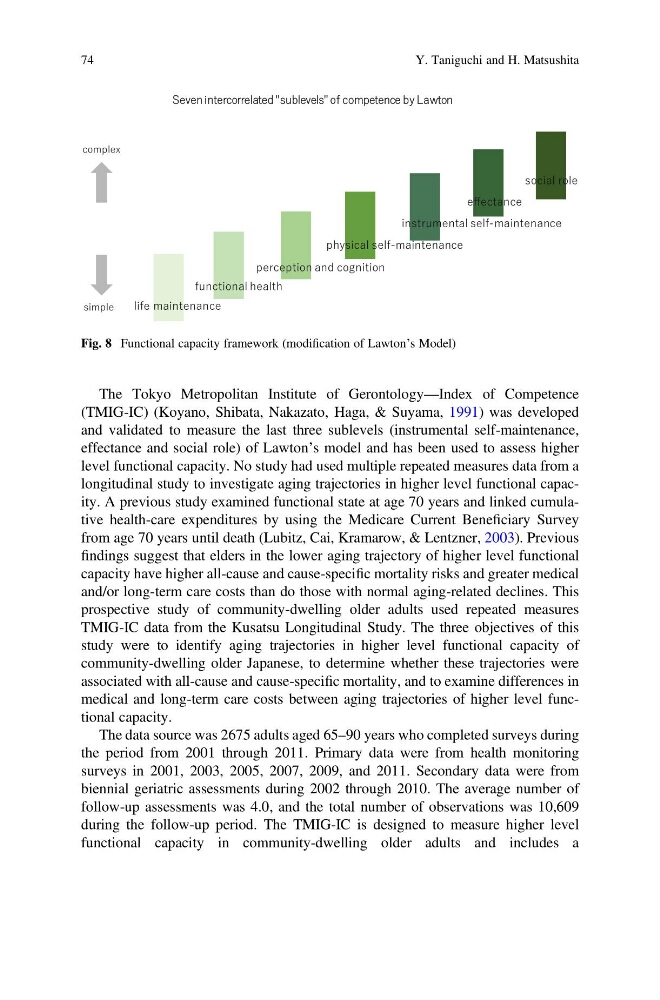
The Tokyo Metropolitan Institute of Gerontology—Index of Competence
(TMIG-IC) (Koyano, Shibata, Nakazato, Haga, & Suyama, 1991) was developed
and validated to measure the last three sublevels (instrumental self-maintenance,
effectance and social role) of Lawton’s model and has been used to assess higher
level functional capacity. No study had used multiple repeated measures data from a
longitudinal study to investigate aging trajectories in higher level functional capacity. A previous study examined functional state at age 70 years and linked cumulative health-care expenditures by using the Medicare Current Beneficiary Survey
from age 70 years until death (Lubitz, Cai, Kramarow, & Lentzner, 2003). Previous
findings suggest that elders in the lower aging trajectory of higher level functional
capacity have higher all-cause and cause-specific mortality risks and greater medical
and/or long-term care costs than do those with normal aging-related declines. This
prospective study of community-dwelling older adults used repeated measures
TMIG-IC data from the Kusatsu Longitudinal Study. The three objectives of this
study were to identify aging trajectories in higher level functional capacity of
community-dwelling older Japanese, to determine whether these trajectories were
associated with all-cause and cause-specific mortality, and to examine differences in
medical and long-term care costs between aging trajectories of higher level functional capacity.
The data source was 2675 adults aged 65–90 years who completed surveys during
the period from 2001 through 2011. Primary data were from health monitoring
surveys in 2001, 2003, 2005, 2007, 2009, and 2011. Secondary data were from
biennial geriatric assessments during 2002 through 2010. The average number of
follow-up assessments was 4.0, and the total number of observations was 10,609
during the follow-up period. The TMIG-IC is designed to measure higher level
functional capacity in community-dwelling older adults and includes a
6 6HYHQLQWHUFRUUHODWHGVXEOHYHOVRIFRPSHWHQFHE\/DZWRQ
VLPSOH
FRPSOH[
OLIHPDLQWHQDQFH
IXQFWLRQDOKHDOWK
SHUFHSWLRQDQGFRJQLWLRQ
SK\VLFDOVHOIPDLQWHQDQFH
LQVWUXPHQWDOVHOIPDLQWHQDQFH
H⒐HFWDQFH
VRFLDOUROH
Fig. 8 Functional capacity framework (modification of Lawton’s Model)
74
Y. Taniguchi and H. Matsushita
(TMIG-IC) (Koyano, Shibata, Nakazato, Haga, & Suyama, 1991) was developed
and validated to measure the last three sublevels (instrumental self-maintenance,
effectance and social role) of Lawton’s model and has been used to assess higher
level functional capacity. No study had used multiple repeated measures data from a
longitudinal study to investigate aging trajectories in higher level functional capacity. A previous study examined functional state at age 70 years and linked cumulative health-care expenditures by using the Medicare Current Beneficiary Survey
from age 70 years until death (Lubitz, Cai, Kramarow, & Lentzner, 2003). Previous
findings suggest that elders in the lower aging trajectory of higher level functional
capacity have higher all-cause and cause-specific mortality risks and greater medical
and/or long-term care costs than do those with normal aging-related declines. This
prospective study of community-dwelling older adults used repeated measures
TMIG-IC data from the Kusatsu Longitudinal Study. The three objectives of this
study were to identify aging trajectories in higher level functional capacity of
community-dwelling older Japanese, to determine whether these trajectories were
associated with all-cause and cause-specific mortality, and to examine differences in
medical and long-term care costs between aging trajectories of higher level functional capacity.
The data source was 2675 adults aged 65–90 years who completed surveys during
the period from 2001 through 2011. Primary data were from health monitoring
surveys in 2001, 2003, 2005, 2007, 2009, and 2011. Secondary data were from
biennial geriatric assessments during 2002 through 2010. The average number of
follow-up assessments was 4.0, and the total number of observations was 10,609
during the follow-up period. The TMIG-IC is designed to measure higher level
functional capacity in community-dwelling older adults and includes a
6 6HYHQLQWHUFRUUHODWHGVXEOHYHOVRIFRPSHWHQFHE\/DZWRQ
VLPSOH
FRPSOH[
OLIHPDLQWHQDQFH
IXQFWLRQDOKHDOWK
SHUFHSWLRQDQGFRJQLWLRQ
SK\VLFDOVHOIPDLQWHQDQFH
LQVWUXPHQWDOVHOIPDLQWHQDQFH
H⒐HFWDQFH
VRFLDOUROH
Fig. 8 Functional capacity framework (modification of Lawton’s Model)
74
Y. Taniguchi and H. Matsushita