

movements are described in terms of the algorithm, but they correspond almost
exactly to those used in FACS. The facial expression of each emotion mentioned
above includes the requisite movements.
7 Examples of IT/AI and Communication Robot Use
for Healthcare Innovation
As previously mentioned, the goal of care is to increase QOL. Japan is currently
experiencing a rise in the number of older adults with dementia, and mental health
care is particularly important for these patients. Accordingly, we will now focus on
how to provide mental health care. We will present perspectives on how new
technology should be integrated into healthcare activities and ways to advance
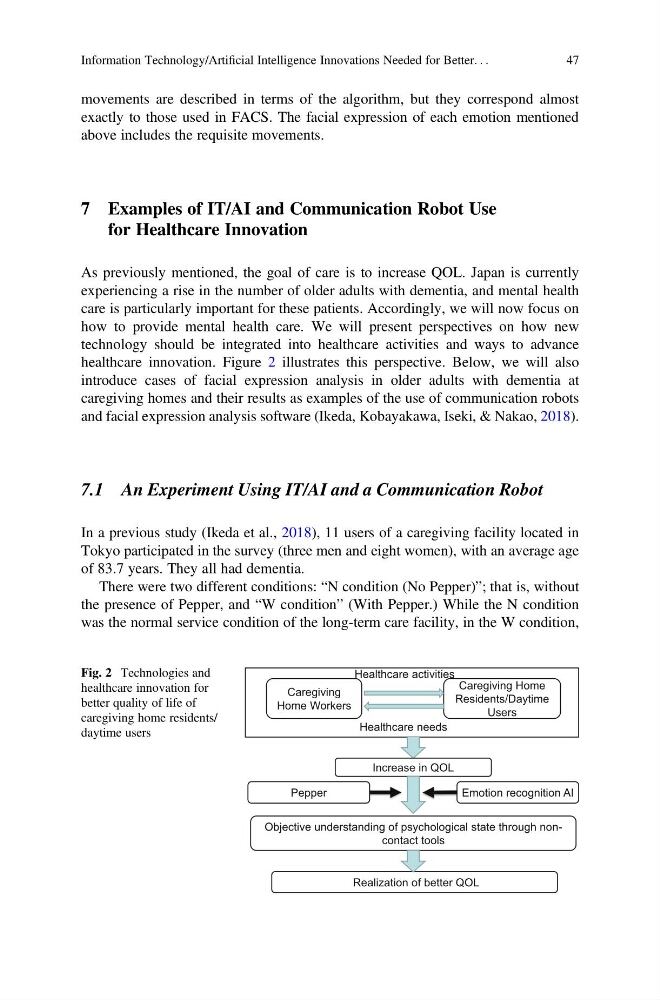
healthcare innovation. Figure 2 illustrates this perspective. Below, we will also
introduce cases of facial expression analysis in older adults with dementia at
caregiving homes and their results as examples of the use of communication robots
and facial expression analysis software (Ikeda, Kobayakawa, Iseki, & Nakao, 2018).
7.1 An Experiment Using IT/AI and a Communication Robot
In a previous study (Ikeda et al., 2018), 11 users of a caregiving facility located in
Tokyo participated in the survey (three men and eight women), with an average age
of 83.7 years. They all had dementia.
There were two different conditions: “N condition (No Pepper)”; that is, without
the presence of Pepper, and “W condition” (With Pepper.) While the N condition
was the normal service condition of the long-term care facility, in the W condition,
Caregiving
Home Workers
Caregiving Home
Residents/Daytime
Users
Increase in QOL
Healthcare activities
Healthcare needs
Realization of better QOL
Pepper
Emotion recognition AI
Objective understanding of psychological state through noncontact tools
Fig. 2 Technologies and
healthcare innovation for
better quality of life of
caregiving home residents/
daytime users
Information Technology/Artificial Intelligence Innovations Needed for Better. . .
47
exactly to those used in FACS. The facial expression of each emotion mentioned
above includes the requisite movements.
7 Examples of IT/AI and Communication Robot Use
for Healthcare Innovation
As previously mentioned, the goal of care is to increase QOL. Japan is currently
experiencing a rise in the number of older adults with dementia, and mental health
care is particularly important for these patients. Accordingly, we will now focus on
how to provide mental health care. We will present perspectives on how new
technology should be integrated into healthcare activities and ways to advance
healthcare innovation. Figure 2 illustrates this perspective. Below, we will also
introduce cases of facial expression analysis in older adults with dementia at
caregiving homes and their results as examples of the use of communication robots
and facial expression analysis software (Ikeda, Kobayakawa, Iseki, & Nakao, 2018).
7.1 An Experiment Using IT/AI and a Communication Robot
In a previous study (Ikeda et al., 2018), 11 users of a caregiving facility located in
Tokyo participated in the survey (three men and eight women), with an average age
of 83.7 years. They all had dementia.
There were two different conditions: “N condition (No Pepper)”; that is, without
the presence of Pepper, and “W condition” (With Pepper.) While the N condition
was the normal service condition of the long-term care facility, in the W condition,
Caregiving
Home Workers
Caregiving Home
Residents/Daytime
Users
Increase in QOL
Healthcare activities
Healthcare needs
Realization of better QOL
Pepper
Emotion recognition AI
Objective understanding of psychological state through noncontact tools
Fig. 2 Technologies and
healthcare innovation for
better quality of life of
caregiving home residents/
daytime users
Information Technology/Artificial Intelligence Innovations Needed for Better. . .
47